
You heard that Oregon has new energy rebates coming. You checked the ODOE Home Energy Rebates page (opens in new tab) and found a timeline but no application portal. That is where things stand right now. The Oregon HOMES and HEAR rebate programs are funded, have assigned implementers, and are targeting a spring 2026 launch for the first phase. But the application system is still in development.
This guide covers what we know about applying, who qualifies, how the two programs differ, and what you can do right now to be ready when they open. If you need a broader view of every incentive available in Portland, our energy efficiency rebates guide covers the full picture.
Rebate amounts, income thresholds, and program rules are subject to change as ODOE finalizes its launch. Confirm current details with ODOE (opens in new tab) or your assigned implementer before making financial decisions.
Two Programs, Two Purposes
HOMES and HEAR are both funded by the federal Inflation Reduction Act, but they work differently.
| HOMES | HEAR | |
|---|---|---|
| How it works | Performance-based (20%+ energy savings required) | Appliance-based (fixed per-item rebates) |
| Income limit | None, but rebate amount varies by income | 150% AMI or below |
| Max rebate | $10,000 per project (opens in new tab) | $14,000 per household (opens in new tab) |
| Energy assessment | Yes | No |
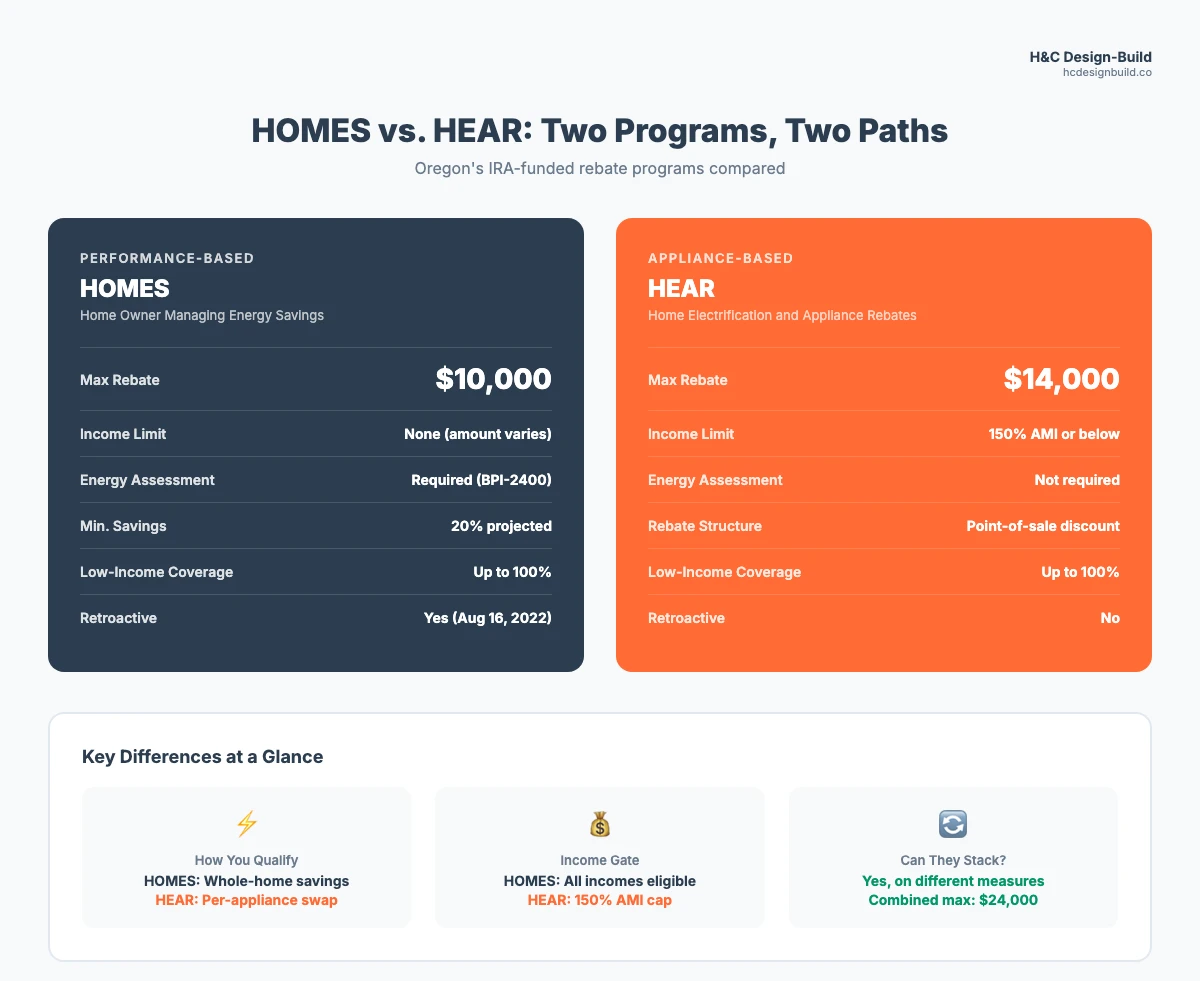
HOMES is performance-based. Your home gets an energy assessment, and if the proposed upgrades hit a minimum 20% projected energy savings, you qualify. The bigger the savings, the larger the rebate. Common qualifying measures include heat pumps, insulation, air sealing, and weatherization packages.
HEAR is appliance-based. You pick from a list of eligible electrification upgrades, each with a fixed maximum rebate. No energy modeling required. But HEAR has a hard income ceiling: your household must be at or below 150% of Area Median Income (opens in new tab).
Both survived the One Big Beautiful Bill Act (opens in new tab) that ended the 25C and 25D tax credits on December 31, 2025. Section 25C covered energy-efficient home improvements like heat pumps, insulation, and windows. Section 25D covered residential clean energy systems like solar. Both were claimable as federal tax credits until the OBBB terminated them. HOMES and HEAR are DOE grant programs to states, not IRS tax credits. They remain funded through September 30, 2031.
Who Qualifies for HOMES and HEAR
HOMES Eligibility
HOMES is open to all income levels for existing homes. New construction doesn't qualify. Income determines how much you get, not whether you qualify.
| Income Level | Rebate | Maximum (35%+ savings) | Maximum (20-34% savings) |
|---|---|---|---|
| Below 80% AMI | 100% of project cost | $10,000 (opens in new tab) | $8,000 (opens in new tab) |
| 80-150% AMI | 50% of project cost | $4,000 (opens in new tab) | $2,000 (opens in new tab) |
| Above 150% AMI | 50% of project cost | $4,000 (opens in new tab) | $2,000 (opens in new tab) |
The bigger the modeled savings, the bigger the rebate. Low-income households can receive up to 100% of project costs. Everyone else caps at 50%. The required energy assessment uses the BPI-2400 standard (a modeling protocol for predicting home energy savings based on your home's characteristics and proposed upgrades).
ODOE states that at least 40% of total HOMES funding is reserved for low-income households.
HEAR Eligibility
HEAR has a harder income gate. You must be at or below 150% AMI to participate. Below 80% AMI, the program covers up to 100% of project costs. Between 80% and 150%, the cap is 50% of actual costs.
Above 150% AMI, you aren't eligible for HEAR.
Portland Metro AMI Thresholds
Income limits follow HUD Area Median Income (opens in new tab) data, adjusted by county and household size. For the Portland-Vancouver-Hillsboro MSA, the median family income for a 4-person household is approximately $124,100 (HUD FY2025).
Estimated thresholds for a 4-person Portland metro household:
| AMI Level | Approximate Income | What It Means |
|---|---|---|
| Below 80% AMI | Under ~$99,300 | Full HOMES and HEAR eligibility at highest rebate tiers |
| 80-150% AMI | ~$99,300 to ~$186,150 | HOMES at 50% coverage; HEAR at 50% coverage |
| Above 150% AMI | Over ~$186,150 | HOMES only (at 50% coverage); HEAR not available |
These thresholds change with household size and county. ODOE publishes an annually updated income workbook (opens in new tab) with county-specific limits. Smaller households have lower thresholds. Larger households have higher ones.
HEAR Rebate Amounts by Upgrade
HEAR covers specific electrification upgrades. Each has a per-item maximum, and the household cap across all HEAR upgrades is $14,000 (opens in new tab).
| Upgrade | Maximum Rebate |
|---|---|
| Heat pump (space heating/cooling) | $8,000 (opens in new tab) |
| Electrical panel upgrade | $4,000 (opens in new tab) |
| Electrical wiring upgrade | $2,500 (opens in new tab) |
| Heat pump water heater | $1,750 (opens in new tab) |
| Insulation, air sealing, and ventilation | $1,600 (opens in new tab) |
| Electric stove, cooktop, or oven | $840 |
| Heat pump clothes dryer | $840 |
Products must be ENERGY STAR certified where applicable. HEAR is designed as a point-of-sale discount. The rebate is applied at the time of purchase or installation, not as a reimbursement after the fact.
Launch Timeline
ODOE has published a phased rollout schedule (opens in new tab), subject to final DOE approval:
| Phase | Timing | What Opens |
|---|---|---|
| Phase 1 | Spring 2026 | Applications for individual home upgrades |
| Phase 2 | Summer 2026 | Applications for multi-unit and shared system upgrades |
| Phase 3 | Fall 2026 | HEAR retail coupons at participating stores |
Contractor enrollment and training are expected to begin shortly before the spring launch.
How to Apply (What We Know)
The full application process isn't published yet. Based on ODOE planning documents (opens in new tab) and Energy Trust implementation details (opens in new tab), the expected steps are:
-
Submit a pre-application through the ODOE online portal. This verifies your income eligibility and assigns you to the correct implementer based on your electric utility.
-
Get routed to your implementer. If you're served by PGE, Pacific Power, NW Natural, Cascade Natural Gas, or Avista, Energy Trust of Oregon (opens in new tab) handles your application. If you're in a consumer-owned utility district (municipal, co-op, or PUD), Earth Advantage (opens in new tab) is your implementer.
-
For HOMES: complete a home energy assessment. A program-enrolled assessor models your home's energy use and confirms the proposed upgrades meet the 20% savings threshold. The assessment follows the BPI-2400 standard and considers your home's characteristics, proposed project scope, and historical energy data.
-
Choose an enrolled contractor. Nearly all projects must use an installer from the state's pre-approved contractor list (opens in new tab). In Energy Trust territories, contractors must first be an Energy Trust trade ally, then separately register for the HOMES/HEAR contractor network.
-
Complete the work and receive the rebate. HEAR rebates are point-of-sale, meaning the discount is applied at purchase or installation. HOMES rebates are processed by your implementer after verifying the completed work meets the modeled savings target.
The ODOE portal and detailed application forms are still in development. Sign up for updates at homeenergyrebates@energy.oregon.gov (opens in new tab).
What to Prepare Now
You can't apply yet, but you can get ready:
- Gather income documentation. The program uses your most recent tax year. Have your household income figure ready, along with the number of people in your household.
- Know your utility provider. This determines your implementer. Use ODOE's Find Your Utility tool (opens in new tab) if you aren't sure.
- Get contractor estimates. Get at least three quotes. Ask each contractor to separate base scope from code-trigger scope (panel upgrades, wiring, distribution changes). If a quote says "rebate included," the quote should name the exact program and category.
- Pull your utility bills. The HOMES energy assessment uses historical energy data. Having 12 months of bills ready speeds up the modeling.
- Check Energy Trust eligibility. Visit the Energy Trust residential incentives page (opens in new tab) to see what you can claim now. Those incentives are live today and stack with HOMES and HEAR.
Stacking Rules: What Combines and What Does Not
This is where most homeowners get confused. Here's the short version:
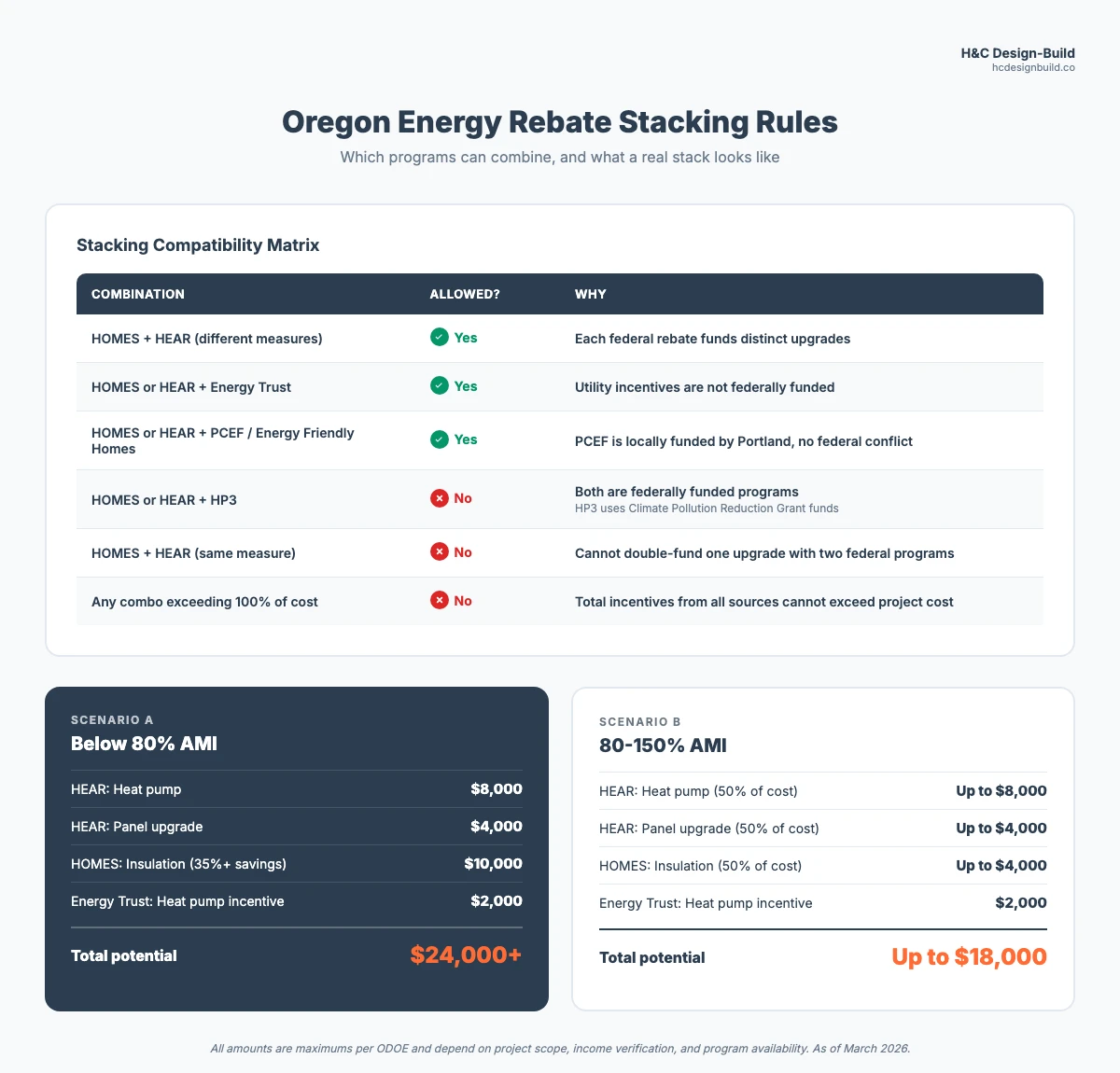
| Combination | Allowed? | Why |
|---|---|---|
| HOMES + HEAR (different measures) | Yes | Each federal rebate funds distinct upgrades |
| HOMES or HEAR + Energy Trust (opens in new tab) | Yes | Utility incentives aren't federally funded |
| HOMES or HEAR + PCEF / Energy Friendly Homes (opens in new tab) | Yes | PCEF is locally funded, no federal conflict |
| HOMES or HEAR + HP3 (opens in new tab) | No | Both federally funded; can't combine |
| HOMES + HEAR (same measure) | No | Can't double-fund one upgrade |
| Any combo exceeding 100% of cost | No | Total incentives can't exceed what you spent |
For a low-income household combining HOMES and HEAR on different upgrades, the theoretical federal maximum is $24,000 ($10,000 from HOMES plus $14,000 from HEAR). Add Energy Trust incentives on top and the total could be higher, as long as it doesn't exceed what you actually spent.
If you already received an HP3 incentive for a heat pump, you can't also claim HEAR for that same equipment. Choose one or the other before you start.
Common Mistakes to Avoid
-
Installing equipment before the program opens. Work completed before launch isn't eligible for HEAR. HOMES has a retroactivity provision back to August 16, 2022 (opens in new tab) (the date the IRA was signed). You'd still need to meet all program requirements: a qualifying energy assessment by an enrolled assessor and installation by an enrolled contractor.
-
Using an unenrolled contractor. Nearly all projects require an installer from the pre-approved list. Hiring outside that list will likely disqualify the rebate.
-
Budgeting HP3 and HEAR on the same heat pump. These can't stack. HP3 owner-occupied funding is currently fully reserved (opens in new tab) in earlier rounds, though rental and new construction categories may still have funds available. If HP3 funding reopens, you still have to choose one program per measure.
-
Confusing the 50% cap. If your household falls between 80% and 150% AMI, HEAR covers up to 50% of actual project cost, not 50% of the per-item maximum. A $16,000 heat pump install at 50% coverage nets $8,000, which happens to match the per-item cap. But a $6,000 heat pump water heater install at 50% coverage nets $3,000, not $1,750.
-
Ignoring scope changes. If your contractor changes the project scope mid-install due to hidden conditions, the rebate reservation may need to be re-submitted. Keep your implementer informed of changes before they happen.
What This Means for Your Project Budget
Don't plan your entire budget around rebates that aren't live yet. We've had clients delay insulation work for months waiting on a rebate launch that kept shifting. The smarter approach: scope and permit the project on its own merits, then layer incentives as they become available.
Start with Energy Trust incentives (opens in new tab) that are available today. Get your permits squared away. If you're income-qualified, check Energy Friendly Homes (opens in new tab) for grants of $15,000 to $50,000 (opens in new tab) through Portland's PCEF program. Then add HOMES and HEAR as supplemental savings once applications open.
A Worked Example
Say you're a Portland homeowner below 80% AMI planning a heat pump and insulation project. Here's what a realistic incentive stack could look like:
| Program | Upgrade | Potential Rebate |
|---|---|---|
| HEAR | Heat pump install | Up to $8,000 |
| HEAR | Electrical panel upgrade | Up to $4,000 |
| HOMES | Insulation + air sealing (35%+ savings) | Up to $10,000 |
| Energy Trust | Ducted heat pump incentive | Up to $2,000 |
| Total potential | Up to $24,000+ |
That's a strong number, but it depends on every program being live, your project qualifying under each set of rules, and the total not exceeding your actual costs. If you're financing the project, structure the loan so early payments cover work while rebate processing catches up.
For a deeper breakdown of every active program, permit requirements, and how to plan without overpromising savings, see our full Portland energy efficiency rebates guide.
Oregon is about to open its largest residential energy rebate programs ever. The money is real. The process is still forming. Get your documentation ready, talk to contractors, and keep an eye on ODOE's rebate page (opens in new tab) for the portal launch.
Planning a heat pump, insulation, or electrification project? Talk to our Portland remodeling team about aligning permits, incentives, and construction scope so nothing falls through the cracks.
Frequently Asked Questions
Who qualifies for Oregon HOMES and HEAR rebates?
HOMES is open to all income levels for existing homes, with larger rebates for households below 80% AMI. HEAR is limited to households at or below 150% of Area Median Income. Both require using an enrolled contractor.
Can I stack HOMES and HEAR rebates together?
Yes, but only on different upgrades. You could use HEAR for a heat pump and HOMES for insulation on the same project. You can't apply both to the same piece of equipment.
Can HOMES or HEAR stack with Oregon HP3?
No. HP3 is federally funded and can't combine with other federal programs like HOMES or HEAR. HP3 can still stack with Energy Trust utility incentives.
When do Oregon HOMES and HEAR rebates open?
ODOE targets spring 2026 for individual-unit applications, summer 2026 for multi-unit projects, and fall 2026 for HEAR retail coupons. The schedule depends on final U.S. DOE approval.
What is the maximum HEAR rebate per household?
The household cap is $14,000 across all HEAR-eligible upgrades. Low-income households (below 80% AMI) can receive up to 100% of project costs. Moderate-income households (80-150% AMI) are capped at 50%.
