
You bought the car. Now you need a way to charge it that doesn't involve a 14-hour wait on a standard wall outlet. A Level 2 home charger is the practical answer for most Portland EV owners, and the install is simpler than you'd expect if your electrical panel has capacity.
What a Home EV Charger Actually Costs in Portland
The total installed cost of a Level 2 EV charger in Portland runs $1,200 to $2,700. That includes the charger itself, labor, permit, and materials. If your home needs a panel upgrade, add $1,800 to $4,500 on top.
The breakdown:
| Component | Cost Range |
|---|---|
| Level 2 charger (equipment) | $300 to $700 |
| Installation labor | $500 to $2,000 |
| Electrical permit | $185 to $225 |
| Materials (wire, conduit, breaker) | $100 to $300 |
| Total (no panel upgrade) | $1,100 to $2,700 |
| Panel upgrade (if needed) | $1,800 to $4,500 |
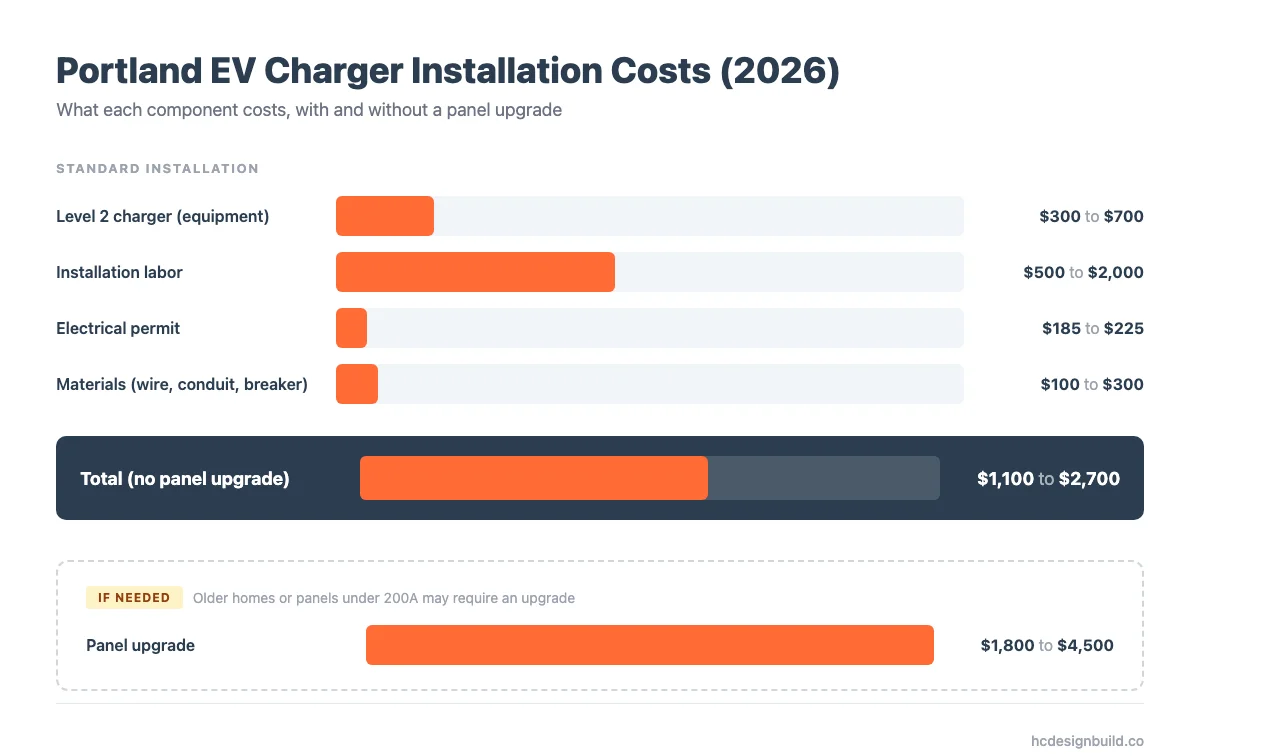
The low end gets you a basic 40-amp charger with a short wire run from a panel that's already in the garage. The high end means a premium smart charger, a long conduit run through an exterior wall, or a panel that's on the opposite side of the house from the garage.
What Drives the Price Up
Distance from panel to charger is the biggest variable. Every additional foot of wire and conduit adds cost. A panel in the garage keeps things simple. A panel in the basement on the far side of the house means 50-plus feet of conduit, potentially through exterior walls or crawlspaces.
Panel capacity matters just as much. If your panel can't handle the added load, you need an upgrade first. About 45 percent of Portland's housing stock (opens in new tab) dates to the 1950s or earlier, per U.S. Census data, and many of those homes still run on 60-amp or 100-amp service. A Level 2 charger on a 100-amp panel eats 40 to 50 percent of total capacity. That math doesn't work.
Hardwired vs. plug-in is less of a cost difference than people expect. A NEMA 14-50 outlet installation costs roughly the same as hardwiring, but gives you a 40-amp continuous cap instead of 48 amps. The real cost difference is in the charger: plug-in models sometimes run $50 to $100 cheaper. Most Portland electricians recommend hardwiring for permanent installations.
Outdoor installations add a bit more. Mounting a charger on the exterior of the house or on a pedestal in the driveway means weatherproofing, conduit, and potentially a concrete pad. Budget an extra $200 to $500.
Level 1 vs. Level 2: Why Level 2 Is Worth It
Every EV comes with a Level 1 charger that plugs into a standard 120V outlet. It works. It's also painfully slow.
| Level 1 | Level 2 | |
|---|---|---|
| Voltage | 120V (standard outlet) | 240V (dedicated circuit) |
| Charging speed | 3 to 5 miles of range per hour | 20 to 35 miles per hour |
| Full charge (empty to 80%) | 40 to 50+ hours | 4 to 10 hours |
| Best for | PHEVs, very short commutes | Everyone else |
If you drive 40 miles a day, a Level 1 charger needs 8 to 13 hours to replace that range. A Level 2 charger does it in one to two hours. For anyone who drives more than 30 miles daily or who occasionally forgets to plug in, Level 2 is the practical minimum.
Choosing a Charger
Match the charger to your car's connector, your panel's capacity, and your tolerance for phone apps.
| Charger | Price | Amps | Smart Features | Notes |
|---|---|---|---|---|
| Grizzl-E Classic | ~$400 | 40A | None | Weatherproof, durable, no-frills |
| Emporia | ~$450 | 48A | Full (app, solar, scheduling) | Best value smart charger |
| Tesla Wall Connector | ~$450 | 48A | Tesla app | NACS connector only |
| Grizzl-E Ultimate | ~$480 | 48A | Basic (scheduling) | J1772 or NACS, Canadian-made |
| ChargePoint Home Flex | ~$549 | 50A | Full (app, cost tracking) | Adjustable amperage (16-50A) |
| Wallbox Pulsar Plus | ~$550 | 48A | Full (app, scheduling) | Compact design |
A few things that matter more than brand:
Tesla, Rivian, and Ford now use NACS (North American Charging Standard) connectors. Most other manufacturers use J1772, the standard plug for non-Tesla EVs. Some chargers come in both versions. If you might switch car brands later, J1772 with a NACS adapter is the safer bet.
The ChargePoint Home Flex lets you dial amperage from 16 to 50 amps. If you're on a smaller panel and need to limit draw without upgrading, that matters. The 2023 National Electrical Code (NEC), which Oregon adopted, explicitly allows adjustable amperage settings on EV chargers. That makes this a code-compliant way to work with limited panel capacity.
Smart chargers let you schedule off-peak charging, track energy costs, and integrate with solar systems. If you don't care about any of that, the Grizzl-E Classic charges just as fast for $150 less.
Portland Permit Requirements
Portland requires an electrical permit (opens in new tab) for any new 240V circuit. No exceptions for EV chargers.
Permit Fees (as of July 2025)
| Permit Type | Base Fee | With 12% State Surcharge |
|---|---|---|
| Branch circuit (new dedicated circuit) | $165 | ~$185 |
| 200-amp service upgrade | $201 | ~$225 |
| Each additional branch circuit | $20 | ~$22 |
Source: City of Portland Electrical Permit Fee Schedule (opens in new tab), effective July 1, 2025.
If you're only adding a dedicated EV charger circuit (no panel upgrade), the branch circuit permit at roughly $185 is all you need. If the project includes a service upgrade, the $225 service fee covers the panel work.
From Assessment to Inspection
- Electrician assessment. A licensed electrician evaluates your panel capacity, proposes a charger location, and determines the wire routing.
- Permit application. Your electrician pulls the permit through Portland Permitting and Development. Online through DevHub (opens in new tab) is fastest, with 24-hour turnaround for most residential electrical work.
- Installation. Two to five hours for a standard install. The electrician runs the dedicated circuit, mounts the charger, and connects everything.
- Inspection. Portland sends an inspector to verify the work meets Oregon Electrical Specialty Code and the 2023 NEC. Schedule through DevHub or by calling 503-823-7000.
Only licensed electricians can legally install new circuits in Oregon. This isn't a DIY project, and the permit requires a contractor license number.
Does Your Panel Need an Upgrade?
This is the question that determines whether your project costs $1,500 or $5,000.
A Level 2 EV charger typically needs a 50 or 60-amp breaker. The NEC 80 percent rule requires the breaker to be rated at 125 percent of the continuous load, so a 48-amp charger needs a 60-amp breaker. On a 200-amp panel with available slots, that's usually fine. On a 100-amp panel, it's almost always a problem.
| Panel Size | EV Charger Feasibility |
|---|---|
| 200-amp with open slots | Usually fine. Electrician runs a load calculation to confirm. |
| 200-amp, full panel | May need a sub-panel ($500 to $1,500) or tandem breakers. |
| 100-amp | Almost certainly needs upgrade. EV charger takes 40-50% of total capacity. |
| 60-amp or fuse box | Upgrade required. These panels can't support a Level 2 charger safely. |
Your electrician performs a load calculation during the assessment. They add up your existing electrical loads (HVAC, water heater, range, dryer, lights) and compare the total to your panel's rating at 80 percent capacity. If there's room for 40 to 50 more amps, you're good. If not, you need a panel upgrade before the charger goes in.
If you're also planning a heat pump or other electrification projects, do the panel upgrade once and size it for everything. Upgrading twice is paying the electrician twice.
Rebates and Incentives (March 2026 Update)
The rebate situation thinned out heading into 2026. One federal credit remains, and a state program is on the way.
Federal 30C Tax Credit: Active, Expiring June 2026
The Alternative Fuel Vehicle Refueling Property Credit (opens in new tab) covers 30 percent of installation costs, up to $1,000. It expires June 30, 2026.
The catch: your home must be in an eligible census tract (opens in new tab) (low-income or non-urban). Many Portland tracts qualify, but not all. Check your address with the Argonne National Laboratory's 30C eligibility tool before counting on this credit. It's non-refundable, meaning it reduces your tax bill but won't generate a refund on its own.
PGE Charger Rebate: Closed
PGE's residential EV charger rebate offered up to $300 (up to $1,000 for income-qualified households) toward a Level 2 charger, plus up to $1,000 (up to $5,000 income-qualified) for panel upgrades. New enrollments closed July 31, 2025. No replacement program has been announced for 2026.
Pacific Power: Suspended
Pacific Power's residential charger rebate (up to $500, or $1,500 income-qualified) is under review with no timeline for reopening.
Oregon HEAR Program: Coming Fall 2026
The HEAR program targets low-to-moderate income households with point-of-sale rebates covering 50 to 100 percent of electrification costs up to $14,000. Panel upgrades tied to EV charger installation may qualify. Expected launch: fall 2026, administered by Energy Trust of Oregon.
What This Means for Timing
If your home is in an eligible census tract, install before June 30, 2026, to capture the federal credit. If you're income-qualified and not in a rush, waiting for the HEAR program could save you far more. If you don't qualify for either, you're paying full price regardless, so install when it suits your schedule.
Installation Planning
A few practical decisions to make before your electrician shows up.
Inside the garage is the easiest spot for wire routing and protects the charger from weather. If you park in the driveway, an exterior-mounted charger works fine. Modern Level 2 chargers are rated for outdoor use, though mounting on covered walls extends their life. Charger cables typically reach 18 to 25 feet, so plan the mounting height and location around where your car's charge port sits.
If you have a two-car garage and sometimes park on either side, a charger with a 25-foot cord gives you more flexibility than one with an 18-foot cord.
Walk from your panel to where you want the charger. If it's under 20 feet with no walls to penetrate, your installation stays on the low end of the cost range. Past 30 feet or through exterior walls, costs climb.
If you might add a second EV, ask your electrician about running conduit for a second circuit now even if you only install one charger. The conduit is cheap. Pulling wire and patching walls later is not.
Why Home Charging Matters in Portland
We're seeing EV charger requests bundled into remodel projects more often than even two years ago. Oregon passed 100,000 registered EVs as of late 2024 (opens in new tab), most of them in the Portland metro. A proposed House Bill 2961 (opens in new tab), currently in the 2025 legislative session, would require new residential construction to include Level 2 EV charging capacity.
For existing homes, a home charger handles the vast majority of day-to-day charging. That means no per-session fees, no waiting for a public spot, and overnight charging at residential rates. If you're already planning a kitchen remodel or panel upgrade, adding the EV circuit at the same time keeps costs down and avoids a second round of permits.
What You'll Pay and Where to Start
A Level 2 EV charger installation in Portland runs $1,200 to $2,700 if your panel can handle it. If it can't, add $1,800 to $4,500 for the panel upgrade. The federal 30C tax credit can knock up to $1,000 off if your home is in an eligible census tract, but it expires June 30, 2026.
Start with an electrician assessment. They'll tell you within an hour whether your panel has capacity, what the wire routing looks like, and what the job will cost. If an EV charger is part of a bigger plan that includes a heat pump or kitchen remodel, bundle the panel upgrade with the rest of the work. One permit, one electrician visit, less money out the door.
Need help planning an EV charger installation alongside a remodel? Reach out to us and we'll coordinate the electrical scope with the rest of your project.
This guide is for informational purposes. Electrical work in Portland requires a licensed electrician. Consult a qualified professional for your specific situation and a tax advisor regarding credits and deductions.
Frequently Asked Questions
Can I install an EV charger myself in Portland?
No. Portland requires a licensed electrician to install any new 240V circuit. You need an electrical permit from Portland Permitting and Development, and the work must pass inspection. DIY installation violates Oregon code and voids most charger warranties.
How long does a home EV charger installation take?
A straightforward install takes two to five hours. If your electrician needs to run wire more than 30 feet from the panel, add conduit through exterior walls, or install a sub-panel, expect a full day. Panel upgrades add one to three days plus PGE coordination.
Will a Level 2 charger increase my electric bill?
A typical EV driven 12,000 miles per year uses about 3,600 kWh. At PGE residential rates around 12 to 14 cents per kWh, that's roughly $430 to $500 per year. PGE's time-of-use rate charges less for off-peak charging between 9 PM and 7 AM, which can cut that cost by 20 to 30 percent.
Should I hardwire or use a NEMA 14-50 outlet?
Hardwiring gives you 48 amps continuous and a cleaner install with no outlet degradation risk. A NEMA 14-50 outlet caps at 40 amps but lets you take the charger if you move. Staying more than five years? Hardwire. Might move? Go with the outlet.
Does my Portland home need a panel upgrade for an EV charger?
Check the main breaker rating printed on its handle. If it reads 200A and you see open slots, you're likely fine. If it reads 100A or lower, plan for an upgrade. An electrician can run a load calculation in about an hour for $100 to $200, and most firms waive that fee if you hire them for the install.
