
You're planning a remodel or new build in Portland, and you've heard the building codes are changing. Some already did. The 2026 Oregon building code changes affect new construction more than existing homes, but the timing matters for every project. Some rules are already mandatory. Others take effect later this year. And Portland just suspended several requirements that used to add cost to remodels.
Here's what changed, what's coming, and what it means for your project.
Which code governs your home
Oregon uses separate codes for different building types. Single-family homes and duplexes (three stories or fewer) fall under the Oregon Residential Specialty Code (ORSC) (opens in new tab). Larger buildings, commercial structures, and multi-family projects (three or more units) follow the Oregon Structural Specialty Code (OSSC) (opens in new tab).
This distinction matters because the 2025 OSSC and Oregon Mechanical Specialty Code (OMSC) updates that took effect October 1, 2025 apply to commercial and multi-family. If you own a single-family home or duplex, the current code is still the 2023 ORSC (based on the 2021 IRC) until the 2026 ORSC takes effect.
For single-family homeowners, the 2026 ORSC is the one to watch.
The 2026 ORSC: what's changing for residential
The Residential and Manufactured Structures Board (opens in new tab) voted to approve the 2026 ORSC energy package on February 18, 2026. The full code is based on the 2024 International Residential Code with Oregon amendments. Anticipated effective date is October 1, 2026, with a six-month phase-in making it mandatory around April 1, 2027.
These changes apply to new construction, not remodels of existing homes.
Heat pump requirement (Section N1105.8)
This is the headline change. New homes where split-system air conditioning is installed must use a heat pump for both heating and cooling. The heat pump must be first-stage heating.
What this does not mean:
- Not a gas ban. Gas furnaces are still allowed for supplemental and backup heating. Dual-fuel systems work fine.
- Not a blanket mandate. If a builder chooses not to install AC, the heat pump requirement doesn't apply.
- Not for existing homes. Remodels, renovations, and HVAC replacements are not affected.
The heat pump only needs to be sized for the cooling load. For Portland's climate, that's typically smaller than the full heating demand. Gas handles the peak. The Sierra Club reported (opens in new tab) 54 building professionals and climate organizations submitted letters supporting the codes.
The Northwest Gas Association opposed the provision (opens in new tab) in a November 2025 letter, citing a 57.7% average cost increase for installing heat pumps versus traditional AC units. They also raised concerns about Oregon's electric grid capacity during winter peaks. Their proposals to remove or weaken the requirement were not adopted.
Energy efficiency: 27% more efficient overall
The 2026 ORSC raises the bar across the board for new homes. The Oregon Building Codes Division's 2026 analysis (opens in new tab) projects average savings of $125 per month for new homeowners.
| Requirement | 2026 value | What changed |
|---|---|---|
| Air leakage (blower door) | 2.75 ACH50 max (air changes per hour at 50 Pascals) | Down from 3.25 (tighter envelope) |
| Heat recovery ventilation | 66% min sensible efficiency | HRV (heat recovery ventilator) or ERV (energy recovery ventilator) now required |
| On-site renewable energy | 4.0 kWh or 1.5 W/SF | Solar or equivalent now required |
| Floor insulation | R-38 | Higher than previous code |
| Below-grade walls | R-15 | Higher than previous code |
| Above-grade walls | R-21 | With intermediate framing |
| Lighting | 65 lumens/watt per lamp | Updated for LED |
EV-ready wiring
Separate from the ORSC, proposed HB 2961 (opens in new tab) would require new residential construction to support one Level 2 EV charger. The bill is still working through the legislature as of March 2026. If enacted, multifamily buildings with 10 or more units in metro counties would need EV capacity at 20% of parking spaces. Townhouses would be excluded.
What this means for remodels
If you're remodeling an existing home, the 2026 ORSC energy requirements generally don't apply to your project. Alterations must meet certain energy provisions (Sections N1101.2.1 through N1101.2.3), but the full heat pump, solar, and air sealing requirements target new construction.
If you're building new in Portland, projects permitted before the mandatory date can use the current code. After the transition, the new requirements apply.
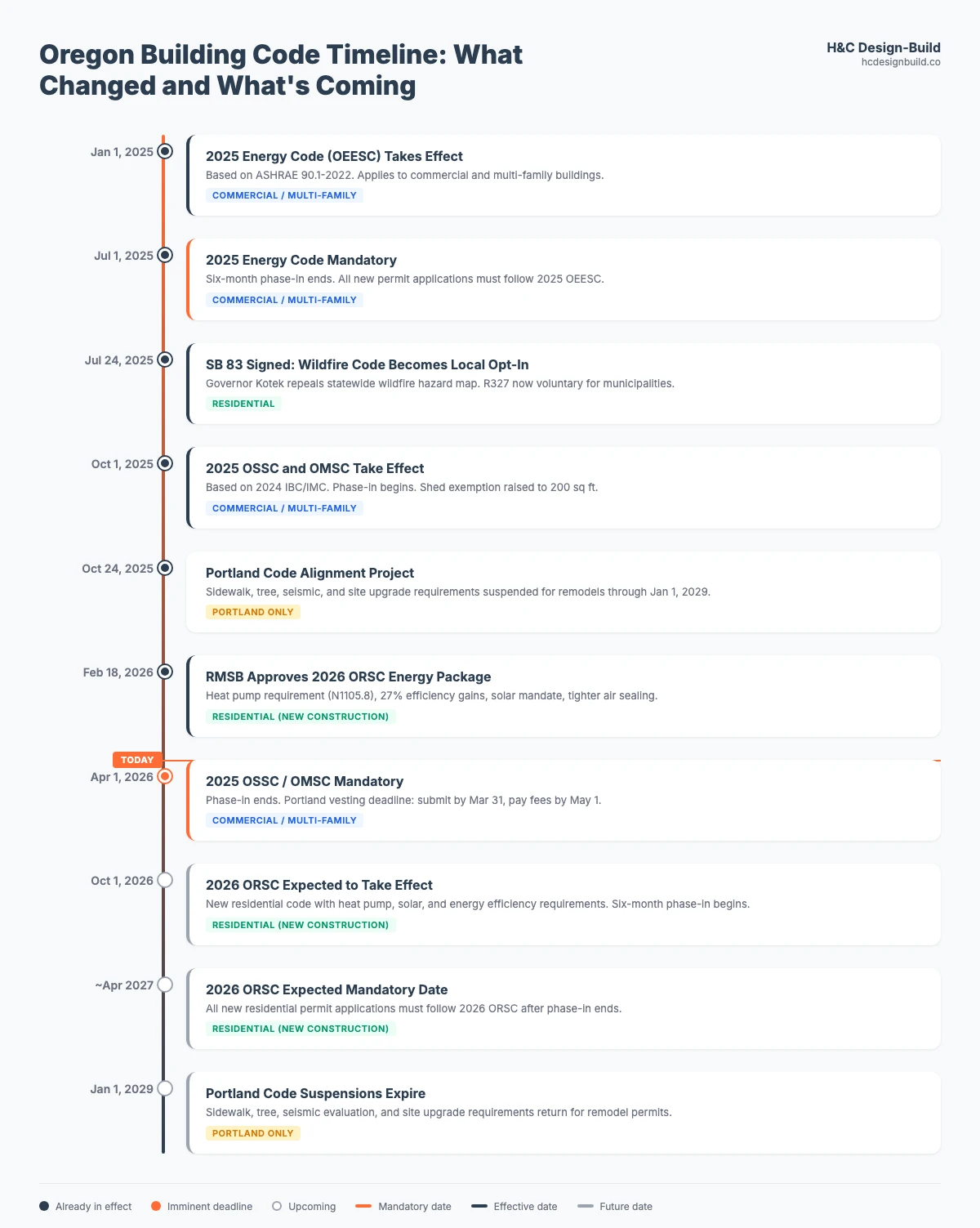
2025 codes already in effect
Two codes have already gone mandatory that affect Portland projects right now.
2025 energy code (OEESC)
Based on ASHRAE 90.1-2022. Effective January 1, 2025. Mandatory since July 1, 2025. Primarily applies to commercial buildings, but mixed-use and multi-family projects fall under it. Portland's announcement (opens in new tab) details the transition.
2025 OSSC and OMSC
Based on the 2024 IBC and 2024 IMC with Oregon amendments. Effective October 1, 2025. Mandatory April 1, 2026. These govern commercial and multi-family, but a few provisions touch residential homeowners:
The accessory structure permit exemption was raised. Unoccupied one-story detached structures (sheds, workshops) are now exempt from building permits up to 200 square feet, up from 120. This is one of the most practical changes for homeowners.
New provisions also allow egress windows under decks and porches, provided the opening can fully open and a 36-inch clearance path leads to a yard.
On the seismic side, the 2025 OSSC now references ASCE 7-22, which uses 22 seismic response periods instead of two. Portland remains Seismic Design Category D. If you're building an accessory dwelling unit (ADU) or multi-family project, your engineer will use updated seismic calculations.
Portland vesting deadlines
To keep your commercial or multi-family project under the 2022 codes, Portland requires a complete application through DevHub (opens in new tab) by 11:59 PM on March 31, 2026. Intake fees must be paid by May 1, 2026. After that, the 2025 codes are mandatory.
Portland's Code Alignment Project: fewer requirements for remodels
This is the change that saves the most money for homeowners remodeling right now.
On September 24, 2025, Portland City Council unanimously approved (opens in new tab) temporary suspensions of several upgrade requirements for projects that alter or add to existing buildings. These suspensions run through January 1, 2029.
| Suspended requirement | What it means for your project |
|---|---|
| Street tree planting (Title 11) | No longer triggered by additions or alterations |
| Sidewalk and curb improvements (Title 17) | No sidewalk, curb, or ramp upgrades required |
| Seismic evaluation reports (Title 24) | No ASCE 41 evaluation required for alterations |
| Site upgrades (Title 33) | Bike parking, pedestrian connections, and landscaping upgrades paused for all projects |
These requirements used to add thousands to remodel budgets before construction even started. The suspension applies to existing buildings only, not new construction.
For context on seismic requirements, see our Portland seismic retrofit guide. The key detail: even when the evaluation requirement returns in 2029, detached one- and two-family homes are exempt under PCC 24.85.060 (opens in new tab). The $175,000 trigger threshold (now inflation-adjusted to $386,338) applies to multi-family and commercial buildings.
Portland permitting updates
The former Bureau of Development Services is now Portland Permitting and Development (PP&D) (opens in new tab), effective July 2024. The reorganization consolidated permitting from five bureaus into one.
A few practical changes to know about.
Fees increased roughly 5% as of July 1, 2025 (current fee schedules (opens in new tab)). The permit timeline dashboard (opens in new tab) updates weekly. Check it before scheduling your project.
The Field Issuance Remodel (FIR) program, which provided expedited permitting through a single assigned inspector, is closed to new participants due to budget constraints. No waitlist.
Home Energy Score disclosure is still required when selling most single-family homes. Scores are valid for eight years. Penalty for non-compliance is up to $500.
Wildfire building code: not a Portland issue (yet)
Oregon's wildfire hazard mitigation code (R327) has had a turbulent history. After the 2020 fires, SB 762 mandated statewide wildfire building standards. Property owner backlash led to SB 83 (opens in new tab), signed by Governor Kotek on July 24, 2025. SB 83 repealed the statewide wildfire hazard map and made R327 a local opt-in code (opens in new tab).
Only a few fire-prone communities have adopted R327 so far: the City of Sisters and Deschutes County (both effective April 1, 2026), with Bend in the process.
Portland has not adopted R327. The city does have a Wildfire Hazard Zone Map (opens in new tab) from 2002 covering about 8,000 properties near Forest Park and the West Hills, but it doesn't trigger R327 building requirements.
If you're building in Central Oregon, R327 requirements include fire-rated roofing (no wood shakes), ember-resistant vents, ignition-resistant exterior walls, and tempered glass. The statewide wildfire risk explorer (opens in new tab) is still available as an informational tool even though it no longer carries legal authority.
Rebates and incentives in 2026
Code changes pair with current rebates and incentives. Here's what's available and what isn't.
Federal 25C tax credit (expired)
The Section 25C credit for home energy improvements ended December 31, 2025. It is not available for 2026 projects.
HOMES and HEAR rebates (launching in phases)
These are separate from the expired tax credit and were not terminated. Funded by the Inflation Reduction Act and administered by the Oregon Department of Energy (ODOE) (opens in new tab):
- HOMES (performance-based efficiency rebates for existing homes): anticipated spring 2026
- HEAR (high-efficiency electric appliance rebates, up to $14,000 based on income): retail coupons anticipated fall 2026
- Both still pending final U.S. DOE approval
Energy Trust of Oregon (active)
Rebates up to $2,000 (opens in new tab) on qualifying heat pumps, depending on system type. Must use an approved contractor.
Portland Clean Energy Fund (active)
PCEF (opens in new tab) funds heat pump installations, weatherization, and electrification through nonprofit-led programs. Prioritizes low-income residents. The fund awarded $64.4 million for 60 projects in its 2025 grant cycle.
Our Portland energy efficiency rebates guide covers current incentives, stacking rules, and eligibility details.
Your application date determines your code
Oregon uses a consistent rule: the code in effect when your permit application is submitted is the code that governs your project. During phase-in periods, you can choose either the old or new code. After the mandatory date, the new code applies to all new applications.
Current and upcoming deadlines:
| Code | Mandatory date | Applies to |
|---|---|---|
| 2025 OEESC | July 1, 2025 | Commercial, multi-family |
| 2025 OSSC / OMSC | April 1, 2026 | Commercial, multi-family |
| 2026 ORSC | ~April 2027 (anticipated) | Single-family, duplexes |
If you're planning a new home, submitting your permit application before the 2026 ORSC becomes mandatory lets you build under the current residential code. After the transition, the new energy, heat pump, and solar requirements apply.
For remodels, the current code already governs your project. The 2026 ORSC's biggest changes target new construction, not alterations to existing homes.
What to do with this information
If you're planning a project in Portland, here's the practical takeaway.
Remodeling an existing home
The Code Alignment Project suspensions are saving homeowners money through 2029. The 2026 ORSC heat pump and solar requirements don't apply to your remodel. We've had clients worried they'd need to add solar panels for a kitchen renovation. They don't. Your biggest code consideration is still getting the right building permits and meeting current residential code for your scope.
Building new
The 2026 ORSC raises the standard for energy efficiency, heat pump systems, and on-site solar. These are real cost additions, but the projected $125/month savings offsets them over time. Plan your mechanical systems early and price both heat-pump-primary and dual-fuel options. Our heat pump installation cost guide breaks down system types, pricing, and how to stack rebates.
Buying a home
Portland's Home Energy Score requirement means you'll see the energy performance of most homes you tour. Older homes with lower scores may benefit from energy rebates available in 2026.
This article is educational and current as of March 2026. Building codes, permit rules, and incentive programs change. Verify details with Oregon BCD (opens in new tab) and Portland PP&D (opens in new tab) before making project decisions.
If you want help understanding how these code changes affect your specific project, contact H&C Design-Build.
Frequently Asked Questions
What Oregon building codes changed in 2025 and 2026?
The 2025 OSSC and OMSC took effect October 1, 2025 for commercial and multi-family buildings. The 2025 energy code became mandatory July 1, 2025. The 2026 ORSC for single-family homes was approved February 2026 and is anticipated to take effect October 1, 2026.
Does the Oregon heat pump mandate apply to my remodel?
No. Section N1105.8 of the 2026 ORSC only applies to new construction where split-system air conditioning is installed. Existing home remodels, renovations, and HVAC replacements are not affected.
Which building code applies to my Portland project?
Your permit application date determines which code applies. During phase-in periods, you can submit under either the old or new code. Once the mandatory date passes, all new applications follow the new code.
Did Portland suspend any permit requirements for remodels?
Yes. Through January 1, 2029, Portland suspended street tree planting, sidewalk upgrades, seismic evaluation reports, and site improvement requirements for projects that alter or add to existing buildings.
Does the Oregon wildfire building code apply in Portland?
No. Oregon repealed the statewide wildfire code mandate in July 2025 with SB 83. R327 is now local opt-in only, and Portland has not adopted it.
