You live in one of the most seismically active regions in the country, and your house probably isn't bolted to its foundation. That's not a scare tactic. For many older homes, a Portland seismic retrofit starts with foundation bolts and cripple wall bracing.
The Cascadia Subduction Zone runs 600 miles offshore from Northern California to British Columbia. The last full rupture was a magnitude 9.0 on January 26, 1700. Oregon's Department of Emergency Management puts the probability of a magnitude 7.1 or greater earthquake at 37% in the next 50 years (opens in new tab). The USGS estimates a 10 to 15% chance of a full magnitude 9.0 (opens in new tab) in the same window.
A seismic retrofit is the most cost-effective way to protect your home. Here's what it costs, how Portland's permit system works, and where to start.
What a Seismic Retrofit Actually Does
Most Portland homes built before 1978 sit on their foundations by gravity alone. The wooden sill plate rests on concrete without bolts. The cripple wall (the short wood-framed wall between the foundation and the first floor) has no bracing.
In an earthquake, the house slides off the foundation or the cripple wall collapses. Either way, the house drops and the damage is catastrophic.
A seismic retrofit fixes this with two changes:
1. Foundation bolting: Steel anchor bolts or retrofit plates connect the wood sill plate to the concrete foundation. 2. Cripple wall bracing: Structural plywood gets nailed to the cripple wall studs, turning a weak point into a shear wall.
That's it. No tearing out drywall. No rerouting plumbing. Most of the work happens in the crawl space.
What Portland Seismic Retrofits Cost
Cost depends on house size, crawl space access, and whether you have cripple walls.
| Retrofit Type | Cost Range | Typical Home | | ----------------------- | ------------------ | -------------------------------------- | | Foundation bolting only | $1,000 to $5,000 | Slab or no cripple walls | | Cripple wall bracing | $1,000 to $3,000 | Short cripple walls, good access | | Standard bolt and brace | $3,500 to $7,000 | Most pre-1978 Portland homes | | Soft-story retrofit | $10,000 to $80,000 | Multi-level, tuck-under garage, duplex | | DIY bolt and brace | $1,500 to $5,000 | Materials plus permit fees |
For a typical Portland home with a crawl space, expect $3,500 to $7,000 for a professional bolt-and-brace retrofit. That estimate fits many 1,500 to 2,500 square foot homes. It works out to roughly $3 to $7 per square foot, based on the Oregon Construction Contractors Board's retrofit guide (opens in new tab).
Soft-story retrofits cost more because they require engineered steel moment frames or plywood shear walls to reinforce open-front structures like tuck-under garages. These need a structural engineer's design.
Portland's Seismic Permit Process
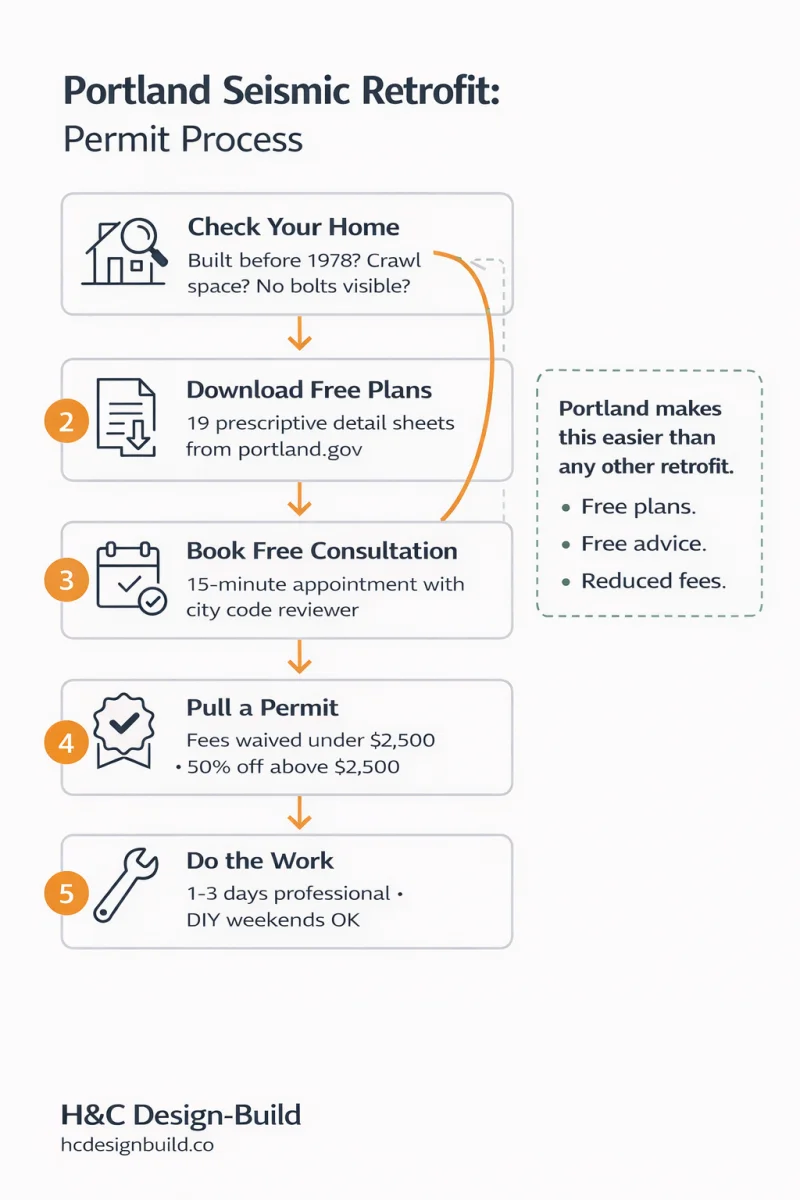
Portland makes seismic retrofits easier to permit than most construction work. The city offers three advantages you won't find with other project types.
Free Prescriptive Plans
Portland provides free downloadable retrofit plans (opens in new tab) for qualifying one- to three-story residential buildings. These prescriptive plans include 19 technical detail sheets covering sill plate bolting, cripple wall bracing, anchorage details, and approved products.
No engineering stamp required for prescriptive work. You download the plans, pull a permit, and follow the specifications.
Free 15-Minute Consultation
The city offers a free 15-minute appointment with a building code reviewer before you apply. They'll review your situation and confirm whether prescriptive plans apply to your home. They'll also help you prepare your permit application. This alone can save hundreds in engineering fees.
Fee Waivers for Seismic Work
Under Portland Code Chapter 24.85 (opens in new tab), building permit fees for structural seismic strengthening work are waived entirely when fees total less than $2,500. When fees would total $2,500 or more, they're reduced by 50%. Most residential bolt-and-brace retrofits fall under the full waiver threshold.
Check Portland's current fee schedule (opens in new tab) to estimate your permit costs before applying.
When Seismic Upgrades Become Mandatory
Portland does not require seismic retrofits for most existing single-family homes. The triggers below come from Chapter 24.85 (opens in new tab):
Major alterations (Section 24.85.060): Alteration projects over $175,000 can trigger an ASCE 41 seismic evaluation. This trigger is deferred until January 1, 2029, and detached one- and two-family dwellings are exempt under PCC 24.85.060 (opens in new tab). Portland's Code Alignment Project temporarily suspended seismic evaluation requirements through that date.
Occupancy change (Section 24.85.040): Converting to a higher-risk occupancy can trigger seismic requirements under PCC 24.85.040 (opens in new tab).
Unreinforced masonry (Section 24.85.065): URM buildings can be required to add seismic improvements during qualifying alterations under PCC 24.85.065 (opens in new tab). This can include roof work.
If you're planning major work or a change of use, confirm seismic implications with the city before design is finalized.
For a detailed walkthrough of Portland's permit process and what inspectors check, see our Portland building permits guide.
Phased Upgrades Over 10 Years
Can't afford the full retrofit now? Portland allows phased seismic improvement programs under Chapter 24.85 (opens in new tab). The City Administrator can approve a pre-designed multi-year plan with a maximum ten-year completion period. Extensions are possible at the administrator's discretion.
This means you can bolt the foundation this year, brace the cripple walls next year, and address the chimney the year after. The work gets pre-designed as a complete package, then executed in phases as your budget allows.
Three Retrofit Options (BCG 24-10)
Portland's Building Code Guide 24-10 (opens in new tab) outlines three retrofit paths for wood-frame buildings:
Option 1: No additional work. Buildings already retrofitted to 1993 or later OSSC standards may not need further seismic work. The same applies to homes that meet 2003 or later ORSC standards or ASCE 41 Life Safety level.
Option 2: Limited deficiency check. Designers evaluate six specific items: foundation anchorage, cripple walls, soft or weak stories, elevated decks, chimneys, and masonry veneer. Prescriptive methods can be used without engineering review for qualifying items.
Option 3: ASCE 41 full checklist. Uses Tier 1 checklists from ASCE 41-17 to identify all deficiencies, then applies Tier 2 retrofit procedures. Requires a licensed professional engineer or architect.
Most single-family homes follow Option 2. It covers the common vulnerabilities without requiring a full structural analysis.
Why Portland Homes Are Vulnerable
Older Housing Stock
Portland has a large stock of single-family homes built before 1978, when Oregon adopted its first meaningful seismic building code. Neighborhoods like Sellwood, Foster-Powell, Laurelhurst, Irvington, and St. Johns are full of Craftsman bungalows and mid-century homes sitting unbolted on their foundations.
Soil Conditions
Portland has significant liquefaction zones along the Willamette and Columbia river corridors. South Waterfront, the NW Industrial district, and parts of inner Southeast sit on alluvial soils that lose strength during sustained shaking. The DOGAMI O-18-02 report (opens in new tab) estimates a magnitude 9.0 Cascadia event would cause 27,000 injuries and displace 85,000 people. It also estimates $23.5 to $36.7 billion in building repair costs across Clackamas, Multnomah, and Washington counties.
The Portland Hills Fault, running directly beneath the West Hills, poses an even more concentrated risk. DOGAMI (opens in new tab) estimates that a magnitude 6.8 event on this fault would cause more than twice the casualties and displacement of a Cascadia event. The epicenter would sit directly under densely populated neighborhoods.
Chimney Risk
Unreinforced masonry chimneys are the most common earthquake damage in Portland homes. A brick chimney can collapse through the roof during moderate shaking. Chimney bracing or replacement with a lightweight metal flue is a separate retrofit item, and cost depends on height and access.
What Doesn't Exist (Yet)
Be honest about what Portland and Oregon don't offer for residential seismic retrofits as of 2026:
- No state tax credit for residential seismic work. Oregon's Seismic Rehabilitation Grant Program (opens in new tab) funds schools and emergency facilities only.
- No mandatory retrofit ordinance for single-family homes. Portland's URM ordinance targets commercial buildings.
- No widely available insurance premium discount for residential retrofit work in Oregon.
- No active federal grant program for homeowners at the time of writing.
The financial case for retrofitting rests on protecting your investment, not on rebates. A retrofit helps protect a high-value asset from severe structural damage. Standard homeowner insurance does not cover earthquake damage. Separate earthquake policies often carry high deductibles and can still leave major out-of-pocket losses after a large event.
DIY vs. Hiring a Contractor
DIY Bolt-and-Brace
Portland's prescriptive plans are designed for homeowner use. If you're comfortable working in a crawl space with a rotary hammer drill and impact driver, you can do the work yourself. Material cost depends on the number of bolts and plywood panels needed. The city's approved products list (opens in new tab) specifies exactly which bolts, plates, and fasteners to use.
The work is physical but not technically complex. You're drilling into concrete, installing bolts or plates at specified spacing, and nailing plywood to framing. The hardest part is working in tight crawl spaces.
Hiring a Contractor
For homes with limited crawl space access, complex foundations, or soft-story conditions, hire a licensed contractor. Get three bids. Verify the contractor holds an active Oregon CCB license and carries liability insurance.
Ask specifically about seismic retrofit experience. Not every general contractor has done this work.
A professional retrofit for a standard Portland home takes one to three days. Soft-story retrofits take one to three weeks.
Making the Decision
Check your home's age. If it was built before 1978 and has a crawl space, it almost certainly needs foundation bolting at minimum. Walk your crawl space or hire an inspector.
Look for bolts connecting the wood sill plate to the concrete. If you don't see any, your house isn't attached to its foundation.
Start with Portland's free prescriptive plans and 15-minute consultation (opens in new tab). The city has made the permit process as straightforward as possible for this work. Take advantage of the fee waivers while they're available.
If you're planning a major remodel, factor seismic work into the project. It's cheaper to retrofit during a kitchen remodel or basement finishing project when walls and crawl spaces are already exposed.
Need help assessing your home's seismic vulnerability? Contact H&C Design-Build for a walkthrough. We'll check your foundation, crawl space, and cripple walls and give you honest options for your specific situation.