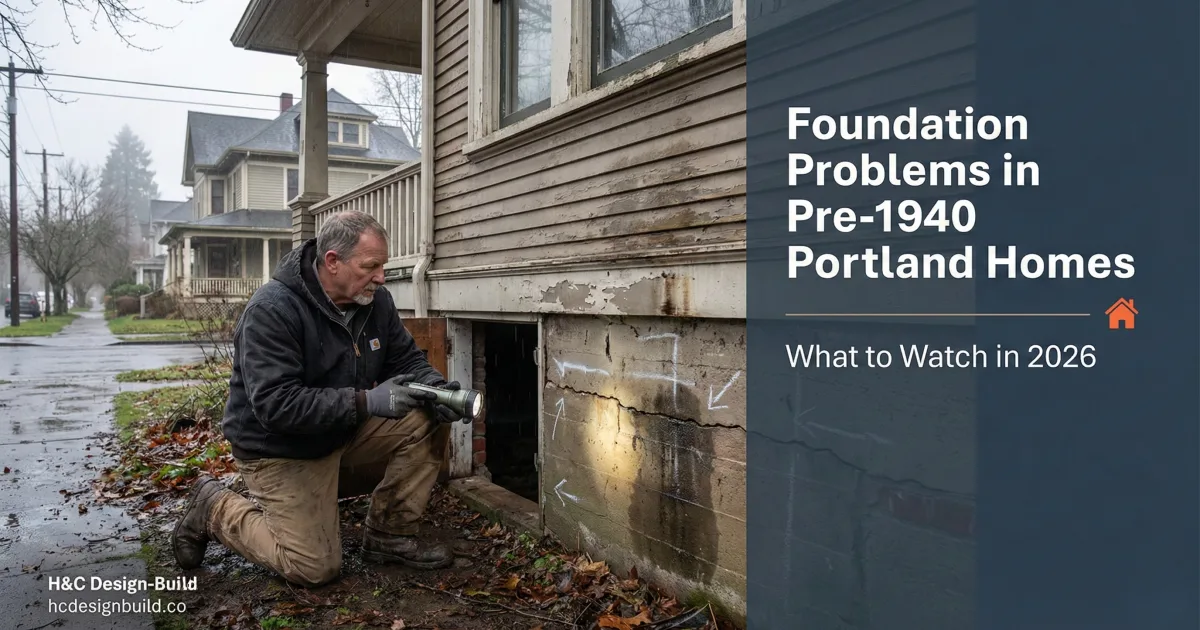
Portland still has thousands of homes built before 1940. Many are still sitting on original foundations that predate modern code and seismic detailing.
If you own one of these homes in Irvington, Alameda, Laurelhurst, Ladd's Addition, or Sellwood, your foundation has specific vulnerabilities. Those vulnerabilities depend on when it was built, what materials went in, and what Portland's soil has done to it since.
Here's what to look for and when to worry.
Portland's Soil Makes It Worse
Portland sits in the Willamette Valley (opens in new tab), where soils formed 10,000 to 14,000 years ago from massive Ice Age flooding. The Missoula Floods deposited layers of clay and silt across the valley floor. Portland's soils contain 20 to 35% clay (opens in new tab) depending on location and depth.
That clay content matters for your foundation. Clay expands when wet and shrinks when dry (opens in new tab). Portland gets 36 to 40 inches of annual rainfall, mostly between October and May.
Then summers dry out. This seasonal cycle pushes and pulls against your foundation walls every year.
The result: cracks develop, walls bow inward, and foundations settle unevenly. A hundred years of this cycle takes a toll.
Foundation Types by Era
Not all pre-1940 foundations are the same. The era your home was built determines what you're dealing with.
Pre-1900: Brick and Stone
Portland's oldest homes sit on brick foundations laid with lime mortar and no steel reinforcement. Stone foundations exist but are rarer since quality building stone was scarce (opens in new tab) in early Oregon.
These foundations are porous. Lime mortar crumbles over time, especially below grade where moisture is constant. The biggest risk is repointing with modern Portland cement. That cement is harder than the original brick.
When mortar is harder than the masonry, the brick becomes the failure point (opens in new tab) instead of the mortar. Water and freeze-thaw cycles destroy the brick from the inside out.
If your pre-1900 foundation has been repointed, check whether lime mortar or Portland cement was used. This single detail determines the repair approach.
1900 to 1920: Portland's Building Boom
Portland's population surged in the early 1900s. Demand for housing outpaced supply in many neighborhoods. Builders moved fast.
Foundations from this era are often shallow poured concrete cast with minimal formwork. Many were built without the spread footings and reinforcing details expected today.
Mix quality varies widely from house to house. Some foundations remain serviceable. Others are soft, brittle, and crumbling after a century of moisture cycling.
Cripple walls are also common in this era. These short timber-framed walls raise the floor above the foundation. Wood rots in Portland's wet climate, and cripple walls lack lateral bracing for earthquakes.
1920 to 1940: Better But Still Pre-Code
Construction improved in this era, but homes still predate the Uniform Building Code (first published in 1927). Many homes used unreinforced concrete block or poured concrete without rebar.
The concrete is more consistent than the boom-era mix, but many assemblies still lack the reinforcing and anchorage details modern seismic practice expects. During inspection, verify sill-plate anchorage, foundation condition, and cripple-wall bracing before planning major renovation work.

What This Means by Neighborhood
The era breakdowns above map directly to Portland's older neighborhoods.
Irvington and Alameda (NE Portland): Peak building era 1905 to 1925. Expect shallow poured concrete with inconsistent mix quality and cripple walls. These neighborhoods sit on the east side's clay-heavy soil. Seasonal movement is visible in nearly every basement.
Laurelhurst: Developed 1909 to 1930. Similar foundation stock to Irvington but more homes from the improved 1920s era.
Ladd's Addition: Portland's oldest planned neighborhood. Homes date to 1891 through the 1920s. Brick and early concrete foundations are common. The neighborhood's low elevation means higher groundwater. Moisture issues are more frequent here.
Sellwood (SE Portland): Mixed era, 1890s to 1930s. Brick foundations in the oldest sections, transitioning to concrete block. The Sellwood bluff creates variable soil depths. Some homes sit on shallow bedrock while others have deep clay.
What We See on the Jobsite
Foundation problems rarely show up in isolation. They surface during renovation work when walls come down and basements get opened up.
On a whole-home renovation of a Portland craftsman in North Portland, our crew got into the basement and found deteriorated foundation walls that needed waterproofing. We applied dry lock waterproofing to the foundation walls, demolished failing interior basement walls, and skim-coated them for a clean finish. Then we regraded the entire backyard to direct water away from the foundation. The drainage correction was critical. Without it, the waterproofing would have been fighting a losing battle against Portland's seasonal rain.
We saw the same thing on a Northeast Portland project during a basement-to-master-suite conversion. We excavated for two egress windows and discovered the drainage around the foundation needed rerouting before we could finish the interior. We poured new concrete window wells, installed ladder systems and polycarbonate covers, and redirected the drainage to protect the foundation. The interior work (vinyl casement egress windows, electrical update from rigid conduit to Romex) came after the water problem was solved.
On a North Portland project, we legalized a non-permitted basement by cutting egress windows for basement bedrooms and running the full permitting and inspection process with the city. On another project in Southeast Portland, the scope was French drains and site grading correction to stop water from reaching the foundation in the first place.
The pattern across all of these projects: solve the water problem first. Foundation waterproofing without drainage correction is temporary. Drainage correction without waterproofing leaves the walls exposed.
Reading Foundation Cracks
Every old foundation has cracks. The question is whether they're cosmetic or structural. Direction, movement, and pattern tell the story.
Vertical Cracks
Most vertical cracks in poured concrete foundations are shrinkage cracks that formed within the first few years after the pour. They're narrow, uniform in width, and don't move. The test: mark both ends with tape and a date. Check again in six months. If nothing changed, it's cosmetic. If they widen or let water through, get them assessed.
Horizontal Cracks
Horizontal cracks at mid-wall height are the most common structural concern we see in Portland basements. They indicate lateral soil pressure pushing against the wall from outside. Portland's clay soil saturates in winter, expands, and presses inward on basement walls. A crack that's also bowing even slightly needs engineering attention. Don't wait for the next rainy season.
Stair-Step Cracks
Stair-step cracks follow the mortar joints in brick or block foundations in a zig-zag pattern. They usually indicate differential settlement, where one part of the foundation sinks more than another.
In block foundations, stair-step cracks often follow the weakest mortar joints first. If the mortar crumbles when you scratch it with a screwdriver, the entire wall section may need repointing. In brick foundations, check whether previous repairs used Portland cement. That's often what's causing the newer damage.
In Portland, differential settlement often correlates with drainage problems. One side of the house gets more water, the soil softens unevenly, and the foundation follows. Widening stair-step cracks or cracks with visible offset need a structural engineer.
Width Matters
Crack width is your best initial gauge of severity:
| What you see | Assessment | Action | | -------------------------------------------------- | ---------------------------------------------- | ---------------------------------------------------- | | Fine vertical crack that does not change | Often cosmetic shrinkage or minor settling. | Monitor annually. Mark endpoints with tape and date. | | New crack that keeps growing | Could indicate active movement. | Schedule a professional foundation inspection. | | Horizontal crack or inward bowing wall | Likely lateral soil pressure against the wall. | Call a structural engineer promptly. | | Crack with water intrusion or visible displacement | Ongoing structural and moisture risk. | Get engineer guidance and correct drainage. |
Width alone isn't the full picture. A small horizontal crack can be more urgent than a wider stable vertical crack. Context matters.
Other Warning Signs
Cracks aren't the only indicator. Foundation movement shows up throughout the house.
Sticking doors and windows. When the foundation shifts, the frame goes out of square. Doors bind at the top or won't latch. Windows stick or won't lock. Rule out simpler causes first (loose hinges, humidity swelling), but when sticking happens with other symptoms, it points to foundation movement.
Sloping floors. Walk from one side of a room to the other. If you feel a slope, the foundation has settled unevenly. A marble on the floor confirms it.
Gaps between walls and ceilings. Separations at the wall-ceiling joint or cabinets pulling away from walls indicate the structure is moving.
Bowing basement walls. Walls curving inward are under lateral pressure from saturated soil outside. This is common in Portland basements during the rainy season and requires prompt attention.
Efflorescence. White powdery deposits on interior foundation walls mean water is moving through the concrete and depositing minerals as it evaporates. It's not structural damage itself, but it confirms moisture is reaching your foundation.
The Seismic Factor
Portland's foundation problems don't exist in isolation. The city sits in an active seismic zone.
Paleoseismic research has identified roughly 19 to 20 magnitude-9 earthquakes on the Cascadia Subduction Zone in the past 10,000 years. The last one was in 1700, and these events average about 350 years apart. The Portland Hills Fault (opens in new tab) runs directly beneath the city.
A DOGAMI study estimates (opens in new tab) a Cascadia event would cause 27,000 injuries and $37 billion in building damages across the Portland metro's three-county region.
For pre-1940 homes, the compounding risk is clear:
- Missing or inadequate foundation anchorage at sill plates
- Weakened concrete from a century of soil movement
- No seismic bracing on cripple walls
- Brick foundations with deteriorated mortar
An earthquake doesn't create new problems. It accelerates existing ones to catastrophic failure in seconds. A home that's been slowly settling for decades can slide off its foundation entirely.
When to Call a Structural Engineer
Not every crack needs an engineer. But some situations demand one.
Call an engineer when:
- A crack is new and keeps widening
- Horizontal cracks appear on basement walls
- Walls are visibly bowing or leaning
- Previously repaired cracks re-open
- Multiple symptoms appear together (sticking doors plus sloping floors plus new cracks)
- You're buying a pre-1940 home and want a foundation assessment
Oregon law (ORS 672.060 (opens in new tab)) exempts some single-family residential work from requiring a registered professional engineer. But that doesn't mean you shouldn't hire one. For foundation problems, an engineer's stamped report carries weight with mortgage lenders, insurance companies, and the city.
Permits and Repair Options
Portland's approach to foundation repair depends on the scope of work.
Seismic strengthening (foundation bolting and cripple wall bracing) requires a building permit under Portland Bulletin 12 (opens in new tab). The city provides prescriptive plans for qualifying homes: one- and two-family dwellings up to three stories with continuous concrete foundations. Cripple walls can't exceed 4 feet for one- and two-story homes. See our Portland seismic retrofit guide for full details on costs and the permit process.
Helical piles and push piers (for settling foundations) require a site-specific geotechnical investigation (opens in new tab) by a registered design professional. Portland's BOD 25-01 also mandates continuous special inspections during installation.
Minor crack repair (epoxy injection, surface patching) typically doesn't require a permit when it's maintenance-only with no structural alteration.
If you're unsure whether your project needs a permit, Portland's Bureau of Development Services offers free 15-minute consultations (opens in new tab) at 503-823-7300. For a deeper look at the permit process, see our Portland building permits guide.

What Foundation Repairs Cost in Portland
Repair costs vary by scope, access, and soil conditions. These ranges reflect Portland-area pricing as of early 2026.
| Repair Type | Typical Portland Range | When It's Needed | | --------------------------------------- | -------------------------- | ----------------------------------------------- | | Crack injection (epoxy or polyurethane) | $500 to $1,500 per crack | Stable vertical cracks with water entry | | Foundation waterproofing (interior) | $3,000 to $8,000 | Moisture migration through walls | | Exterior drainage correction | $2,000 to $6,000 | Water pooling against foundation | | Sill plate bolting (seismic) | $3,000 to $7,000 | Pre-1960 homes without anchorage | | Cripple wall bracing | $4,000 to $10,000 | Homes with short wood walls above foundation | | Helical piles or push piers | $1,500 to $3,000 per pier | Active settling, typically 6 to 10 piers needed | | Full underpinning | $30,000 to $80,000+ | Severe settlement or foundation replacement | | Mortar repointing (lime-based) | $20 to $40 per square foot | Pre-1900 brick or stone foundations |
Actual costs depend on access, soil conditions, and scope. A foundation under a finished basement costs more to repair than one with open crawl space access. Get a structural engineer's assessment before committing to a repair approach.
The most common mistake we see: homeowners spending money on interior waterproofing without fixing the exterior drainage that's causing the problem. Solve water entry at the source first.
Start With an Inspection
If you own a pre-1940 Portland home, a foundation inspection is the simplest first step. Walk the perimeter. Go into the basement or crawl space with a flashlight.
Look for the signs described above. Mark any cracks with tape and a date so you can track whether they grow.
For anything beyond hairline cracks, get a professional assessment. They get worse with every wet season. The earlier you catch them, the less the repair costs.
Finishing your basement or planning structural work? Our basement finishing guide covers Portland's code requirements for moisture, egress, and permits. If you're opening up the foundation, test for radon before closing anything back up. Our radon mitigation guide explains when to test and what systems cost. If your home needs foundation bolting or wall bracing, reach out to our team for an assessment.