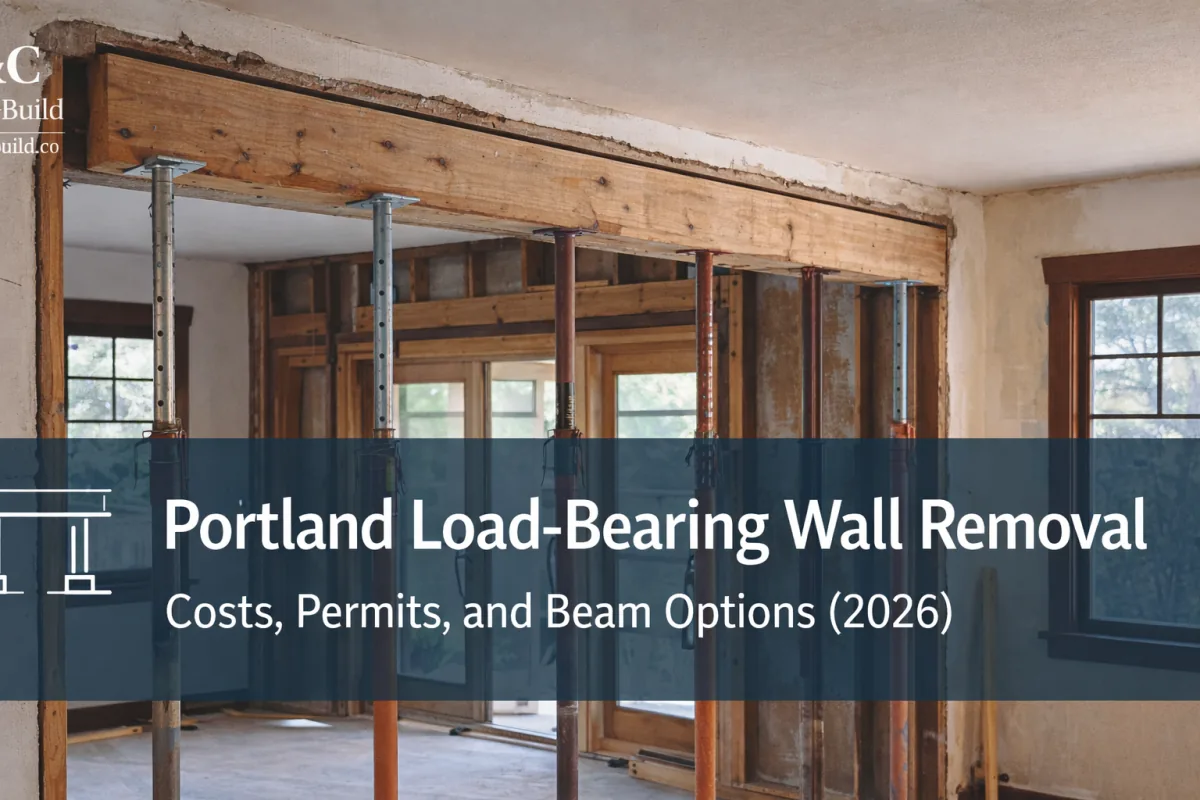
You want to open up your kitchen. The wall between the kitchen and living room has been there since your bungalow was built. It chops the main floor into small, disconnected rooms.
Before you grab a sledgehammer, you need to know one thing: is that wall holding up the floor above?
Load-bearing wall removal in Portland is one of the most common structural remodels we handle. Portland's older homes were built with central bearing walls that modern open layouts don't need. Here's what it costs, what Portland requires, and how the process works.
Why Portland Homes Have So Many Bearing Walls
Portland's housing stock drives demand for this work. Much of the city's housing stock predates modern open-concept framing methods. Craftsman bungalows, Foursquares (opens in new tab), and postwar ranch homes share one structural trait: central load-bearing walls.
These homes use dimensional lumber joists that span 10 to 20 feet. That's not enough to cross a full house width of 24 to 30 feet. Builders solved this with an interior bearing wall at the midpoint. Floor joists from each side overlap on top of that wall and transfer load down to the foundation.
Modern homes use engineered trusses and LVL beams that span 30 feet or more without interior support. Older Portland homes don't have that option. The wall between your kitchen and dining room in a 1920s Craftsman is almost certainly structural.
How to Tell If a Wall Is Load-Bearing
A few indicators help you screen before calling an engineer.
Joist direction is the strongest clue. Check how floor or ceiling joists run at the wall. If joists run perpendicular and bear on top, the wall is almost certainly structural. Joists running parallel suggest a partition, but don't guarantee it.
Location matters. Interior walls near the center of the house, running parallel to the ridge line, frequently carry loads. Walls that stack directly above one another on multiple stories are strong candidates.
Check below. If there's a beam, footing, or foundation wall directly beneath the wall in question, it's transferring structural load downward.
Don't trust the knock test. Tapping a wall tells you nothing about structural function. Both bearing and partition walls can sound hollow or solid.
The only definitive answer comes from a structural engineer. They review framing, load paths, and foundation conditions before confirming.
Portland Permit Requirements
Portland requires a building permit (opens in new tab) for moving, removing, or adding walls. There is no separate "structural permit." The structural review is part of the standard building permit process.
Stamped Engineering Drawings
Portland's structural plan review (opens in new tab) requires construction documents stamped by a design professional registered in Oregon. Oregon law exempts single-family residential work from mandatory engineering registration under ORS 672.060 (opens in new tab). But in practice, load-bearing wall removal exceeds prescriptive code tables. Portland reviewers will require engineered beam calculations and a professional stamp.
Plan on hiring a licensed structural engineer. HomeAdvisor's 2025 cost guide (opens in new tab) shows a national structural engineer average of $500, with typical ranges from $350 to $800 before any Portland market adjustment.
Fees and Timeline
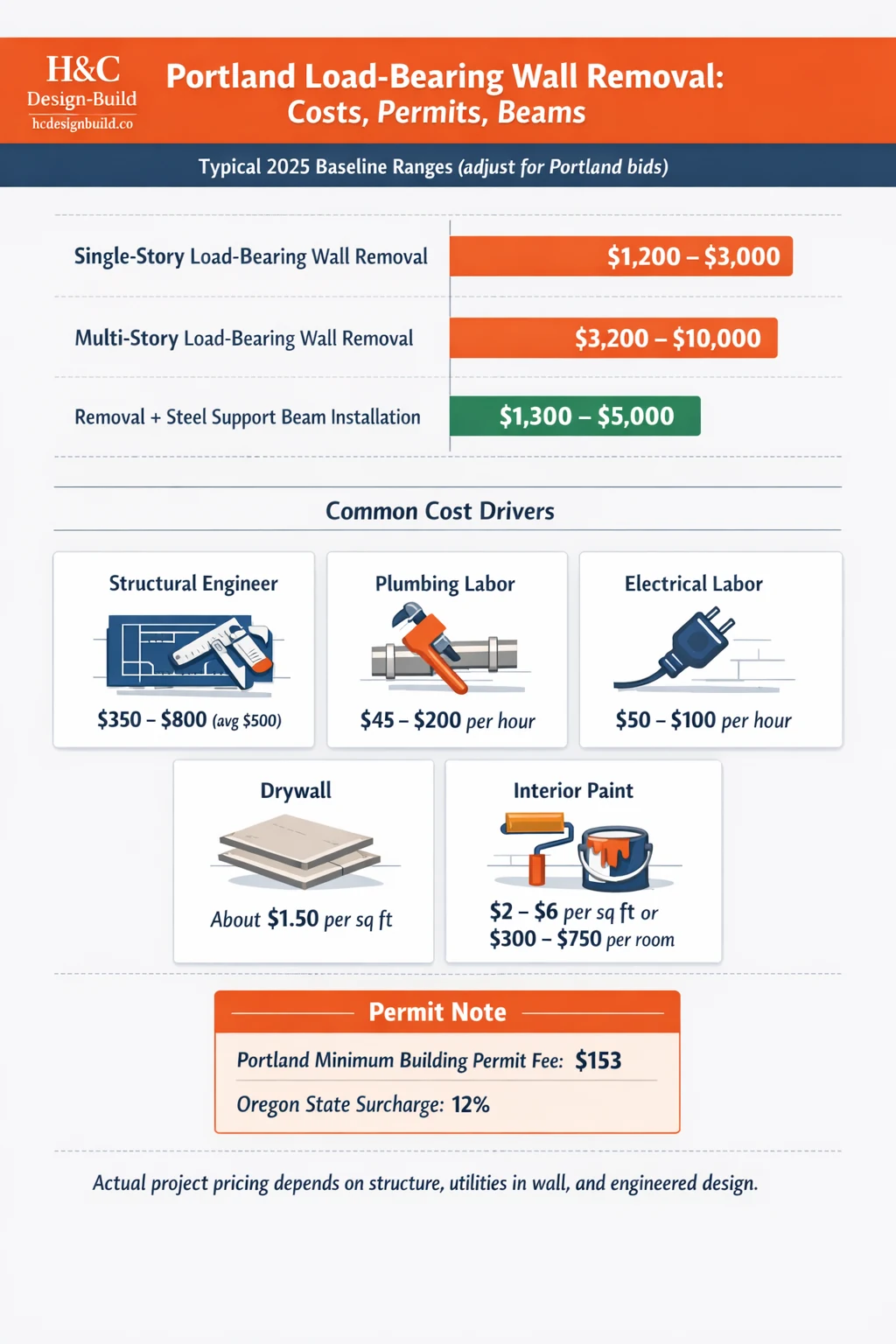
Permit fees scale with project valuation. The minimum building permit fee is $153 as of the July 2025 fee schedule (opens in new tab), plus a 12% Oregon state surcharge. Most wall removal projects land well above the minimum. Use Portland's permit cost estimator (opens in new tab) for your specific scope.
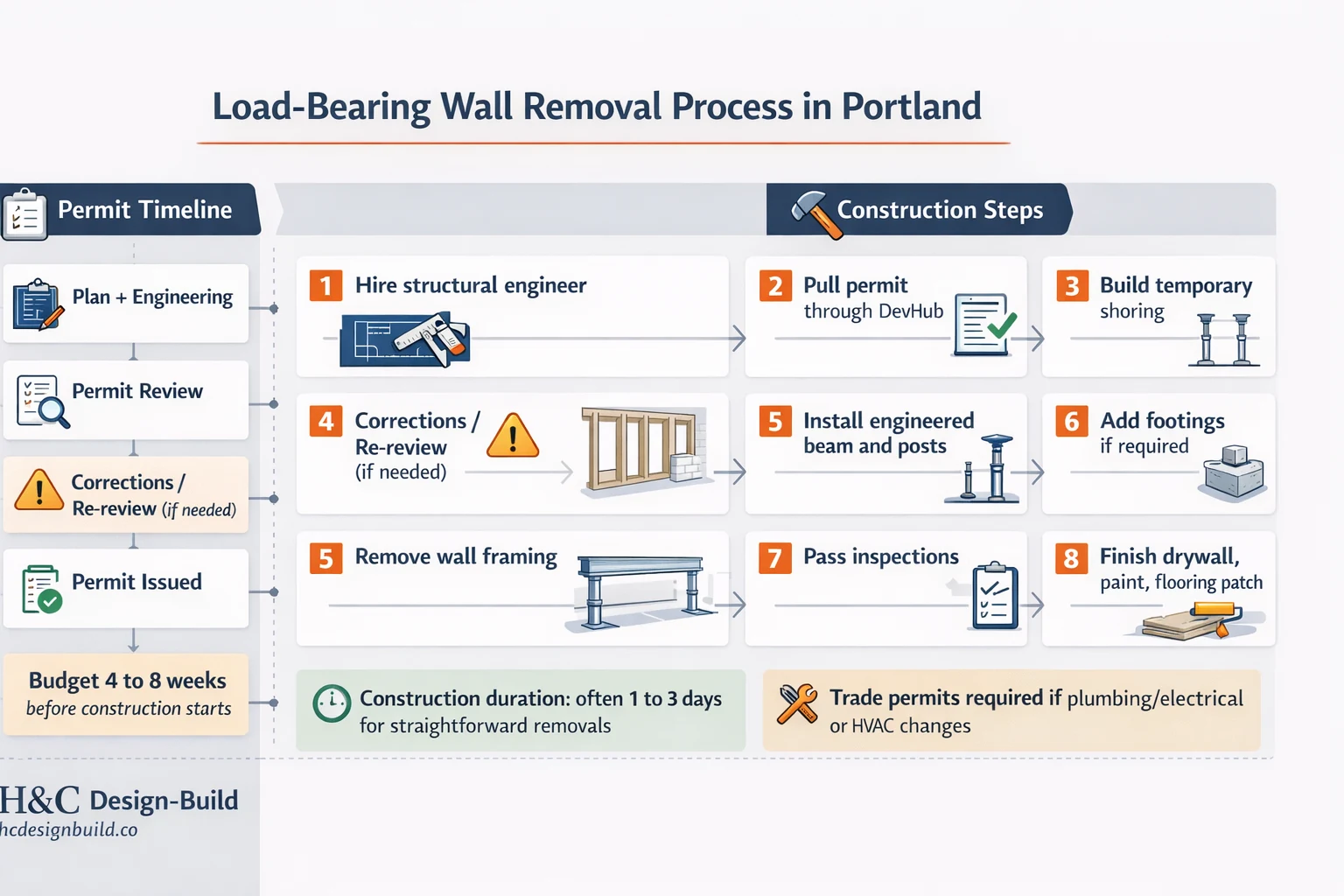
Portland's structural review goal is seven working days. Re-reviews after corrections target three to five days. Check the permit timeline dashboard (opens in new tab) for current processing times. Budget four to eight weeks from application to permit in hand.
If the project involves electrical, plumbing, or HVAC rerouting, separate trade permits are required. For a full breakdown of the process, see our Portland building permits guide.
Inspections
Portland requires multiple inspections (opens in new tab) during construction. A straightforward wall removal needs three to four: framing, insulation, final building, and final permit closure. Add trade inspections if electrical, plumbing, or mechanical work is involved.
All rough trade inspections must pass before the framing inspection can occur.
Load-Bearing Wall Removal Costs in Portland
Cost depends on three factors: the number of stories, what's inside the wall, and the beam type your engineer specifies. HomeAdvisor's 2025 load-bearing wall dataset (opens in new tab) shows a broad national range of $1,000 to $10,000, with an average around $3,000. In our Portland projects, most single-story removals with an LVL beam land between $2,500 and $5,000. Multi-story work with steel beams runs $6,000 to $12,000.
| Project Scope | Typical Cost Range | | -------------------------------------------- | ------------------ | | Single-story load-bearing wall removal | $1,200 to $3,000 | | Multi-story load-bearing wall removal | $3,200 to $10,000 | | Removal plus steel support beam installation | $1,300 to $5,000 |
Ranges from HomeAdvisor's 2025 cost guide (opens in new tab). Use them as a baseline, then adjust for Portland bids and your engineer's design.
Where the Money Goes
A typical project breaks down like this:
- Structural engineer: $350 to $800 (opens in new tab) is a common national range, with a $500 average
- Building permit: $200 to $500+ depending on valuation (fee schedules (opens in new tab))
- Plumbing labor if stacks or drains are in the wall: $45 to $200 per hour (opens in new tab)
- Electrical labor for reroutes: $50 to $100 per hour (opens in new tab)
- Drywall and paint blending: Drywall around $1.50 per square foot (opens in new tab), plus interior paint at $2 to $6 per square foot or $300 to $750 per room (opens in new tab)
- Beam-related labor and installation scope: A steel-beam-supported removal commonly lands around $1,300 to $5,000 (opens in new tab)
Walls with major plumbing and electrical runs usually cost more because of access, rerouting, patching, and repeat inspections.
Beam Options
When the wall comes out, a beam goes in. Your structural engineer specifies the type and size based on span, load, and depth constraints.
LVL (laminated veneer lumber) is the default for most residential work. Two or more LVL plies bolted together handle spans up to roughly 16 to 18 feet. Weyerhaeuser's Microllam (opens in new tab) is the most common brand. LVL is lightweight and cuts with standard framing tools.
Steel I-beams are necessary for longer spans or heavy loads. Steel carries the same load at a shallower depth than wood. That matters when you want a flush ceiling. Steel needs specialized cutting and lifting equipment.
Glulam is the aesthetic option. These beams are often left exposed as an architectural feature. Glulam handles medium to long spans well.
When a design requires steel support, HomeAdvisor's 2025 data (opens in new tab) places wall removal plus steel beam installation in a $1,300 to $5,000 national range.
For most Portland wall removals in single-story Craftsman homes, a doubled or tripled LVL beam is the practical choice.
What Can Complicate the Project
Plumbing in the Wall
The biggest cost surprise is plumbing in the wall. If your wall contains the main waste/vent stack, that 3 to 4 inch pipe runs vertically from the basement through the roof.
Relocating it means rerouting drains on every floor it serves. Some homeowners keep the stack in a boxed-out chase or column instead. Others reroute, with plumber labor often billed at $45 to $200 per hour (opens in new tab).
Electrical Wiring
Most bearing walls contain at least one or two circuits. Electrician labor commonly runs $50 to $100 per hour (opens in new tab) for rerouting and reconnection. If the electrical panel is on the wall, relocation costs jump significantly.
Point Loads and Foundation Work
This is the detail homeowners overlook most often. A bearing wall distributes weight evenly along its full length. Replace it with a beam on two posts, and those posts concentrate the same total load into two small points.
A standard 4-inch basement slab was not designed for concentrated loads. Your engineer checks whether the existing foundation can handle it. If not, new spread footings get poured beneath each post. That means saw-cutting the slab, excavating, and pouring reinforced concrete pads.
In crawl space homes, new concrete piers may be needed.
HVAC Ducts
Supply and return ducts often run through interior wall cavities to serve upper floors. Rerouting through soffits or adjacent walls adds labor, finish work, and coordination across trades.
The Process from Start to Finish
1. Hire a structural engineer. They assess the wall, calculate loads, and produce stamped drawings. 2. Pull your permit. Submit plans through Portland's DevHub portal. Wait for structural plan review. 3. Build temporary shoring. Before any framing is cut, the contractor erects temporary support walls or adjustable shoring posts to carry the load above. 4. Remove the wall. Strip drywall, pull studs and top plate. 5. Install the beam. Set the permanent beam on its posts with engineered connection hardware. 6. Pour footings if needed. New pads beneath posts when the engineer requires them. 7. Pass inspections. Framing, insulation, and final building inspections. 8. Finish. Patch drywall, match texture, paint, and repair flooring.
Your contractor must hold an active Oregon CCB license (opens in new tab). For multi-trade structural work, a Residential General Contractor endorsement is the appropriate license type.
Making the Decision
Start by confirming the wall is actually load-bearing. An engineer's assessment is the only reliable way to know. The scope from there depends on what's inside the wall and what's underneath it.
A single-story removal with an LVL beam is one of the highest-impact remodels you can do in a Portland Craftsman or ranch home. It transforms how the main floor functions. Combined with a kitchen remodel, it's the upgrade that changes daily use of the home most.
If the wall removal is part of a larger project to add square footage, our Portland home addition cost guide covers planning, permits, and budgeting for the full scope.
Get three bids from licensed Portland contractors. Compare scope and engineering approach first, then price.
Need help planning a wall removal? Contact H&C Design-Build for a project assessment. We'll evaluate the wall, explain what's involved, and give you honest numbers for your situation.