You have a yard, a sliding door that leads nowhere useful, and a vision for what that space could become. Maybe it's a place to grill, a spot for morning coffee, or extra living space for half the year.
Portland's climate will shape every choice you make. Long rainy seasons, moss on every north-facing surface, and a building code with strict footing requirements. If you're also considering how to expand usable space below grade, our basement finishing guide covers that approach. Here's what building a deck involves.
Do You Need a Permit?
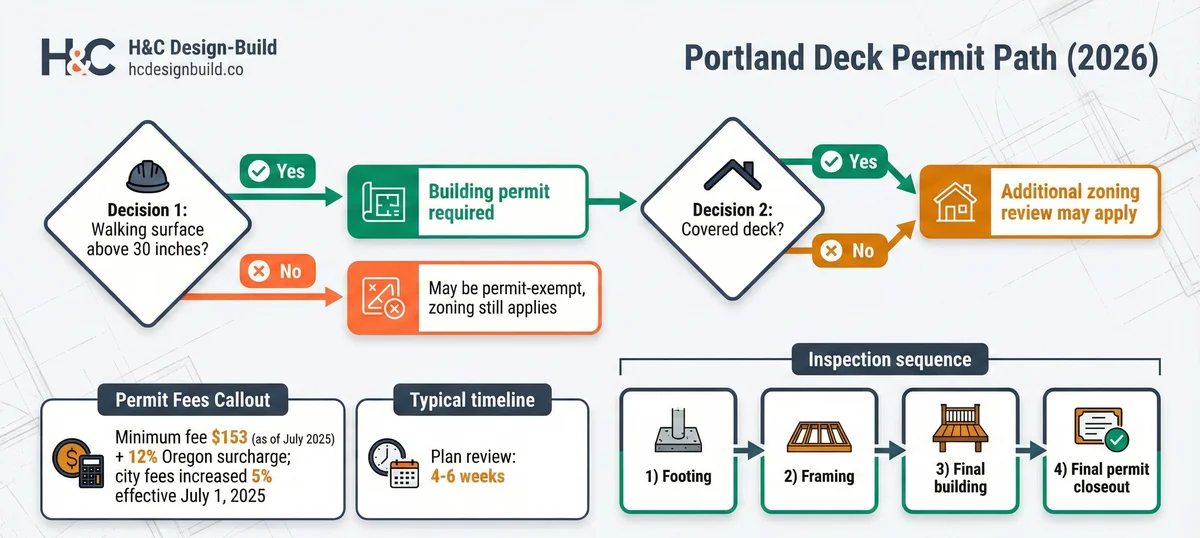
Portland uses a simple rule. If your deck's walking surface is more than 30 inches above the ground, you need a building permit (opens in new tab). Height is measured from the adjacent grade to the top of the walking surface, taken 36 inches from the deck's perimeter.
Decks at or below 30 inches are exempt from building permits. But zoning rules still apply. Setbacks, lot coverage limits, and overlay zone restrictions don't go away just because the deck is low.
Covered decks trigger additional zoning requirements regardless of height.
What the Permit Costs
Fees are based on project valuation, calculated using ICC Building Valuation Data at 50% of the cost per square foot. As of July 2025, the minimum fee is $153 (opens in new tab). Building permits also include a 12% State of Oregon surcharge. Fees increased 5% (opens in new tab) effective July 1, 2025.
What You'll Submit
Portland requires three sets of drawings:
- Site plan: Property layout showing the deck location, distances to lot lines, and existing structures. Drawn to scale.
- Structural plans: Framing details, joist spacing, beam sizes, post locations, and footing specs. You can use Portland's Deck Design Guide permit-ready plans (opens in new tab) for simple single-level, attached, rectangular wood decks.
- Elevation drawing: Shows how high the deck sits above grade, ground slope, guardrail details, and nearby windows and doors.
Plan review typically takes 4 to 6 weeks (opens in new tab). Complex projects can run longer. Submit through DevHub (opens in new tab) or in person at the Development Services Center. For a full walkthrough of the permit process, see our Portland building permits guide.
Inspections
Expect these inspection steps:
1. Footing inspection (before pouring concrete) 2. Framing inspection (before covering structural work) 3. Final building inspection 4. Final permit inspection (closes the permit)
Don't cover any work before it's inspected. Schedule inspections through DevHub or by calling the city inspection line.
Choosing Materials for Portland Rain
Portland's wet season runs from fall through spring. Moss and algae grow on shaded surfaces. Your decking material must handle constant moisture, wet-dry swings, and long stretches of shade.
Material Comparison
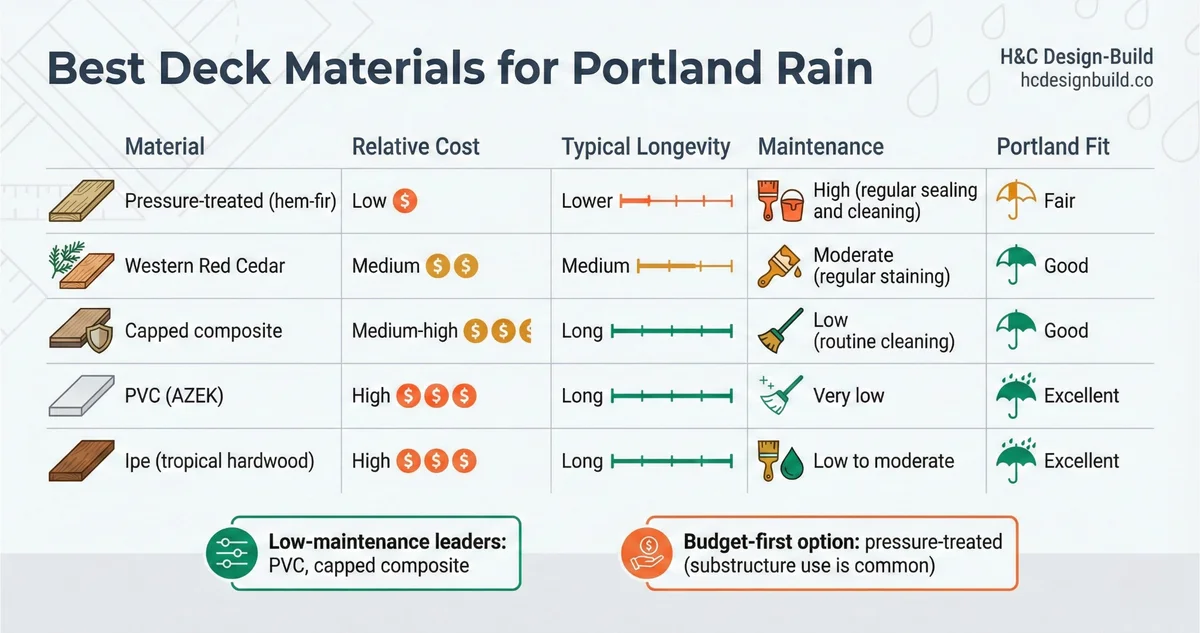
| Material | Relative Cost | Typical Longevity | Maintenance | Portland Fit | | -------------------------- | ------------- | ----------------- | ----------------------------------- | ------------ | | Pressure-treated (hem-fir) | Low | Lower | High (regular sealing and cleaning) | Fair | | Western Red Cedar | Medium | Medium | Moderate (regular staining) | Good | | Capped composite | Medium-high | Long | Low (routine cleaning) | Good | | PVC (AZEK) | High | Long | Very low | Excellent | | Ipe (tropical hardwood) | High | Long | Low to moderate | Excellent |
Pressure-Treated Lumber
The cheapest option, but there's a catch specific to the Pacific Northwest. Many local yards stock hem-fir pressure-treated lumber, which tends to be less durable in wet service than higher-performance decking materials.
Warranty coverage varies by treater and product line. Ask your supplier for written warranty terms and approved-use limits before you buy.
Pressure-treated lumber still makes sense for substructure (joists, beams) where it's protected by the deck surface above. For the walking surface, consider something better.
Western Red Cedar
Cedar is the local choice. It grows in the Pacific Northwest and is stocked at most lumber yards. Its natural thujaplicin oils (opens in new tab) resist rot without chemical treatment.
Specify heartwood for decking. Sapwood doesn't have the same resistance. Custom Knotty is the most popular grade for residential decks.
Left unfinished, cedar weathers to silver-gray. In Portland's variable moisture and sun, that weathering can be uneven. If you want even color, plan for regular staining.
Capped Composite
Composite decking (Trex, TimberTech, Fiberon) combines recycled wood fibers and plastic. The "capped" part matters: a polymer shell wraps all four sides, sealing the wood-fiber core from moisture.
In Portland, only buy capped composite. Uncapped boards expose the wood-fiber core directly to rain, which can lead to moisture damage and persistent mold issues.
Even capped boards grow surface mold and algae in Portland's shade. The mold usually stays on the surface, but it still creates a slip hazard. Mineral-based composites contain no wood fibers and generally resist that growth better.
Warranty terms vary by product line. Review the current terms from Trex (opens in new tab), TimberTech (opens in new tab), and Fiberon (opens in new tab) before you choose.
PVC Decking
PVC (AZEK is the market leader) contains no wood fiber. That leaves less organic material for mold growth. PVC boards also absorb very little water, which helps reduce swelling, warping, and rot.
It's one of the strongest options for Portland's wet climate. Heat performance varies by board color and manufacturer, but moisture durability is usually the bigger concern here.
The downside is cost. PVC sits at the top of the price range alongside tropical hardwoods.
A Note on Substructure
Your decking surface gets all the attention, but the framing underneath is where hidden rot starts. Steel deck framing is immune to rot and insects. It usually costs more upfront than wood framing, but it can reduce long-term maintenance risk on decks expected to stay in service for decades.
What a Portland Deck Costs
Deck cost is driven by size, elevation, material, site access, railing complexity, and stair count. Use the framework below to set a planning budget, then validate scope and pricing with itemized bids.
Budget Framework by Scope
| Scope | Typical Features | Budget Direction | | ------------- | ------------------------------------------------------ | -------------------- | | Compact | Simple layout, basic railing, limited stairs | Lower total cost | | Mid-size | Standard layout, upgraded finish choices | Mid-range total cost | | Large/Premium | Multi-level layouts, premium finishes, complex details | Higher total cost |
Common Add-Ons
- Railings: Cable and glass options usually cost more than basic wood or composite rails.
- Stairs: Every additional stair run adds framing, finish work, and labor time.
- Old deck removal: Demolition and disposal can add meaningful cost before new work starts.
- Covered roof structure: Adding a roof changes structural scope and permit complexity.
- Built-in lighting: Low-voltage lighting adds planning, wiring coordination, and fixture costs.
Seasonal Pricing
Spring and summer are peak deck seasons. If you can start permitting in fall or winter and build in early spring, you can often get better contractor availability and smoother scheduling.
Return on Investment
In the 2025 Cost vs. Value Report (opens in new tab), deck additions are among the strongest exterior projects for resale.
The 2025 Cost vs. Value Report (opens in new tab) shows wood deck additions returning roughly 95% of cost nationally.
The same report puts composite deck additions at about 89% nationally.
The trade-off: Wood costs less upfront and can return well at resale, but it needs regular upkeep. Composite costs more upfront and lowers maintenance over time. If you plan to sell soon, wood can be a better short-term choice. If you plan to stay, composite often wins on maintenance burden. For comparison, kitchen remodels often return less than deck projects. For the bigger picture on covered patios, hardscaping, and year-round outdoor spaces, see our outdoor living guide.
Portland Zoning Rules
Zoning requirements vary by your base zone (R5, R7, R10, etc.). Look up your property on PortlandMaps.com (opens in new tab) before designing anything.
Rules that affect deck projects:
- Setbacks: Decks at or below 30 inches above grade can often use more of the lot. Overlays, easements, and site constraints can still limit placement. Taller decks must follow front, side, and rear setback requirements for your zone. Specific distances are in Table 110-4 of Chapter 33.110 (opens in new tab).
- Building coverage: Decks count as structures. Your total building footprint (house plus all structures) cannot exceed the maximum percentage for your zone, set in Table 110-5.
- Stormwater: Adding 1,000 or more square feet of impervious surface (opens in new tab) triggers stormwater management requirements. Solid-surface or covered decks count. Open-grate wood decks that allow water through may be treated differently.
- Historic districts: Properties with historic designations may need additional design review.
- Overlay zones: Environmental, greenway, and river overlay zones may require zoning permits beyond the building permit.
Portland offers free 15-minute consultations (opens in new tab) for zoning questions. Use them.
Planning Your Build
Code Requirements to Know
The 2023 Oregon Residential Specialty Code (opens in new tab) (ORSC Section R507) governs deck construction. Portland's permit-ready deck plans (opens in new tab) show city-accepted details.
Requirements to plan for:
- Footings: Footing depth and size are set during plan review based on design and soil conditions. Use city permit-ready deck plans (opens in new tab) as your starting standard.
- Guards: Guards are required on higher decks and must meet code height and opening limits. City permit-ready deck plans (opens in new tab) show accepted details.
- Ledger boards: Attach the ledger to structural framing per approved details and install proper flashing above and behind the ledger. Skipping flashing is one of the fastest ways to cause hidden rim-joist rot.
- Stairs: Stair geometry and handrail requirements must follow code limits. City permit-ready deck plans (opens in new tab) show accepted details.
- Fasteners: All hardware must be hot-dipped galvanized or stainless steel. Pressure-treated lumber's copper content corrodes standard fasteners.
What Goes Wrong
The most common deck failures in Portland:
- Skipped ledger flashing. Water runs behind the ledger board and rots the house rim joist. This is the single most expensive deck repair.
- Uncapped composite in shade. The wood-fiber core absorbs moisture and grows mold from the inside out.
- Hem-fir decking surface. Poor preservative penetration leads to early rot, especially in board ends and fastener holes.
- No slope for drainage. Deck surfaces should slope away from the house so water drains instead of pooling.
- Ignoring moss and algae. Portland decks need regular cleaning, and shaded decks often need more frequent cleaning. Buildup traps moisture and creates slip hazards.
Best Time to Start
Submit permits in fall or winter when review queues are shorter. Plan for a spring build when ground conditions allow footing work. This also avoids the summer labor premium.
Call Oregon 811 (opens in new tab) before any digging. It's free and required by law.
Making the Decision
Deck projects can approach payback in some Portland markets, but results vary by neighborhood and home condition. The material choice depends on your budget, maintenance tolerance, and how long you plan to stay.
Start by looking up your property on PortlandMaps.com to confirm zoning constraints. Get at least three contractor bids. Ask each one what they'd use for substructure material and how they handle ledger flashing. Their answers tell you a lot.
Need help planning your deck project? Contact H&C Design-Build for a project assessment. We'll walk your site, review your zoning constraints, and give you a realistic scope and budget.