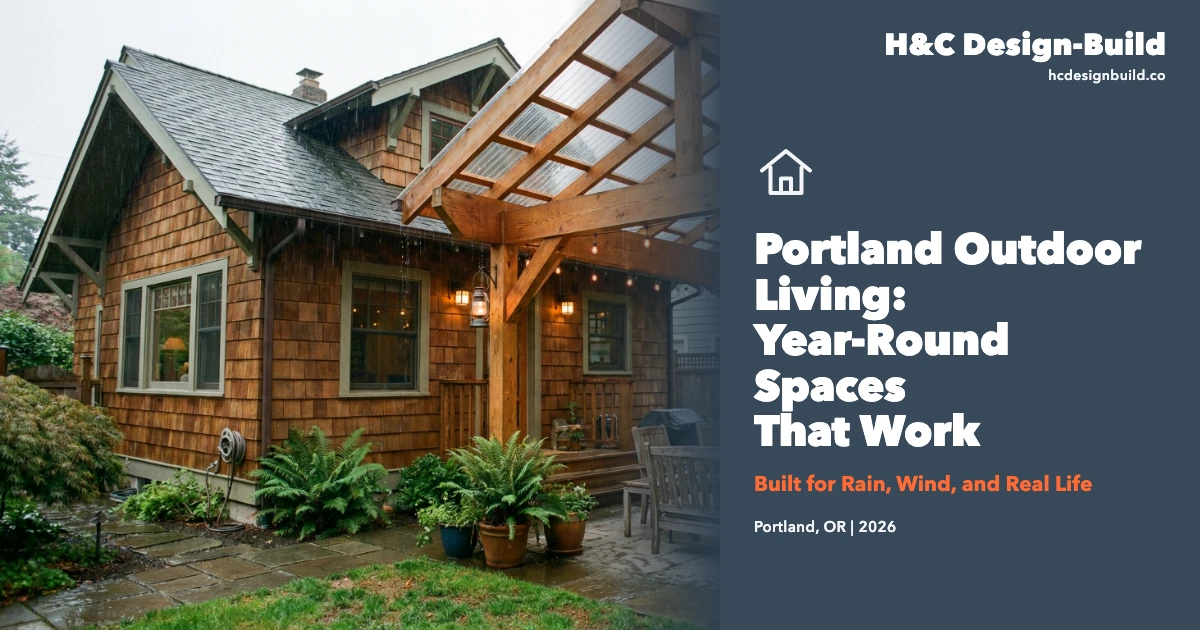
Most outdoor projects in Portland fail for one simple reason. They are designed for July, not November.
If you want outdoor living spaces Portland weather will not shut down by fall, start with performance before style. That means cover, drainage, wind control, and layout that respects permit and zoning limits. Then add the fun parts.
This guide walks through what actually works here, what triggers permits, and how to phase the project so you do not pay twice.
Code and guidance references in this article are current as of February 26, 2026.
This article is for educational purposes only and is not legal advice. Confirm current requirements with Portland Permitting & Development.
Outdoor Living Spaces Portland Homes Can Use Year-Round
Year-round use in Portland means your space works from October through April, not just during two dry summer months.
Portland's 30-year climate normals (opens in new tab) show the same pattern Portland homeowners feel every year: wetter fall and winter months, with much drier midsummer conditions. Design choices that feel optional in drier climates are mandatory here.
Start with these three priorities:
- Dry zone coverage: A roofed or protected area where seating and cooking can stay functional in rain.
- Water movement: Surface slope, collection points, and runoff routing so water leaves the space quickly.
- Wind management: Screen walls, planting, or panel systems that reduce crosswind in shoulder seasons.
When homeowners skip one of these, the space becomes storage by November.
Start With the Shell: Cover, Drainage, and Wind Protection
The shell is the part that makes every other dollar work harder.
A high-end grill does not matter if the cooking zone is exposed to rain. Premium pavers do not matter if drainage leaves standing water at the door. Solve the shell first.
Covered Patio vs Pergola in Portland
A pergola and a covered patio are not interchangeable in this climate.
| Option | What It Does Well | Trade-Off | Portland Reality | | ----------------------------------- | ------------------------------------------------ | --------------------------------------------- | ------------------------------------------ | | Covered patio (solid roof) | True rain protection, better shoulder-season use | Higher structural scope and permit complexity | Best all-around choice for year-round use | | Pergola (open top) | Shade and visual structure | Limited rain protection | Better as a summer feature unless upgraded | | Pergola with louver or panel system | Flexible light and weather control | Higher equipment cost and maintenance | Works when budget supports system upkeep |
If your goal is consistent use in wet months, prioritize the covered patio.
Drainage Is Not Optional
Outdoor rooms fail fast when drainage is treated as a finish detail.
At minimum:
- Slope hardscape away from the house.
- Plan where roof water lands.
- Keep splash and overflow away from foundations and walkways.
- Coordinate drainage with any new impervious area before final layout.
Portland manages stormwater under City Code Chapter 17.38 (opens in new tab), and BES guidance points to the current Stormwater Management Manual effective March 1, 2025 (opens in new tab). If your project changes runoff behavior, check requirements early.
Plan Wind Protection Early
Wind screens, partial walls, and planting belts should be designed with the structure, not bolted on after final inspection. Retrofits usually look worse, cost more, and create awkward transitions.
Permit Triggers to Check Before Design Lock
You can avoid major redesign cycles by checking thresholds before drawings are finalized.
Portland's Brochure 3 for residential outdoor projects (opens in new tab) is the fastest starting point for common permit triggers.
Key thresholds to know:
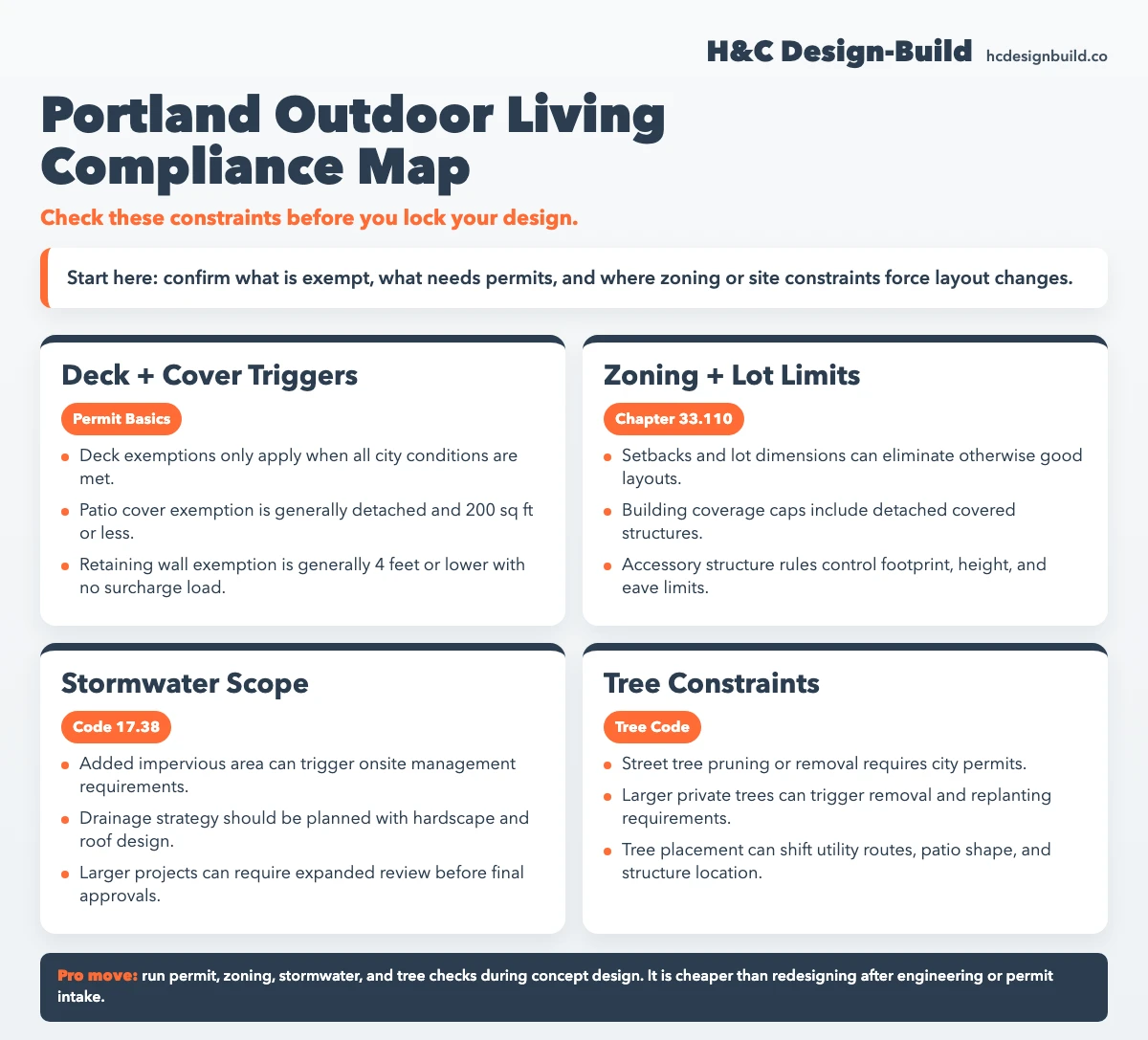
- Deck exemption: No building permit only if all listed exemption conditions are met, including height, area, attachment, use, and setback/easement criteria.
- Porch or patio cover exemption: Generally no permit only if detached and 200 sq ft or less.
- Retaining wall exemption: Generally no permit if 4 feet or lower (measured from bottom of footing to top of wall) and specific surcharge/liquid conditions are not present.
The practical rule: if you are close to a limit, treat it as permit-required until staff confirms otherwise.
For broader workflow and permit sequencing, use our Portland building permits guide.
Zoning Limits That Change Layout Options
Many outdoor designs fail zoning long before they fail construction.
Portland's Chapter 33.110 single-dwelling code (opens in new tab) controls what can fit on your lot. The sections that most often affect outdoor living projects are:
- 33.110.220: Minimum setbacks
- 33.110.225: Building coverage and paved area limits
- 33.110.245: Accessory structures
- Table 110-5: Maximum building coverage by zone and lot size
Why this matters:
- A beautiful concept can die if total footprint exceeds coverage limits.
- Detached covered structures can use reduced setbacks only under strict size and eave rules.
- The same design can be legal on one lot and illegal next door because zoning or lot dimensions differ.
Check zoning early on PortlandMaps (opens in new tab) before paying for full design development.
Stormwater and Tree Rules That Commonly Surprise Homeowners
Two issues drive late-stage redesign more than anything else in Portland outdoor projects: stormwater and trees.
Stormwater Scope Can Expand With Impervious Area
Portland's regulatory framework for onsite management is in 17.38.040 (opens in new tab). In transportation right-of-way guidance, PBOT also flags expanded stormwater review context when projects exceed 1,000 sq ft of impervious area (opens in new tab).
You do not need to memorize every path through the code. You do need to ask the stormwater question before finalizing the plan set.
Tree Constraints Can Dictate the Entire Plan
Portland tree rules are not a minor detail.
- Street tree work is regulated through Tree Code Chapter 11.50 (opens in new tab).
- Private tree removal and replanting permits can be triggered for larger trees, including a common 12-inch DBH threshold on private property (opens in new tab), subject to exemptions and site context.
The result: your best patio location on paper may conflict with root zones, permit constraints, or utility routing. Tree review should happen before you lock orientation and hardscape extents.
Features That Earn Their Keep in Portland
After shell, zoning, and compliance checks, choose features by off-season value.
1) Covered Dining Zone
If the space cannot host a meal in drizzle, it will not get consistent use. Keep this zone dry first, then improve comfort with lighting and heat.
2) Simple, Durable Cooking Setup
Full outdoor kitchens look good in photos. Many underperform in real use because they are overbuilt and underprotected.
A smarter sequence:
- Start with a protected grill zone, prep surface, and power.
- Add plumbing and premium appliances after one season of actual use.
3) Practical Heat Strategy
Heat should match the enclosure level.
- Open areas need directed heat and wind mitigation.
- Semi-enclosed areas can support more efficient, localized comfort.
- Fire elements add atmosphere but should be planned around current open burning and fire safety rules (opens in new tab), which can change seasonally.
4) Materials That Handle Wet Service
In Portland, low-maintenance exterior materials are not just a style trend. They reduce long-term failure points.
Homeowner demand for patios and usable outdoor space has been climbing for years. We've seen it firsthand: outdoor living consultations made up about a quarter of our project inquiries last spring.
Use materials based on actual exposure, not showroom appearance:
- High splash zones: prioritize moisture-stable surfaces.
- Shaded zones: plan cleaning access where algae buildup is likely.
- Heavy-traffic paths: choose slip-resistant textures over smooth finishes.
A Two-Phase Build Plan That Controls Budget Risk
If budget is limited, phase the work around infrastructure.
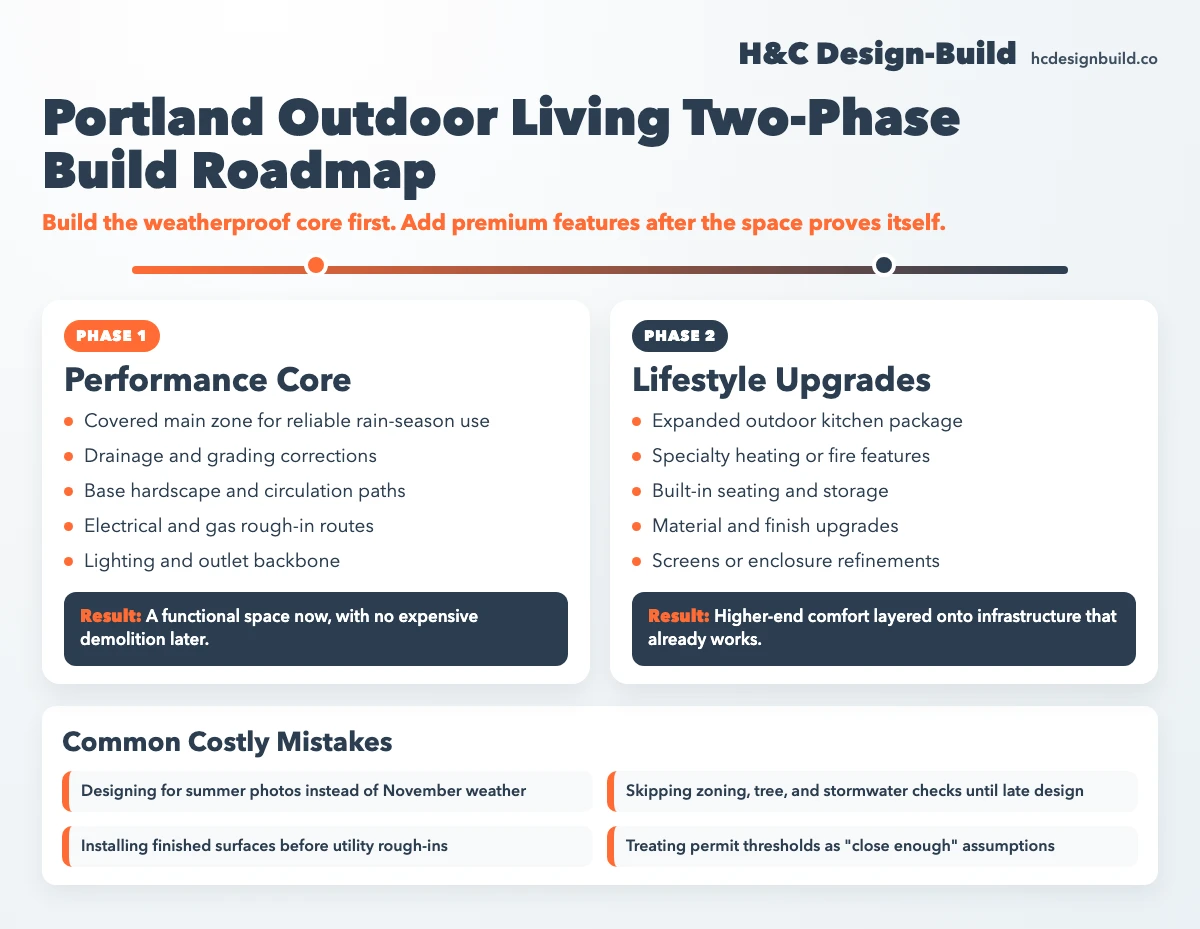
Phase 1: Build the performance core
- Roofed or weather-protected main zone
- Drainage and grading corrections
- Base hardscape
- Electrical and gas rough-in pathways
- Lighting and outlet backbone
This phase creates a functional space that works now.
Phase 2: Add lifestyle upgrades
- Expanded kitchen package
- Specialty heating or fire features
- Built-in seating and storage
- Decorative material upgrades
- Screen systems or enclosure refinements
Phasing this way prevents expensive rework. You are not tearing up finished surfaces to run utilities later.
Common Portland Mistakes and How to Avoid Them
Mistake 1: Designing for dry-season photos
Fix: test every major decision against November use.
Mistake 2: Treating permit thresholds as "close enough"
Fix: verify early using Brochure 3 (opens in new tab) and confirm edge cases with the city.
Mistake 3: Ignoring coverage and setbacks until late design
Fix: run zoning checks first using Chapter 33.110 (opens in new tab) and PortlandMaps.
Mistake 4: Locking layout before stormwater and tree review
Fix: address stormwater scope (opens in new tab) and tree constraints at concept stage.
Mistake 5: Building everything at once without utility planning
Fix: rough in for future upgrades during phase one.
When to Bring in Design-Build
If your project includes a covered structure, hardscape changes, utilities, and tree or stormwater constraints, design-build usually reduces risk.
You get one team coordinating design intent, permit strategy, and construction sequencing. That keeps surprises from cascading late in the process.
For deck-specific guidance, start with our Portland deck building guide. If you are also planning interior updates, our Portland home design trends 2026 guide can help coordinate finishes and style direction.
When you're ready to scope your own project, contact H&C Design-Build. We will walk the site, confirm constraints, and map a build plan that works in real Portland weather.