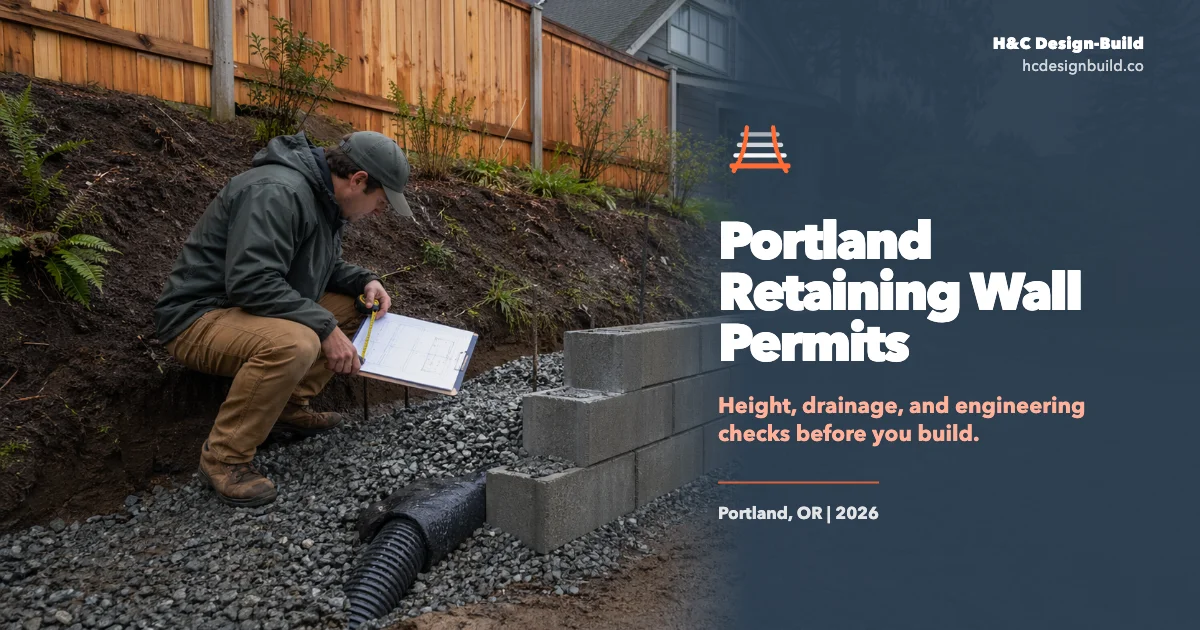
If you are planning a retaining wall in Portland, measure the wall before you price the blocks.
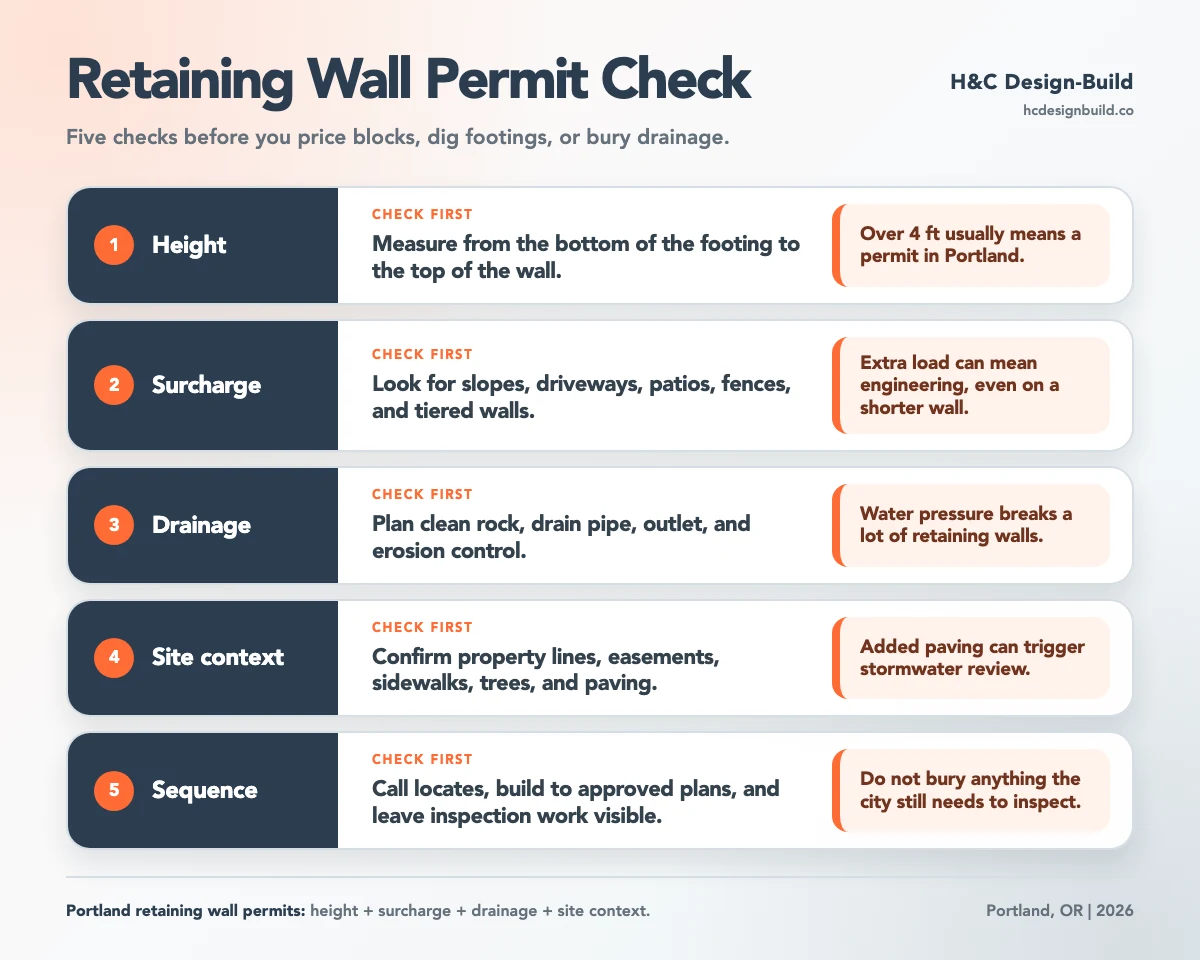
Portland retaining wall permit rules do not use the finished face height you see from the yard. The city measures from the bottom of the footing to the top of the wall. A wall that looks modest after backfill can still cross the permit line once the buried footing is counted.
That detail catches homeowners. So does surcharge: the extra load behind the wall from a slope, driveway, building, patio, or other structure.
The hard part is not always stacking block. The hard part is knowing what the wall is really holding back.
When height or load changes, the job changes with it.
Portland retaining wall permit rules
Portland says a building permit is required for a retaining wall (opens in new tab) when the wall is more than 4 feet high. The city measures from the bottom of the footing to the top of the wall. A permit is also required when the wall supports a surcharge.
The city's Brochure 3 outdoor project guide (opens in new tab) says retaining walls over 4 feet need a building permit and inspection. Walls affected by an adjacent slope or structure can need one too. The guide also gives a useful slope trigger: an ascending slope away from the wall steeper than 3 horizontal to 1 vertical can affect the wall.
Our field rule is simple:
- A short decorative wall holding a flat planting bed may stay simple.
- A wall holding a driveway, patio, building footing, or steep yard is structural.
- A wall near a property line or sidewalk needs more planning than a wall in the middle of a yard.
- A wall that changes drainage should be planned with the water path first.
If you are close to the permit line, assume you need to check with the city before work starts. Guessing wrong on a retaining wall is expensive because the correction usually means excavation, not a small patch.
Height is measured from the footing, not the lawn
This is usually the first surprise.
You may see 3 feet of block above grade. The city is looking at the structural wall height, from the bottom of the footing to the top of the wall. If the footing is buried below the finished grade, the measured height can be higher than what you see after landscaping is done.
That matters during design. A wall that was meant to avoid a permit may still need one. The actual footing depth, grade change, and finished top elevation decide that.
Do not size the job from a photo or a rough tape measure against the exposed wall face. Before pricing, mark:
- low-side grade
- high-side grade
- expected footing depth
- top of wall
- nearby structures, driveways, patios, and fences
- where water will go after the wall is built
On a Southeast Portland driveway and slope correction project, the retaining walls were not the only scope. The driveway grade, concrete layout, soil movement, and drainage path all had to work together. That is normal here. The wall is one piece of the site, not a standalone product.
Surcharge is the word that changes the job
A surcharge is extra load behind the wall.
Homeowners often picture soil only. Contractors look for everything else pushing on that soil. A driveway adds load. A building footing adds load. A slope above the wall adds load. A heavy patio, hot tub pad, or stacked wall can add load too.
Portland's retaining wall code section (opens in new tab) says lateral pressure from surcharge loads must be added to the lateral earth pressure load. It also says lateral pressure must increase when soils are expansive or when the wall supports an ascending slope.
That language matters on site. It is the reason a short wall can still need an engineer.
The warning signs are easy to spot:
- the ground rises behind the wall
- the wall sits below a driveway or parking pad
- the wall is close to a house, garage, or accessory structure
- the wall carries a fence on top
- there are tiered walls instead of one wall
- the yard has heavy clay, poor drainage, or past movement
When those conditions show up, the wall design needs to answer real structural questions. What is pushing on the wall? What keeps the wall from sliding? What keeps it from rotating? What happens when the soil is saturated?
Those are engineering questions, not guesswork questions.
Drainage is part of the wall, not landscaping
In Portland, water is often what exposes a bad retaining wall.
Portland code says retaining walls must be designed to support full hydrostatic pressure from undrained backfill unless a drainage system is installed. In plain terms: if the water cannot get out from behind the wall, the wall has to resist that water pressure.
That is a bad way to build a residential wall if you can avoid it.
A wall that holds soil also interrupts water movement. Rain hits the slope, moves through backfill, and looks for the easiest path. If the backfill is wrong, the drain pipe is missing, the outlet is buried, or the wall has no weep path, water builds pressure behind the wall.
In Portland, design the drainage before choosing the block.
A good retaining wall plan should answer:
- What backfill goes behind the wall?
- Is there a perforated drain pipe?
- Where does that pipe discharge?
- Can the outlet stay clear over time?
- Will water move toward a foundation, crawl space, sidewalk, or neighbor?
- Does the wall need erosion control during construction?
This ties directly to H&C's drainage work. On a North Portland landscaping project, our crew removed excess material, regraded the side of the house, and directed water toward a drywell before finishing the surface work. That same thinking applies to retaining walls. Shape the water path first, then make the wall look finished.
What Portland wants in the permit package
For a residential retaining wall permit, Portland says you need a building permit application, a site plan, and engineering information. For walls over 4 feet tall, a State of Oregon registered engineer must provide stamped drawings and calculations.
The retaining wall permit page (opens in new tab) lists the site plan details the city may need. That can include property lines, easements, distances to buildings, wall placement, and proposed paving area. It also says that if the job adds more than 500 square feet of impervious area, you may need a mitigation form or stormwater plan.
That last point matters. A wall project often comes with a new patio, driveway change, concrete pad, stair run, or walkway. The wall may be the reason you called, but the permit review may care about the full site change.
A clean permit set should usually show:
- wall location and length
- measured wall height
- footing and reinforcement details
- drainage details
- backfill type
- nearby slopes and structures
- property lines and easements
- construction access
- erosion control
- any paving or hardscape added with the wall
Portland's broader building permit plan guidance (opens in new tab) is worth reading before you submit. Complete drawings reduce correction cycles. Thin drawings invite checksheets.
Right-of-way, property lines, and neighbors
The retaining wall itself needs to stay on your property. Portland specifically warns that the wall design should not result in the footing toe being placed off your property.
That sounds obvious until you are working in a tight side yard.
The footing can extend farther than the visible wall face. Excavation can need temporary access. Drainage discharge has to land somewhere appropriate. If the wall is close to a sidewalk, driveway apron, or street edge, Portland Transportation may review work in the public right-of-way.
Before you build near a property line, confirm:
- where the property line actually is
- whether there is an easement
- whether the footing fits fully on your lot
- whether the wall affects a sidewalk, curb, or driveway approach
- whether water discharge could create a neighbor issue
This is one of the reasons design-build helps on outdoor work. The wall, grading, drainage, access, and permit path need to be coordinated before equipment shows up.
Inspections and work sequencing
Once a retaining wall permit is issued, the city inspection card tells you which inspections are required and what work has to be ready.
The timing matters. You cannot cover work that still needs to be inspected. Depending on the approved plans, that may include footing, reinforcement, drainage, backfill, erosion control, or final inspection items.
Portland also says erosion control measures, and sometimes tree protection, must be installed, inspected, and approved before further ground-disturbing work starts after permit issuance.
That sequence affects the schedule:
1. Confirm wall scope, site constraints, and drainage. 2. Get utility locates. 3. Prepare drawings and engineering if needed. 4. Submit the permit. 5. Respond to checksheets. 6. Install erosion control after permit issuance when required. 7. Excavate and build to the approved plans. 8. Keep inspection points uncovered until approval. 9. Finish grading, drainage outlets, and surface work.
Oregon 811 says excavators should contact Oregon 811 within two full business days, but no more than 10 business days, before digging except for emergencies. Retaining walls mean excavation, so utility locate timing belongs in the plan.
When a small wall is fine, and when to call a pro
Some walls are basic landscape work. Others are structural site work.
A low garden wall may be reasonable when it:
- holds a shallow planting bed
- sits away from buildings and driveways
- has level soil behind it
- has a safe place for water to drain
- stays clearly below permit triggers
Call a contractor before you build when:
- the wall is near 4 feet measured from footing to top
- the yard slopes up behind the wall
- there is a driveway, patio, building, or fence near the wall
- water already collects in the area
- the wall is near a foundation or basement
- the wall is close to a property line or public sidewalk
- the old wall is leaning, bulging, cracking, or separating
A good contractor should not make every wall complicated. The job is to keep a simple wall simple, and to catch the structural ones before the yard is open.
Materials are second to load and drainage
Concrete block, poured concrete, timber, natural stone, and segmental wall units can all work in the right situation. They can all fail in the wrong one.
Do not choose material first. Choose it after you know:
- wall height
- retained soil depth
- surcharge conditions
- drainage path
- soil behavior
- exposure to rain and irrigation
- desired finish
- maintenance expectations
In Portland, we are careful with any system that traps water, hides movement, or depends on perfect drainage that nobody can inspect later. The prettier the finish, the easier it is to miss the parts doing the real work.
We care more about footing, backfill, drainage, and outlet conditions than the face of the wall. The face is what you see. The buried work is what keeps the wall standing.
Plan the wall before the yard is open
A Portland retaining wall permit is about more than height. Height matters, but surcharge, drainage, slope, property lines, and engineering can matter just as much.
If the wall is decorative and low, confirm the basics and keep water moving. If the wall holds a slope, driveway, structure, or wet Portland soil, slow down and plan it as structural work.
If you are deciding whether your wall is a simple hardscape job or a permitted structural scope, contact H&C Design-Build. We can walk the site, check the drainage and access, and help you build the wall the right way before the yard is torn open.