
Homeowners usually ask the timeline question in one sentence: how long will it take?
The honest answer is that a Portland remodel timeline depends on what you mean by "take." Build time is only one part of the job. The full plan includes scope, design, pricing, permit review, choices, product orders, city checks, punch list work, and the surprises that show up when old Portland walls come open.
For planning, do not ask for one number. Ask for the path. A bathroom refresh and bringing a basement up to code both happen inside the house, but they behave nothing alike. One may be mostly finish work. The other can involve egress, plumbing, wiring, insulation, city checks, and old work that was never permitted.
At H&C, we'd rather give you the path early than sell you a clean number that falls apart after permits, choices, or old-house conditions enter the job.
Portland remodel timeline: how long each scope takes
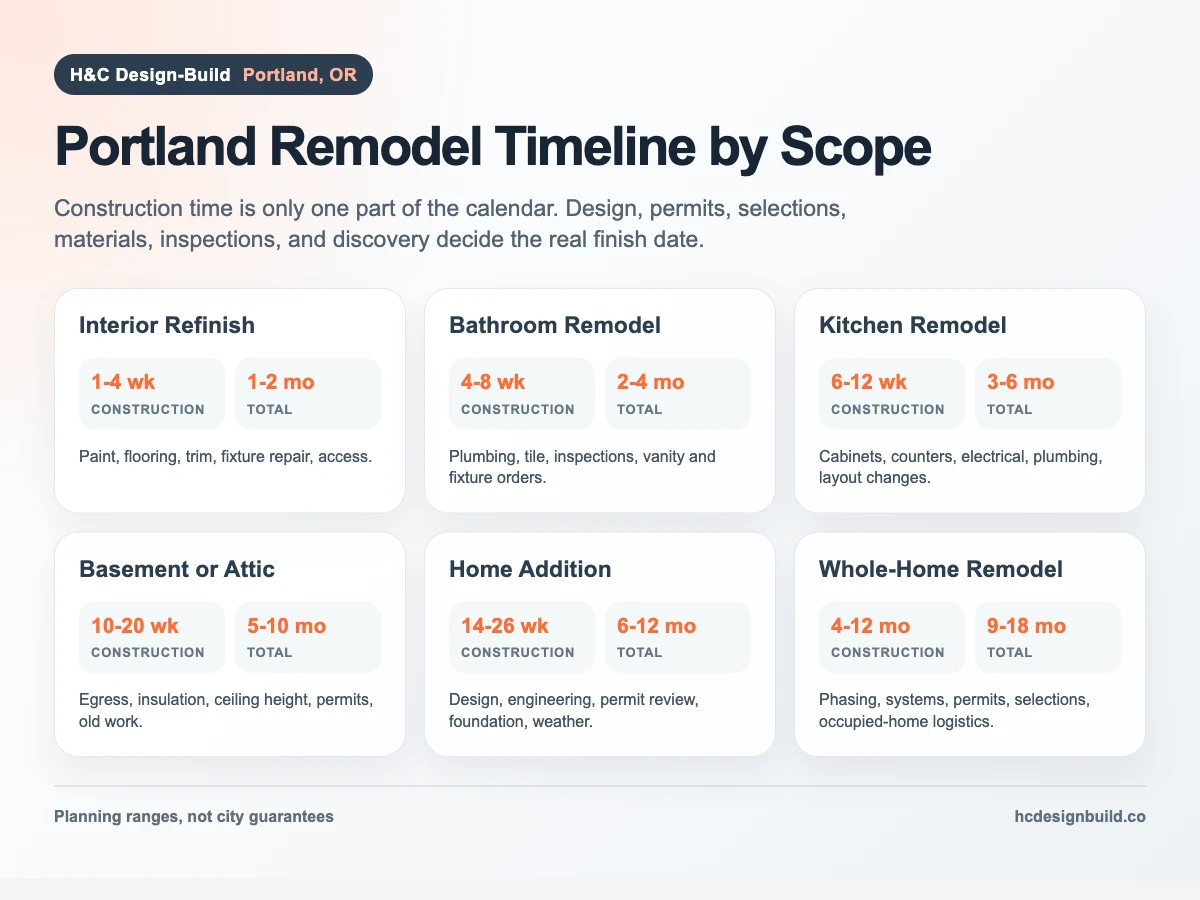
These are practical planning ranges, not city guarantees. Portland permit review queues change, product lead times move, and every house has its own history.
| Remodel scope | Build range | Total planning range | What usually drives the schedule | | --- | ---: | ---: | --- | | Interior refinish | 1 to 4 weeks | 1 to 2 months | Paint, flooring, trim, fixture repair, access | | Bathroom remodel | 4 to 8 weeks | 2 to 4 months | Plumbing, tile, inspections, vanity and fixture orders | | Kitchen remodel | 6 to 12 weeks | 3 to 6 months | Cabinets, counters, electrical, plumbing, layout changes | | Basement or attic conversion | 10 to 20 weeks | 5 to 10 months | Egress, insulation, ceiling height, permits, old work | | Home addition | 14 to 26 weeks | 6 to 12 months | Design, engineering, permit review, foundation, weather | | Whole-home remodel | 4 to 12 months | 9 to 18 months | Phasing, systems, permits, choices, occupied-home logistics |
A small interior refinish in Southwest Portland may move quickly because the work is easy to reach and light on permits. A basement job in Northeast Portland can take far longer because egress windows, water fixes, panel work, laundry moves, and city checks all stack together.
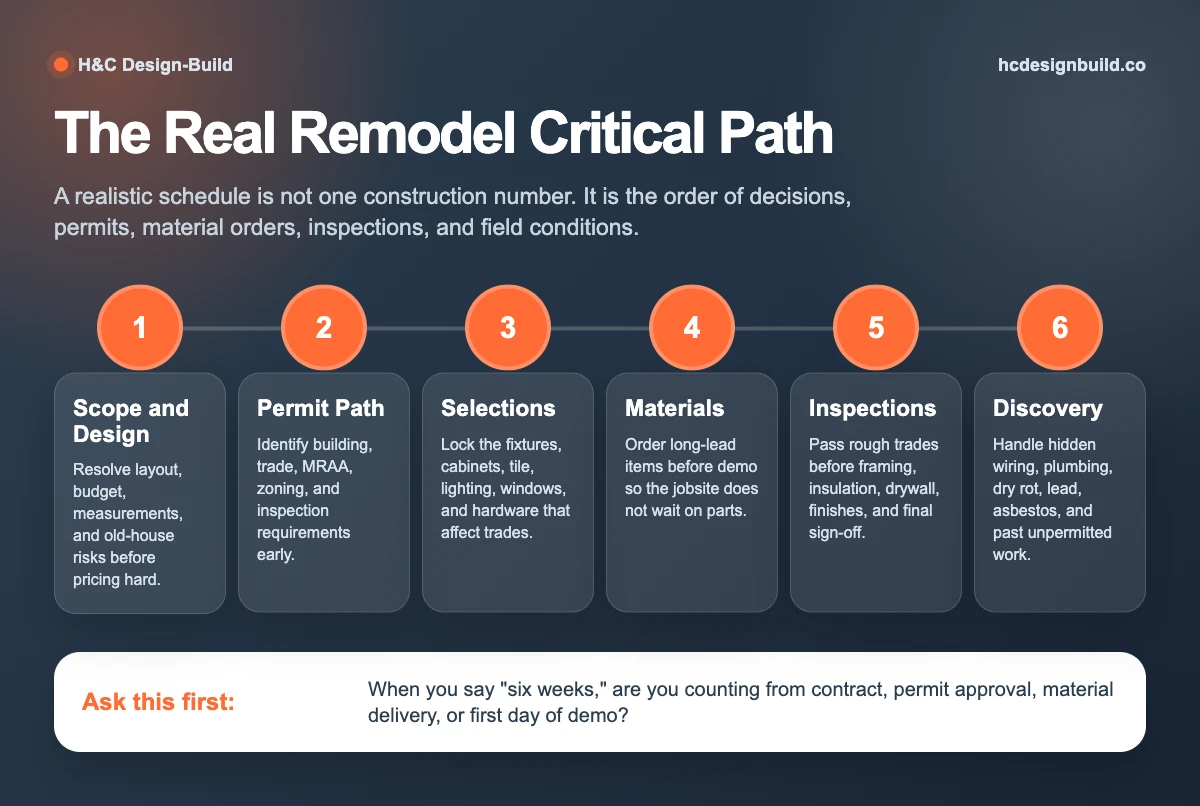
When homeowners get frustrated, it is often because they were sold build time as if it were the whole timeline. If someone says "six weeks," ask six weeks from what point. From signed contract? Permit approval? Product delivery? First day of demo? Those are different dates.
Build time is not the same as the full job
The work starts late in the process. By the time a crew arrives, a well-run remodel should already have answers to the costly questions.
A real path before demo looks like this:
1. Define scope and budget range. 2. Measure existing conditions. 3. Resolve layout and design. 4. Price enough detail to avoid vague allowances. 5. Submit permits when required. 6. Choose cabinets, tile, plumbing fixtures, lighting, doors, windows, and hardware. 7. Order long-lead products. 8. Line up trades and city checks. 9. Start work when the job can keep moving.
Skipping those steps does not save time. It moves choices into the most costly part of the job.
Cabinets are a simple example. If a kitchen starts before cabinet layout, appliance dimensions, electrical needs, and lead time are settled, the framing crew may finish before the cabinet order is even real. Then the homeowner blames the contractor for a quiet jobsite. The jobsite is quiet because the decision process was late.
For most remodels, the owner-controlled schedule is choices. Tile, grout, plumbing trim, vanity, lights, door hardware, cabinet pulls, paint colors, appliance specs, and countertop edge details all need answers. One late choice rarely kills a job. Ten late choices create a stop-start rhythm that everyone feels.
Portland permits can be simple, or they can run the job
Portland Permitting & Development lists common residential work that needs permits (opens in new tab). That includes additions, basement and attic conversions, moving or removing walls, cutting new openings, plumbing changes, hard-wired electrical work, and mechanical system changes. The city also notes that work may still need to meet zoning rules even when a building permit is not required.
That means a remodel can shift permit categories quickly. A cosmetic kitchen refresh may stay simple. Move a sink, add circuits, change a bearing wall, or cut a new window opening, and the permit path changes.
Portland's permit timeline dashboard (opens in new tab) is the current source for review queues. The city says the dashboard is updated every Monday and shows average and median times for commercial and residential permit review. Check it when planning, not after you have already promised yourself a move-in date.
The important contractor point is this: permit time is active project time. Good drawings, a complete scope, and fast responses to checksheets keep the file moving. Vague submissions, missing trade information, and slow corrections add dead time.
Our Portland building permits guide goes deeper on which projects usually need permits.
FIR helps only if your contractor is already in it
Portland's Field Issuance Remodel program, usually called FIR, is built for contractors, architects, and engineers who do repeat remodel and addition work. The program gives them one Senior Building Inspector for the life of the job.
That inspector can help with planning, plan review, city checks, and process issues. For some jobs, that helps. But it is not a shortcut everyone can use.
As of March 2026, Portland's FIR page (opens in new tab) says the city is not accepting new participants. It also says the city is not maintaining a waitlist because of budget and staffing constraints. If a contractor is already in FIR, ask how the project would be handled. If they are not, do not plan your schedule around joining the program.
FIR also does not lower code requirements. It changes the process, not the standard of work.
Additions and major alterations have hard delays
Some remodel delays are negotiable. MRAA is not.
Portland's Major Residential Alteration and Addition rules (opens in new tab) apply when a project removes more than 50 percent of exterior walls above the foundation. They also apply when a project adds more than 500 square feet of new interior space that expands the footprint or envelope. The city requires a 35-day notification delay before the permit can be issued. Plan review can happen during that window, but the permit cannot be issued before the delay is over.
That matters when a scope grows. If a project starts as a modest addition and later crosses the MRAA line, you can lose weeks to notification, revision, or a new permit path. The smart move is to test that threshold before design goes too far.
For additions, the schedule also depends on foundations, erosion control, tree protection, weather, and site access. A tight Portland lot with a large street tree, poor drainage, and limited staging will not move like a wide open suburban lot. Crew access affects real days.
Our Portland home addition guide covers the addition-specific cost and permit issues.
City checks set the work rhythm
City checks are not paperwork at the end. They set the order of work.
Portland's residential inspection guide (opens in new tab) says rough electrical, plumbing, and mechanical checks must be approved before framing inspection can occur.
For remodels and conversions, that usually means rough electrical, plumbing, and mechanical checks first. If structure changes, shear wall or framing inspection joins the sequence. Then come insulation, trade finals, building final, and final permit approval.
Additions have more steps: tree protection when required, erosion control, footing, foundation, underfloor work, rough trades, framing, insulation, finals, and permit closure.
Here is the field version: walls cannot close just because drywall is ready. If plumbing rough-in is approved but electrical has a correction, the framing inspection waits. If framing waits, insulation waits. If insulation waits, drywall waits. One missed inspection item can push several trades.
Good scheduling builds city check days into the plan. Bad scheduling treats them as interruptions.
Old Portland houses add discovery time
The timeline risk in older homes is not age by itself. It is what earlier owners did, what earlier builders could not have predicted, and what stayed hidden until demolition.
Common Portland discoveries include:
- knob-and-tube wiring or ungrounded circuits
- galvanized plumbing with poor pressure or corrosion
- old bathroom fans venting into an attic
- unpermitted basement finishes
- cut joists, missing headers, or questionable bearing changes
- dry rot around old windows and exterior doors
- asbestos in old materials
- lead paint in pre-1978 homes
- drainage problems around foundations and basement windows
On a North Portland code-compliance project, the schedule driver was not the new kitchen finish. It was the old basement work that had to be brought into compliance with proper egress and permit sign-off. On a Northeast Portland basement remodel, egress windows, drainage rerouting, electrical modernization, and laundry relocation all had to be coordinated before the finish work mattered.
A clean-looking scope can still be misleading. "Finish the basement" sounds simple until the work becomes egress, water control, framing, insulation, wiring, plumbing, HVAC, and city checks.
Product choices can decide the start date
Ordering is where homeowners can lose time quietly.
Stock tile, standard plumbing fixtures, and locally available trim rarely drive the schedule. Custom cabinets, specialty windows, exterior doors, large-format tile, special-order hardware, and appliances can. If those items are not chosen early, the job either waits or starts with a higher risk of gaps.
We usually want critical path choices made before demo. That does not mean every paint color has to be final. It means the items that affect framing, plumbing, electrical, and city checks should be locked.
For a kitchen, that includes cabinet layout, sink location, range type, hood needs, refrigerator size, lighting plan, and appliance specs. For a bathroom, it includes valve type, shower layout, tile thickness, drain location, vanity size, and fan path.
If you want a faster project, do not ask the crew to rush. Make decisions before the crew needs them.
Living in the house changes the schedule
Occupied remodels take more planning than empty-house remodels. They can still work, but the plan has to include protection and access.
An occupied job needs dust barriers, work zone separation, temporary utilities, daily cleanup, tool storage, safe walking paths, and a plan for pets and kids. Crews also have to shut down and restore parts of the house more carefully each day.
The biggest question is bathroom and kitchen access. If the house can keep one working bathroom and a basic cooking setup, living through the job may be reasonable. If all bathrooms are offline, or if the kitchen and only full bath are both under construction, moving out is usually the cleaner decision.
Lead, asbestos, structural work, and major utility shutdowns also change the answer. If a pre-1978 home will have painted surfaces disturbed, lead-safe setup and cleanup are part of the schedule. If suspect materials need testing or removal, plan for that before demo.
What you can do to keep the project moving
Homeowners cannot control Portland's review queue, weather, or what is inside the walls. They can control a surprising amount of the schedule anyway.
Start with a real scope. "Update the kitchen" is not enough. Are walls moving? Is plumbing moving? Are floors being replaced into adjacent rooms? Are windows changing? Is the panel large enough for the new load? Those answers affect design, permits, and trades.
Make choices early. If you hate decision pressure, make choices before the work starts. It is far better to take an extra week in design than lose two weeks during the build.
Respect the permit path. Starting without permits does not make the job faster. It creates the risk of stop-work orders, rework, opened walls for city checks, and problems when you sell.
Keep change orders rare. Changes happen on remodels, especially when hidden conditions appear. But preference changes during the work are costly. Moving a wall on paper is cheap. Moving it after plumbing rough-in is not.
Ask for the schedule assumptions. A useful contractor schedule should say what has to be true for the timeline to hold: permits issued, choices complete, products ordered, access available, utilities active, and city checks passed.
Questions to ask before you sign
Ask these before you commit to a schedule:
- What date are you counting from when you say the project will take this long?
- What choices must be made before work starts?
- What permits are required?
- What city checks are on the critical path?
- What products could delay the start?
- What hidden conditions are most likely in this house?
- What parts of the house will be unusable, and for how long?
- What decisions will you need from me during the build?
- What happens if the city issues a checksheet?
- What schedule float is built into the plan?
The answers should be specific to your house. A generic promise is not a schedule.
Plan the schedule before you plan the start date
A good Portland remodel timeline is more than a build calendar. It is a decision plan, permit plan, product plan, inspection plan, and disruption plan.
If you are doing light interior work, the path can be fairly short. If you are opening walls, changing structure, adding space, legalizing a basement, or remodeling an older home, expect the work before demo to matter as much as the build.
The best schedule is the one that tells the truth early. It may not be the shortest number on paper, but it is the one most likely to get you to the finish without expensive pauses.
If you want a realistic timeline for your specific house, contact H&C Design-Build. We will look at the scope, permit path, and likely jobsite risks before promising a start date.