You are hiring more than a set of hands.
You are hiring the person who will open walls, line up trades, read permit rules, protect your house, and tell you the truth when the job changes.
That is why choosing a Portland remodeling contractor should not start with the lowest bid. It should start with fit, license status, scope clarity, and proof that the contractor knows how Portland remodels actually behave.
Portland houses are not simple boxes. A 1920s bungalow, a basement conversion, a second-story addition, and a kitchen inside a pre-1978 home all carry different risks. The right contractor for one job may be wrong for another.
The goal is to hire by proof, not vibes. Pretty photos help, but they do not tell you whether the bid is complete. They do not tell you if the permit path is real, or if the contractor knows what is behind Portland walls.
Start with the kind of project you actually have
Before you call contractors, get clear about what you are asking them to solve.
A tile replacement, a bathroom remodel, a whole-home renovation, and a structural wall removal are not the same hiring problem. Oregon's own Guide to Hiring a Contractor (opens in new tab) makes this point plainly. The bigger the scope, the more homework you should do before choosing a contractor.
That tracks with what we see in the field. Small cosmetic work may only need a specialty contractor with a clean license and good references. A multi-trade remodel needs someone who can line up design, engineering, permits, subs, city checks, schedule, and homeowner choices.
Here is the first filter:
- single trade repair: specialty contractor may be enough.
- kitchen, bath, basement, or addition: general contractor or design-build team.
- structural work: contractor with structural remodel experience and engineering support.
- pre-1978 home: lead-safe experience matters before demo starts.
- occupied home remodel: job management and communication matter as much as craft.
If you are still deciding whether you need a general contractor, architect, or integrated design-build team, our Portland design-build guide explains the delivery models in more detail.
Check the Oregon CCB license before you fall in love with the bid
In Oregon, this is non-negotiable.
Oregon's Construction Contractors Board (opens in new tab) says a license is required for any business that advertises, offers, bids, or arranges for this work. The same rule covers anyone who performs construction, alteration, home improvement, remodeling, or repair work. The CCB also warns that if you use an unlicensed contractor, you lose access to bond recovery and CCB dispute help.
Do not wait until contract signing to check this. Ask for the contractor's CCB number early.
Then verify:
- the license is active.
- the business name matches the person or company bidding the work.
- the endorsement fits the job.
- bond and insurance are current.
- complaint history does not show a pattern you cannot live with.
- the contractor has any specialty licenses the work needs.
The CCB License Summary can show unpaid claims, civil penalties, complaint history, disciplinary sanctions, endorsements, bond, insurance, and lead-based paint license status. That record is more useful than a five-star average.
Online reviews can help, but they are not verification. A polished website and good photos do not replace the license search.
Know what a proper Portland remodel bid should include
A remodel bid should make the scope clearer, not blurrier.
For a small repair, a short proposal may be fine. For a real remodel, vague line items are where disputes start. You want to know what is included, what is excluded, what is an allowance, and what could become a change order later.
A useful bid should answer:
- what areas of the house are included.
- what demo, framing, plumbing, electrical, mechanical, drywall, finish, and cleanup work is included.
- what products are specified by brand, model, allowance, or owner choice.
- what design, engineering, and permit work is included.
- what is excluded.
- how unknown conditions will be priced.
- how change orders are approved.
- what schedule assumptions the price depends on.
The CCB guide is blunt about comparing bids: make sure the bids are based on the same scope and products. If one bid includes cabinets, electrical upgrades, and permit coordination, and another only says "kitchen remodel," you are not comparing the same job.
That is why the lowest bid is not automatically the best bid. Sometimes it is efficient. Sometimes it is missing work that will come back later.
Ask who will manage the job after you sign
The salesperson is not always the person running the work.
Before you choose a Portland remodeling contractor, ask who will manage the job after contract signing. You want the name, role, and availability of the person who will line up trades and answer field questions.
Ask:
- Who is the project manager?
- How often will they be on site?
- Who is my day-to-day contact?
- How many other jobs will the project manager be running?
- How are schedule changes communicated?
- How are homeowner choices documented?
- How are change orders priced and approved?
The CCB contractor guide recommends asking who the project manager will be. It also says to ask how often that person will be on site, how many other jobs they manage, and who the homeowner contact will be.
That is not paperwork. It is the difference between a job that feels controlled and one where you are constantly asking who is in charge.
Make permits part of the hiring conversation
Portland permitting is not something to figure out after demo.
Portland Permitting & Development lists common residential work that needs permits. That includes structural changes, mechanical work, hard-wired electrical changes, plumbing work, and work in the public right of way. Even work that does not need a building permit still has to meet code and zoning rules.
That matters because remodels often cross categories. A kitchen may include wiring, plumbing, structure, ventilation, and finish work. A basement conversion may involve egress, framing, wiring, plumbing, and city checks. A deck may look simple until height, setback, or structural rules show up.
Ask the contractor:
- What permits do you expect this job to need?
- Who pulls each permit?
- Are trade permits handled by licensed subcontractors?
- How do you respond to checksheets or corrections?
- What city checks are likely?
- What work cannot start until permit approval?
Our Portland building permits guide covers common permit triggers. Use it as a gut check when a contractor says, "You probably do not need a permit," on work that clearly changes structure, plumbing, electrical, or mechanical systems.
For pre-1978 homes, ask about lead-safe work before demo
Many Portland homes were built before 1978. That changes the contractor question.
The EPA says firms paid to perform renovation work that disturbs paint in pre-1978 housing generally must be certified under the Renovation, Repair and Painting Rule. The rule covers remodeling, repair, electrical work, plumbing, paint prep, carpentry, and window replacement.
Do not treat this as a side issue. Lead-safe work affects containment, cleanup, schedule, and who is allowed to do the work.
Ask:
- Are you an EPA Lead-Safe Certified Firm?
- Will a certified renovator be assigned to the job?
- What painted surfaces will be disturbed?
- How will containment and cleanup be handled?
- How will this affect schedule and cost?
This is especially important for old-window work, kitchen remodels, exterior repairs, and demo in older homes. Our Portland lead paint remodel guide goes deeper on when testing and lead-safe practices become part of the remodel.
Check references like a builder, not like a shopper
References should tell you how the contractor behaves when the job is messy. Finished photos only tell part of the story.
Ask for recent jobs that match your scope. A contractor who does beautiful bathroom refreshes may not be the right fit for a structural addition. A company that handles full design-build renovations may be overkill for a small repair.
When you call references, ask:
- Did the contractor keep the job moving?
- Did the price stay close to the signed scope?
- What changed during the work?
- Were change orders clear?
- Did the crew protect the house?
- Was the jobsite clean?
- Did the contractor communicate before problems got costly?
- Would you hire them again for the same kind of job?
The last question matters. Some homeowners like the finished result but would not repeat the process. That tells you something.
For Portland specifically, ask whether the job involved old-house conditions. Dry rot, knob-and-tube wiring, lead paint, old plumbing, foundation movement, and previous unpermitted work are normal discoveries here. The contractor's answer should sound experienced, not surprised.
A good contractor asks you hard questions too
Hiring is not one-way.
A contractor who accepts every idea without testing budget, structure, schedule, or permit reality is not doing you a favor. You want someone who asks enough questions to protect the job.
Good questions sound like:
- What problem are you trying to solve beyond the room you want changed?
- How long do you plan to stay in the home?
- Are you living in the house during the work?
- What choices are already made?
- What is your real budget range?
- What tradeoffs are you willing to make?
- Is there known unpermitted work?
- Are there moisture, foundation, electrical, or plumbing concerns already?
On real remodels, early honesty saves money. If a contractor is afraid to talk about budget, unknowns, or tradeoffs, the hard conversations will show up later when they cost more.
Watch the payment terms
Some down payment is normal. A giant vague deposit is not.
The CCB guide cautions homeowners to be careful when a contractor expects a large down payment. Contractors may need money for permits, products, and startup costs, but an unusually large down payment can be a warning sign.
Payment terms should follow job progress. For a larger remodel, the contract should spell out deposit, milestones, progress payments, final payment, and what happens when work changes.
Be cautious if:
- the contractor wants cash only.
- the deposit is large and unexplained.
- payment terms are not tied to milestones.
- the contractor will not put change orders in writing.
- the bid does not separate allowances from fixed costs.
- the contractor pressures you to sign before you understand the scope.
This is not about mistrusting everyone. It is about making sure the business side is as clear as the build side.
Make sure the written contract does real work
Oregon CCB says (opens in new tab) residential construction contracts over $2,000 must be in writing. CCB also recommends written contracts for all agreements, including changes.
A solid remodel contract should include:
- contractor legal name and CCB number.
- job address.
- scope of work.
- plans, drawings, specifications, or allowances.
- price and payment terms.
- permit responsibilities.
- start and target finish timing.
- change order process.
- warranty terms.
- cleanup and site protection expectations.
- required notices.
- signatures.
Do not sign a contract that says less than the bid conversation. The written agreement is what survives after everyone forgets exactly what was said in the kitchen.
For large jobs, ask how the contractor handles preconstruction. A paid design or preconstruction agreement can make sense when the job needs pricing, drawings, engineering, product choices, or permit planning before a full build contract.
Red flags that should slow you down
None of these automatically proves a contractor is bad. They do mean you should pause and ask harder questions.
- no CCB number on the website or proposal.
- license name does not match the company bidding the work.
- inactive license, expired insurance, or unresolved claims.
- no written contract for a meaningful scope.
- no permit plan for structural, electrical, plumbing, or mechanical work.
- pressure to sign today.
- vague bid with no allowances or exclusions.
- much lower price than the other bids without a clear scope reason.
- unwillingness to provide similar job references.
- no answer for pre-1978 lead-safe work.
- communication is already slow before you sign.
That last one is easy to dismiss. Do not. If it is hard to get clear answers before money changes hands, it usually gets harder after the job starts.
The bid meeting should feel specific
A good bid meeting has details.
The contractor should notice site conditions. They should ask about access, parking, stairs, pets, occupied rooms, existing utilities, old repairs, drainage, and what parts of the house need protection. They should ask enough about products and finishes to know whether your budget matches your expectations.
For a Portland home, we want to know about:
- age of the house.
- known unpermitted work.
- previous water intrusion.
- electrical panel capacity.
- plumbing material and access.
- framing changes.
- window and door changes.
- lead paint risk.
- whether the home will be occupied during the work.
The more vague the walkthrough, the more likely the bid is guessing.
The contractor you want may not be available tomorrow
This is frustrating, but true.
Good contractors are often booked out. That is not an excuse for poor communication. It is a reminder that immediate availability is not always a good sign.
If a contractor can start a major remodel tomorrow, ask why. Maybe they had a cancellation. Maybe they are staffed for it. Or maybe they do not have enough work.
The right question is not, "Who can start first?" It is, "Who can run this job cleanly once it starts?"
How to compare two good contractors
Sometimes the hard choice is not between good and bad. It is between two contractors who both look qualified.
Use these filters:
1. Which contractor understands the job risks better? 2. Which bid explains assumptions more clearly? 3. Which team has done the most similar work? 4. Which communication style fits how you make decisions? 5. Which contractor has the clearest permit and city check plan? 6. Which contract gives you the least room for misunderstanding?
Do not choose only by personality. Do not choose only by price. Choose the contractor who has the clearest path from existing conditions to finished work.
That is the difference between a remodel that feels expensive but controlled and one that becomes expensive because nobody saw the problems clearly enough.
The short version
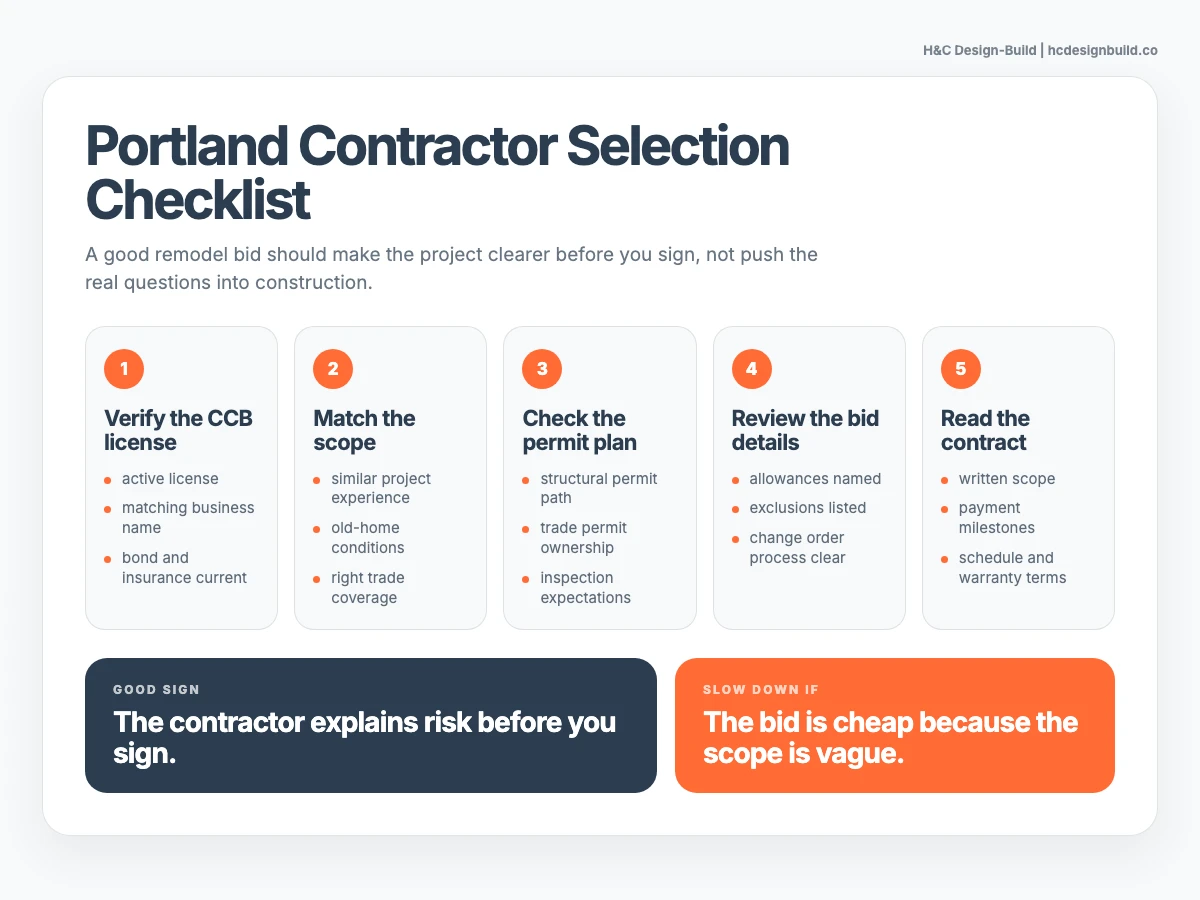
If you are choosing a Portland remodeling contractor, start with license verification. Then look at fit, scope, permits, old-home experience, communication, references, and contract clarity.
A good contractor should make the job easier to understand before you sign. They should tell you what is known, what is not known yet, what could change, and how those changes will be handled.
If you are planning a Portland remodel and want a contractor who will talk through scope, permit realities, old-house conditions, and budget before work starts, contact H&C Design-Build. We will tell you what we see and whether we are the right fit.