You're planning a remodel and every contractor's website says something different. Some call themselves design-build firms. Others say they work with your architect. A few just say "general contractor."
The terms sound interchangeable, but they describe three different ways to run a project. If you're searching for a design-build contractor in Portland, here's what the term means and when it makes sense for your home.
Three Ways to Remodel Your Home
Every remodeling project uses one of three delivery methods. The differences affect your cost, timeline, and how much coordination falls on you.
Design-Bid-Build (Traditional)
You hire an architect to create plans. Once plans are done, you send them to multiple contractors for bids. You pick a builder, usually the lowest bidder, and sign a separate contract. The architect may oversee construction, or you manage the builder yourself.
Two contracts. Two teams. You're the go-between.
Architect Plus General Contractor
You hire an architect and a general contractor separately, but the GC joins earlier than in design-bid-build. The architect designs while the GC provides cost input. You still hold two contracts and manage both relationships.
Design-Build
One team handles design and construction under a single contract. Your designer and builder work together from day one. You have one point of contact, one contract, and one team accountable for the outcome.
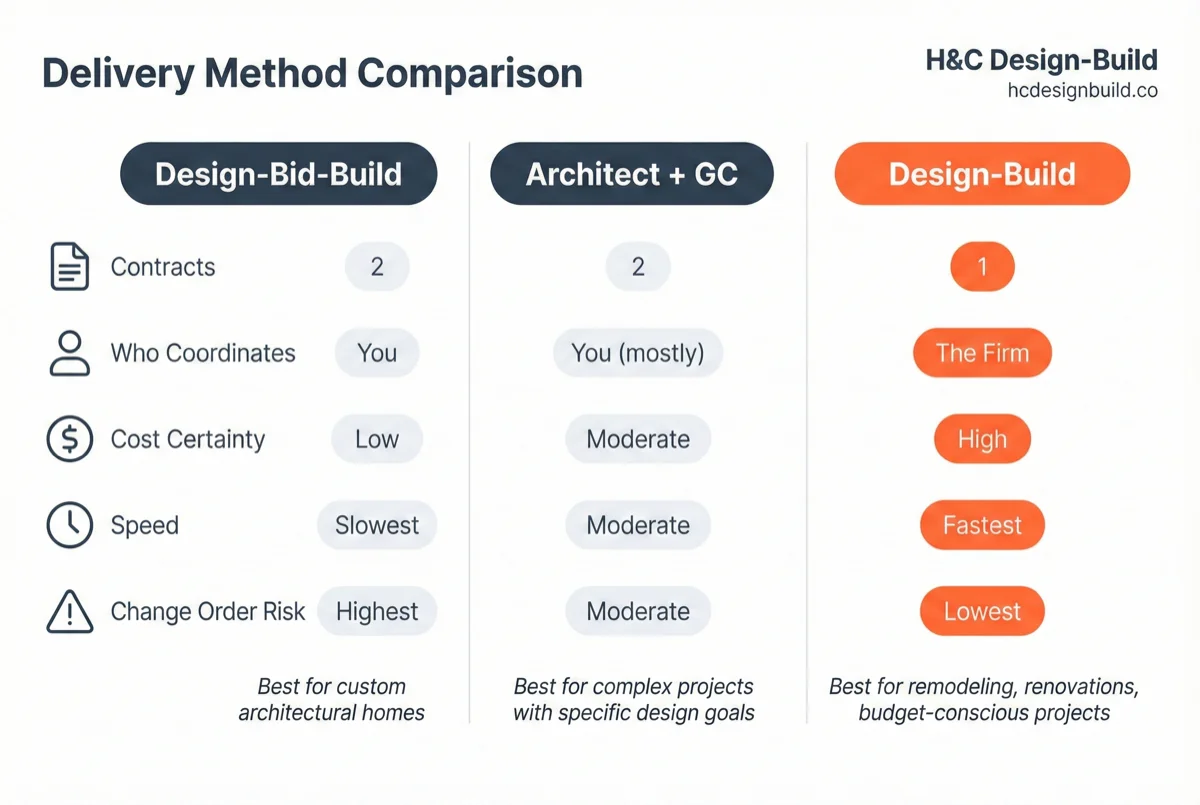
Here's how they compare:
| Factor | Design-Bid-Build | Architect + GC | Design-Build | | ------------------ | -------------------------- | ------------------------------------------- | -------------------------------------------------- | | Contracts | 2 (architect + builder) | 2 (architect + GC) | 1 | | Who coordinates | You | You (mostly) | The firm | | Cost certainty | Low until bids come in | Moderate | High from early design | | Design flexibility | High | High | Moderate to high | | Speed | Slowest | Moderate | Fastest | | Change order risk | Highest | Moderate | Lowest | | Best for | Custom architectural homes | Complex projects with specific design goals | Remodeling, renovations, budget-conscious projects |
What Happens When You Open the Walls
The real difference shows up when something goes wrong. In Portland's older homes, something always goes wrong.
We ran into this on a kitchen remodel at a home in North Portland. The homeowner wanted to open the kitchen to the living area. That meant removing a wall section and installing an 8-foot structural beam with a pass-through bar.
During demo, the crew found the existing electrical panel couldn't support the new kitchen circuits. The panel needed a full upgrade. Nobody could have seen that before the walls came open.
Under design-bid-build: Work stops. The contractor calls you. You call the architect. The architect draws revised electrical plans. Those drawings go back to the contractor for a change order. The electrical sub reprices. The homeowner approves. Timeline slips two to four weeks. Everyone points at someone else.
Under design-build: The electrician was already part of our team. We sized the new panel, pulled the electrical permit alongside the building permit, and kept the project moving. The homeowner got a call with options and costs that afternoon. Decision made, work resumed.
Portland homes built before 1940 hide surprises: galvanized plumbing, undersized electrical panels, balloon framing, and no insulation. Add decades of DIY structural patches to that list. Every one of these discoveries triggers a decision chain. Design-build shortens that chain because the people finding the problem are the same people solving it.
What the Research Shows
University researchers have put numbers to design-build's advantages.
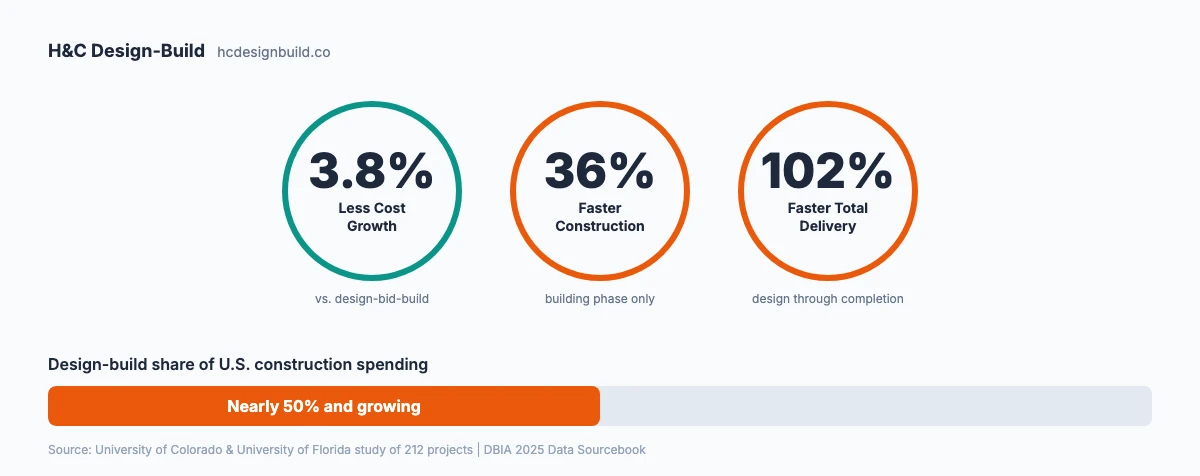
A 2018 study by the University of Colorado and University of Florida (opens in new tab) analyzed 212 construction projects across both public and private sectors. Compared to design-bid-build, design-build delivered:
- 3.8% less cost growth (fewer budget overruns during construction)
- 36% faster construction (building phase only)
- 102% faster total delivery (from first design meeting to final completion)
Put differently: a project that takes 12 months under design-bid-build could finish in roughly 6 months under design-build. The overlap between design and construction phases is what drives the speed. You don't wait for complete drawings before starting work on resolved portions.
The Design-Build Institute of America (opens in new tab) reports that design-build accounts for nearly half of all U.S. construction spending (opens in new tab), projected to reach $2.6 trillion from 2024 to 2028. It's the most commonly used delivery method in the country.
Those numbers come from all project types, not just residential. But the pattern holds for home remodeling because the same advantages apply: fewer handoffs, faster decisions, and less rework.
One caveat for Portland homeowners: the speed gains come from design and construction phases, not permitting. Portland BDS permit review takes the same amount of time regardless of delivery method. Where design-build saves time is in the handoffs before and after that review. Your designer and builder are already aligned on scope, so there are fewer revision cycles before submitting, and construction starts faster once permits are issued.
Why Portland Homeowners Choose Design-Build
Design-build works best when the project involves unknowns and the homeowner wants one team running the show.
Remodeling existing homes. Renovation projects have more variables than new construction. You can't fully predict what's behind finished surfaces. Design-build's integrated team handles discoveries without the contractual friction of separate design and construction firms.
Portland's older housing stock. Most Portland homes predate modern building codes. A kitchen remodel or bathroom renovation in a 1920s bungalow is a different animal than one in a 2010 subdivision. The older the home, the more value you get from a team that designs and builds together.
Budget-conscious projects. With design-build, you pay one markup instead of separate fees for design and construction management. The DBIA research (opens in new tab) confirms lower cost growth. Your budget estimate at contract signing stays closer to your final cost.
Homeowners who want less project management. If coordinating between an architect and a contractor isn't how you want to spend your evenings, design-build removes that burden. One phone call, one email thread, one team.
Projects that cross multiple trades and permit types. A Southeast Portland project required PLA permitting for a lot subdivision, sewer easement negotiation across an adjacent parcel, and residential updates including a new electrical panel and kitchen remodel. All coordinated under one contract. A North Portland project involved legalizing a non-permitted basement, which meant working through the full inspection process from foundation to finish: egress windows, electrical, framing, and final occupancy. On the same project, we did a full roof tear-off, vinyl windows throughout, and a kitchen reconfiguration.
When Design-Build Is Not the Right Fit
Honest answer: design-build doesn't suit every project. Knowing when to use a different model matters.
Historic district projects. Portland neighborhoods like Irvington, Ladd's Addition, and Piedmont have historic district overlays. Exterior changes require design review by the Historic Landmarks Commission. If your project triggers that review, you may want an architect with historic preservation experience leading the design independently. The design review process has its own timeline and requirements that sit outside the construction workflow.
New custom homes on vacant lots. If you're building from scratch, not renovating, a traditional architect-led process gives you more design exploration time before construction costs enter the conversation. You can iterate on floor plans and elevations without a builder's budget input shaping every decision. Design-build works for new construction too, but the tradeoff is less open-ended design freedom.
You already have complete construction plans. If an architect has finished your drawings and you just need a builder to execute them, you don't need design-build. Get competitive bids from general contractors and hire the best fit.
Simple single-trade projects. Replacing windows or re-roofing doesn't need an integrated design-and-build team. Get bids from specialty contractors. Same goes for replacing a deck on a newer home or finishing a basement with clear conditions.
Projects under $10,000. Paint, hardware swaps, cosmetic updates. Design-build overhead doesn't make sense at this scale. Hire a contractor or handyman and skip the contract structure.
Design-build handles complexity and uncertainty better than the alternatives. Portland remodeling projects tend to have plenty of both.
How to Vet a Design-Build Contractor in Oregon
Oregon takes contractor licensing seriously. The Construction Contractors Board (opens in new tab) (CCB) requires every contractor who gets paid to work on a home to be licensed. No exceptions.
Here's what to check before you sign anything:
Look up the CCB number. Every licensed contractor has one. It should appear on their website, business cards, and advertising. Search it at search.ccb.state.or.us (opens in new tab) to confirm an active license.
Verify the bond and insurance. Oregon residential general contractors must carry a $25,000 surety bond and $500,000 in general liability insurance (opens in new tab). The CCB search shows whether these are current.
Check complaint history. The CCB database displays 10 years of complaints, disputes, and disciplinary actions (opens in new tab). A clean record matters more than a polished website.
Confirm the endorsement type. Oregon issues different endorsements for residential general contractors, specialty contractors, and limited contractors. A design-build firm doing full remodels needs a residential general contractor endorsement. A specialty endorsement isn't enough for multi-trade projects.
Ask about their permit track record. Design-build firms handle permitting as part of the service. Ask which Portland permit types they pull regularly and whether they've worked with Portland's current review process.
Choosing the Right Model for Your Project
The delivery method you choose shapes your entire remodeling experience. If you're still deciding whether to remodel or move, start there. For Portland homeowners tackling renovations on older homes with tight budgets and unpredictable conditions, design-build removes friction and keeps the project moving.
If you're weighing your options for a Portland remodel, reach out to our team. We'll tell you straight whether design-build fits your project or whether a different approach makes more sense.