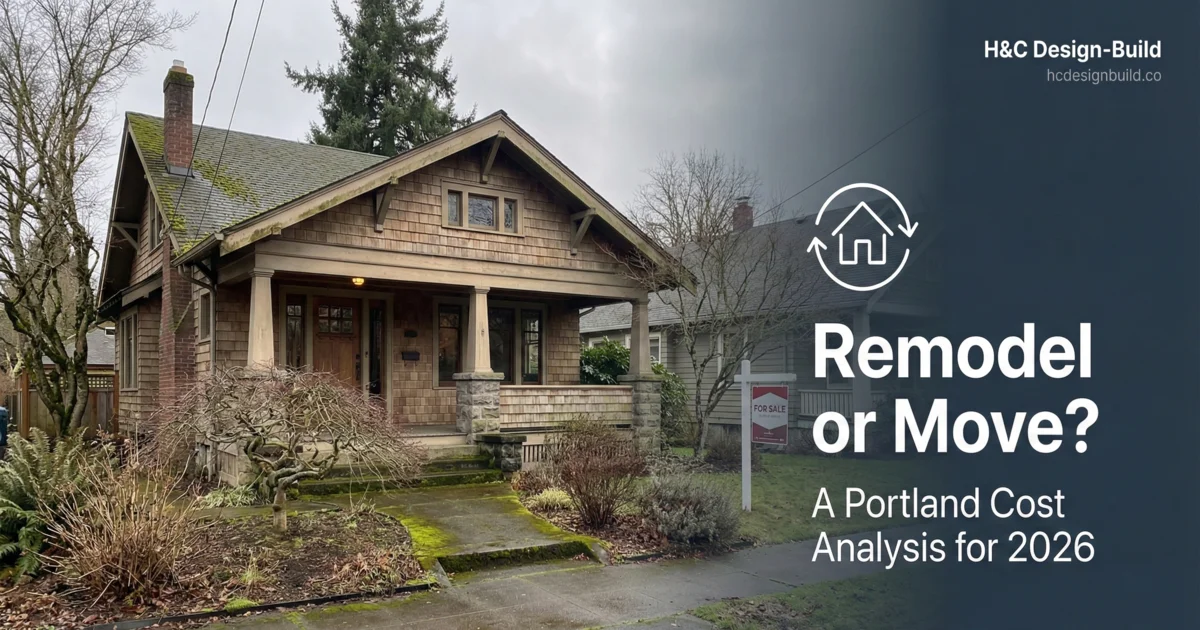
You've been staring at your kitchen for six months. The layout doesn't work. The bathrooms need updating. And you keep circling back to the same question every Portland homeowner eventually asks: should you remodel or move?
The answer comes down to numbers, not feelings. Portland's 2026 market creates specific conditions that shift the math. Transaction costs, mortgage rates, remodeling ROI, and your neighborhood all play a role.
Here's the breakdown from a contractor who's seen both sides. The numbers favor one option for most Portland homeowners right now.
The Real Cost of Moving in Portland
Most homeowners underestimate what selling one house and buying another costs. In Portland, those numbers add up fast.
Agent commissions take the biggest chunk. Oregon's average total commission runs 5.51% (opens in new tab) of the sale price. On a $550,000 home, that's about $30,300. The 2024 NAR settlement (opens in new tab) changed who pays the buyer's agent, but the total cost stays roughly the same.
Closing costs hit both sides. Sellers pay about 2.4% in title insurance, escrow fees, and recording costs (opens in new tab). Buyers pay 3-3.5% for mortgage origination, appraisals, and inspections. One bright spot: Oregon has no state real estate transfer tax (opens in new tab), except for Washington County (0.1%).
Moving costs for a three-bedroom Portland home run $2,000-$3,600 (opens in new tab) depending on distance and season.
For a $550,000 home:
| Category | Cost | | ---------------------------- | ------------------- | | Agent commissions (5.5%) | $30,300 | | Seller closing costs (~2.4%) | $13,310 | | Buyer closing costs (~3%) | $16,500 | | Local move | $2,160 | | Total | $46,000-$57,000 |
That's roughly 8-10% of your home's value. Gone before you change a single thing about where you live.
The Mortgage Rate Penalty
Transaction costs are just the visible hit. The bigger cost hides in your mortgage rate.
As of February 2026, the 30-year fixed rate sits at 6.09% (opens in new tab). Meanwhile, over 52% of current homeowners hold rates below 4% (opens in new tab). About 70% are below 5%.
Here's what a rate reset looks like on a $400,000 mortgage:
| Rate | Monthly Payment | vs. 3.5% Rate | | -------------------- | --------------- | ------------- | | 3.5% (current) | $1,796 | Baseline | | 6.1% (today) | $2,426 | +$630/mo | | 6.5% (if rates rise) | $2,528 | +$732/mo |
That's $7,560 more per year at today's rate. Over 30 years, you'd pay roughly $227,000 in additional interest on the same loan balance.
The Federal Reserve found (opens in new tab) that this "lock-in effect" has prevented over one million home sales nationwide. It pushed prices 5-6% higher as inventory dried up.
Rate forecasts for 2026 range from 5.9% (Fannie Mae) (opens in new tab) to 6.4% (Mortgage Bankers Association) (opens in new tab). Nobody expects a return to 3-4% rates anytime soon.
What Remodeling Actually Returns
Every dollar spent on moving is gone. Remodeling dollars come back, at least partially.
The 2025 Cost vs. Value Report (opens in new tab) tracks ROI across 28 project types. The Pacific region, which includes Portland, consistently shows the highest returns in the country.
Top performers from the 2025 report:
| Project | National ROI | | ------------------------- | ------------ | | Garage door replacement | 268% | | Steel entry door | 216% | | Fiber-cement siding | 114% | | Minor kitchen remodel | 113% | | Wood deck addition | 83% | | Midrange bathroom remodel | 80% |
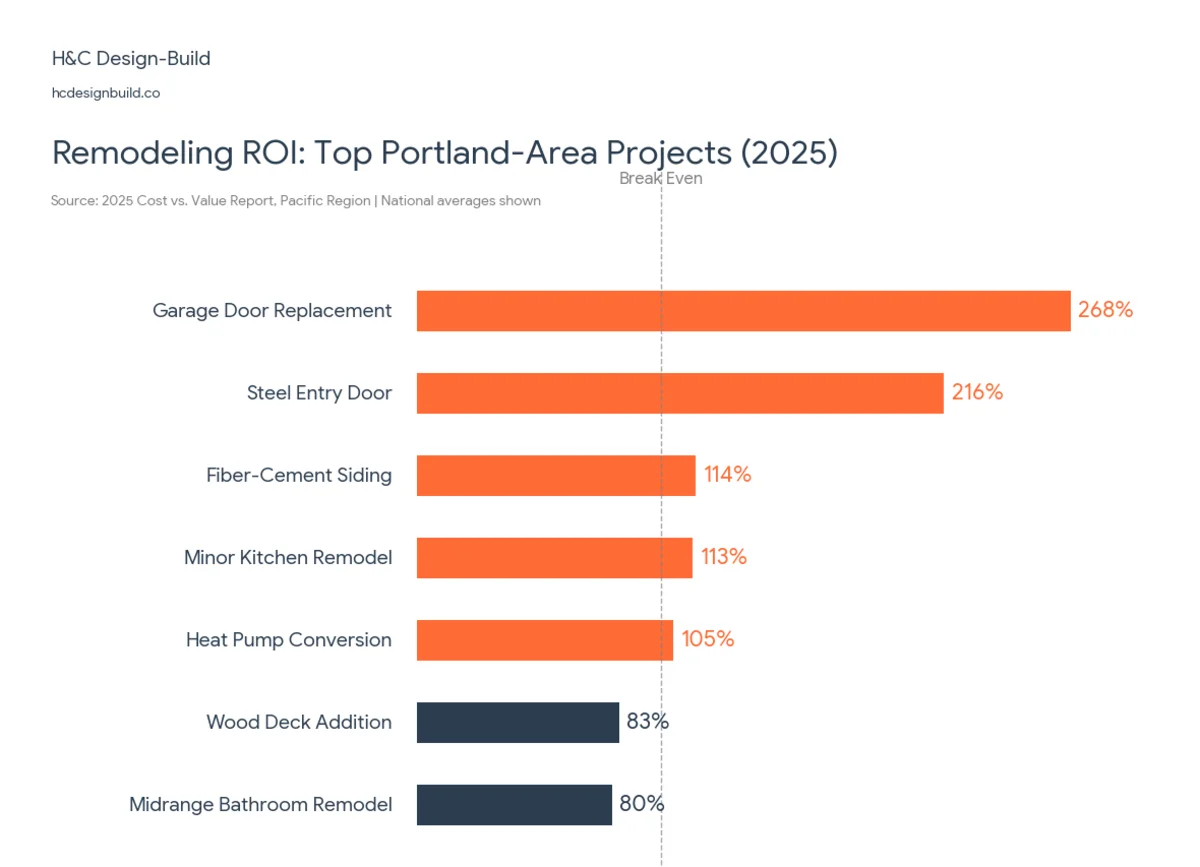
Portland's average across all project types, according to the report's Pacific region data: roughly 74 cents back per dollar invested. That beats the national average. Heat pump conversions also perform well here, where buyers pay a premium for energy-efficient homes and state rebates offset upfront costs.
The premium for renovated homes is growing. Zillow's 2025 analysis (opens in new tab) found remodeled homes sell for 3.7% above expected value. Fixer-uppers sell for 7.3% below. That's an 11-point gap.
In Portland's current market, that gap is visible. Move-in-ready homes still sell quickly (opens in new tab). Fixer-uppers sit, often with price cuts. Nearly half of all active listings carry price reductions (opens in new tab) as of early 2026.
Putting the Numbers Together
Two facts drive the math for most Portland homeowners.
Moving costs money you'll never see again. Transaction fees on a $550,000 Portland home run $46,000-$57,000. The rate penalty if you reset from 3.5% to 6.1%: about $7,560 per year, or $75,600 over a decade. Together, that's $122,000-$133,000 in costs that build zero equity.
Remodeling returns most of what you spend. Portland's average remodeling ROI is 74 cents per dollar. A $150,000 whole-home renovation adds roughly $111,000 in value. Your net cost: about $39,000. Your mortgage rate stays the same.
The gap over 10 years: roughly $90,000 in favor of remodeling.
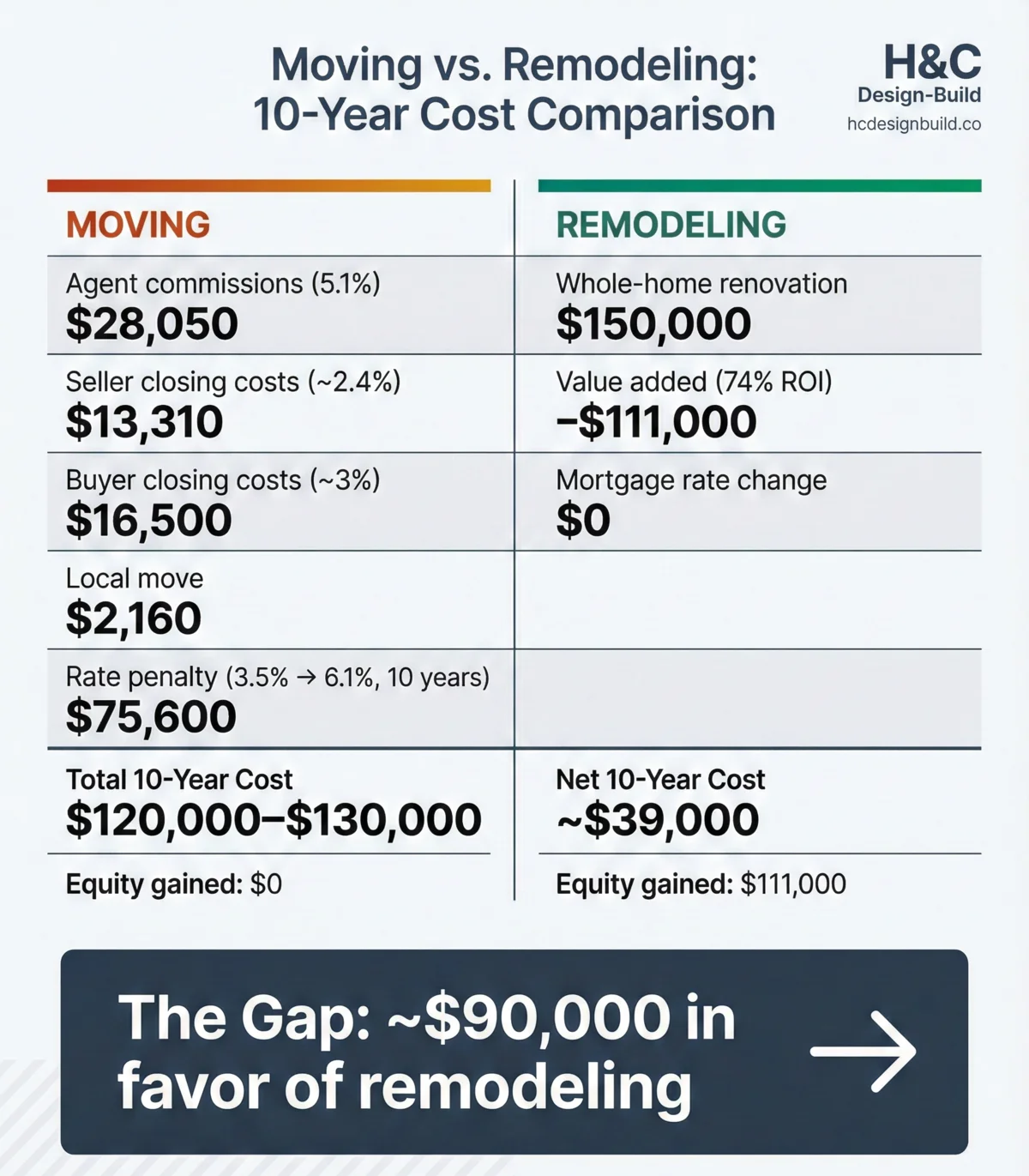
This isn't perfectly apples-to-apples. Moving gets you a different house, possibly in a different location. But the financial penalty for that switch is real, and most homeowners underestimate it.
What This Looks Like in Practice
We worked on a home in Southeast Portland that put these numbers to the test. The owner faced a failed roof, deteriorating siding, a gravel-over-mud driveway, and outdated finishes in every room. Selling as-is would have priced the home as a fixer-upper with steep discounts. In Portland's current market, that means sitting on the listing with price cuts.
Instead, the owner invested in a full renovation: roof, siding, driveway, drainage, and interior finishes throughout. The result: the owner resold at nearly double the pre-work value. That's not a hypothetical Cost vs. Value percentage.
When Remodeling Wins
Remodeling makes the most financial sense when:
You love your location. Your commute works. The schools are right. Neighbors are great. No renovation can replicate a neighborhood you've spent years building into.
You hold a low mortgage rate. Below 4%? The math strongly favors staying. Even a 2-point rate increase costs hundreds per month on the same balance.
Your house has sound structure. Solid foundation, good roof, reasonable systems. Portland homes with post-1940 foundations, updated electrical, and functioning plumbing are strong remodel candidates.
You want targeted improvements. A better kitchen remodel. An additional bathroom remodel. A finished basement. These are specific investments with measurable returns.
Your market punishes fixer-uppers. Portland's does right now. Renovating to stay or renovating before selling both beat listing a home that needs work.
The Friction Is Real. The Math Still Works.
We're not going to pretend remodeling is painless. It isn't. Here's what you should expect:
Permit timelines vary by scope. Portland BDS (Bureau of Development Services) processes simple permits in days, but a kitchen remodel with structural changes can take 4 to 8 weeks just for permit review. Plan for that lead time before demo starts.
Living in a construction zone. Most Portland homeowners stay in the house during remodels. That means dust containment barriers, power tools running from 7am, and no functional kitchen for 3 to 6 weeks during a kitchen gut. It's manageable, but you need to know it's coming.
Surprises behind the walls. Opening walls in pre-1940 Portland homes regularly reveals galvanized plumbing, knob-and-tube wiring, or zero insulation. On a whole-home renovation in Southwest Portland, the scope grew as we uncovered what previous owners had left behind. Budget 10-15% contingency for the unexpected. You will almost certainly use some of it.
Trade coordination in tight spaces. A plumber, electrician, tile installer, and painter all working in a 1,200-square-foot Portland bungalow takes scheduling discipline. One late inspection can cascade into a week of delays.
When Moving Is the Right Call
We're a remodeling company, so we'll be upfront: we have a bias. But sometimes moving makes more sense.
No renovation adds a bigger yard or a second garage bay. If your lot is the constraint, moving solves it.
Structural problems exceed the home's value. Some Portland pre-1940 homes carry failing foundations, knob-and-tube wiring, and outdated framing. When repair costs approach 30-40% of home value, the numbers flip.
Your commute or school district changed. A new job across town or a child entering a different school can't be solved with a kitchen remodel.
Neighborhood values are declining. Remodeling ROI depends on comparable sales. Investing $150,000 where comps are dropping is a losing bet.
You've outgrown the footprint and can't expand. Portland zoning limits and addition costs can make adding square footage expensive enough that buying bigger costs less.
Portland Neighborhood Factors
Where you live changes the equation.
Inner Portland (Irvington, Laurelhurst, Hawthorne, Division): Pre-1940 Craftsman bungalows dominate here. Remodeling makes strong sense because land values are high and the housing stock has character worth preserving. NE Portland saw 5.0% price growth (opens in new tab) year-over-year as of early 2026. Budget for surprises behind the walls: old wiring, lead paint, and foundation work come with the territory.
Mid-century suburbs (Beaverton, Tigard, Milwaukie): Homes from the 1950s-1980s are entering prime renovation years. Kitchens and bathrooms are dated, but bones are typically sound. These suburbs are showing stronger demand and price stability than Portland's core, per recent market data (opens in new tab). Strong remodel candidates.
Newer developments (Happy Valley, West Linn): If your home was built after 2000 and you've outgrown it, the math shifts. The house likely doesn't need systems upgrades. Adding space in a newer subdivision can approach the cost of just buying the next size up.
Your Decision Framework
A contractor's bias disclaimer: H&C is a design-build remodeling company. We benefit when you choose to remodel. We're sharing real numbers so you can make your own call.
Lean toward remodeling if:
- Your mortgage rate is below 5%
- You like your neighborhood and commute
- Your home's structure is sound
- You want specific rooms improved, not a different house entirely
- You plan to stay at least five more years
Lean toward moving if:
- You need a different lot, location, or school district
- Structural repairs would exceed 30% of your home's value
- You've outgrown the house and zoning blocks expansion
- Neighborhood values are flat or declining
- Your current rate is already above 6% (no lock-in penalty)
The tiebreaker: Spend $50,000 on either path. The remodeling route returns roughly $37,000 in home value. The moving route returns $0. Transaction costs are a pure loss. For a deeper breakdown of which projects return the most, see our Portland home remodel ROI guide.
---
Portland's 2026 market doesn't reward impulse decisions. Run the numbers for your specific situation. For most homeowners with a low rate and a home in reasonable shape, the math points toward staying and investing in what you have.
If you're weighing a remodel, reach out. We'll help you understand what your project would cost and whether it makes sense for your home.