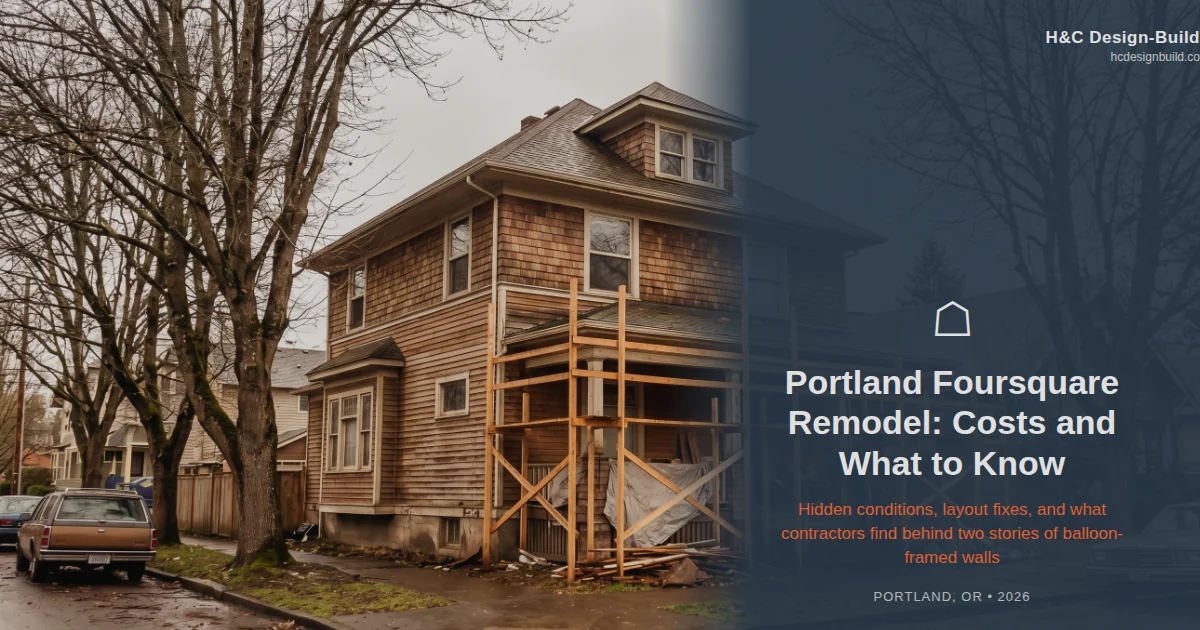
You bought the Portland Foursquare. Two full stories, four rooms per floor, a basement you can stand in, and a hipped attic with more headroom than you expected. Foursquares are the biggest pre-war homes most Portland families will ever own. That's the upside. The downside: there's more house to fix.
Portland Foursquare remodels share the same era and many hidden conditions as Craftsman bungalows. The two-story layout, hip roof, and square footage change the scope and cost.
What you're working with
Portland's Foursquares were built between about 1900 and 1930, with many showing up during the building boom around and after the 1905 Lewis and Clark Exposition. The fair drew 1,588,000 paying visitors (opens in new tab) to a city of about 120,000, and Portland kept growing after it. Builders needed houses that went up fast on narrow city lots. The Foursquare answered that need: a simple box, two stories, four rooms per floor, and a hipped roof on top.
The style is so common here that real estate listings often call it Old Portland Style. You'll find Foursquares in Irvington, Ladd's Addition, Laurelhurst, Sunnyside, Buckman, Concordia, King, Woodlawn, and Piedmont. Some were architect-designed. Many came from pattern books. Some may be kit homes. Treat that as a clue, not proof. Framing stamps, catalog matches, and old records are what confirm a kit house.
Construction characteristics across the era:
- Balloon framing with studs running two stories from foundation sill to roof plate
- 9- to 11-foot ceilings on both floors
- Low-pitched hipped roof, usually with one or two dormers
- Full-width front porch with tapered columns
- Full basement, typically unfinished
- Knob-and-tube wiring on a 60-amp service
- Galvanized steel supply lines and clay sewer pipes
- Little to no wall insulation
A typical Portland Foursquare sits on a 50-foot lot with a 26-by-30-foot footprint. Two main floors give you 1,500 to 2,400 square feet before you count the basement or attic. That's 30 to 50 percent more living space than a Craftsman bungalow on the same size lot. The Portland exterior treatment is distinctive: horizontal cedar lap siding on the first floor topped by wood shingles on the second.
What you'll find behind the walls
Same era as a Craftsman means the same problems: knob-and-tube wiring, galvanized pipes, lead paint, asbestos, and balloon framing with no fire blocks. The difference is scale. Two full stories of balloon-framed walls doubles the vertical cavity you need to address, and more square footage means more hazardous surface area and more pipe to replace.
Knob-and-tube wiring
Nearly every Foursquare still has some. The original 60-amp service was designed for a few lights and a radio. Active knob-and-tube becomes a scope issue when walls open, circuits are exposed, or insurance asks about the wiring. Full rewire with a 200-amp panel upgrade runs $15,000 to $30,000 on a two-story Foursquare. That's higher than a bungalow because there's more cable to pull through two full floors.
Galvanized pipes
After 100 years, the interior of a 1-inch galvanized pipe can restrict to a pencil-width opening. You'll notice it as low water pressure and rust-colored water at first draw. Whole-house repipe with PEX runs $5,000 to $8,000. The clay sewer line to the street is a separate concern. Get a sewer scope ($200 to $300) before committing to a remodel scope.
Lead paint and asbestos
Every Portland Foursquare predates the 1978 lead paint line. For asbestos, the working assumption is simpler: do not guess. Oregon DEQ recommends (opens in new tab) an accredited asbestos survey before renovation and requires one before demolition of residences built before 2004. Oregon's RRP rule (opens in new tab) applies to contractors working in pre-1978 homes when the disturbance is not minor repair. OHA defines minor repair as less than 6 square feet of interior painted surface per room or less than 20 square feet outside. Asbestos can show up in pipe insulation, 9x9 floor tiles and the black mastic underneath, and sometimes vermiculite attic insulation.
Balloon framing
The stud bays run from basement to attic with no fire stops between floors. In a fire, these open cavities act as chimneys. When you open walls during a remodel, adding fire blocking is straightforward and cheap. But there's a practical upside to the continuous cavities: rewiring is easier because you can fish new cables between floors without cutting into every ceiling.
Foundations
Most Portland Foursquares sit on poured concrete basements, but early 1900s concrete lacked standardized mixes. Quality varies from house to house. The structure may not be bolted to the foundation. Portland's prescriptive seismic retrofit path (opens in new tab) can apply when the house meets criteria such as a continuous concrete perimeter foundation and qualifying cripple-wall conditions. For two-story homes, the city's instructions call for anchor bolts every 4 feet and plywood bracing on 50 percent of cripple wall length. A standard bolt-and-brace retrofit in H&C planning ranges runs $3,500 to $7,000. Our seismic retrofit guide covers the full process.
The kitchen everyone wants to open
The kitchen is usually the first room on the list in a Portland Foursquare remodel. Original kitchens occupy one of the four ground-floor quadrants. Small, enclosed, separated from the dining room by a load-bearing wall. The wall between kitchen and dining room is almost always structural because the four-room plan depends on two perpendicular bearing walls that cross at the center of the house.
Removing that wall requires a structural engineer, an LVL or steel beam, and a Portland building permit. H&C planning ranges put the structural work alone around $4,000 to $12,000. A smarter option for many Foursquares is a wide cased opening, often 6 to 8 feet, instead of removing the entire wall. You get the sightlines and the flow without losing the room definition that makes these houses work.
H&C planning ranges for kitchen remodel costs in a Portland Foursquare as of 2026:
| Scope | Typical range | |---|---| | Cosmetic refresh (keep layout) | $15,000 to $30,000 | | Mid-range (new cabinets, counters, appliances) | $45,000 to $85,000 | | Full gut with layout changes | $85,000 to $150,000+ |
For a pre-1930 home, H&C usually carries a 15 to 20 percent contingency before walls open. That is not padding. It is how you keep hidden wiring, plaster repair, framing, and hazmat surprises from wrecking the rest of the plan.
Adding bathrooms
One bathroom on the second floor, directly above the kitchen to share plumbing risers. That's what the builder gave you in 1915. For a modern family, it's the biggest functional gap in the house.
Three approaches that work in Foursquares:
1. First-floor powder room. Tuck a half bath under the staircase or carve it from the entry hall. You need about 15 square feet minimum. Plumbing runs are short if you place it against the kitchen wall. Cost: $8,000 to $15,000.
2. Second-floor bathroom. Borrow space from a bedroom or a large closet to add a second full bath upstairs. Place it back-to-back with the existing bathroom to share the plumbing wall. You lose bedroom square footage but gain a bathroom the family actually needs. Cost: $25,000 to $50,000.
3. Basement bathroom. If you're finishing the basement anyway, run supply and drain lines through open framing. Watch the drain slope to the main sewer exit. If the main line exits above the basement floor, you'll need a sewage ejector pump ($1,500 to $3,000 extra).
The attic question
The hipped roof gives a Foursquare its look. It also makes the attic hard to use. Unlike a Craftsman's gable roof, which concentrates headroom along a central ridge, the hip slopes in from all four sides. A 4:12 hip on a 30-foot-wide house might yield only 300 to 400 square feet of usable space at the center.
Converting a Foursquare attic almost always requires dormers on multiple sides to meet Portland's minimum ceiling height of 6 feet 8 inches over at least half the room area (opens in new tab). Dormers add $15,000 to $40,000 each in H&C planning ranges, depending on size and style. Hip dormers suit the Foursquare roofline best. See our attic conversion guide for the full cost breakdown and code requirements.
The practical alternative: skip the attic and finish the basement instead. Most Foursquare basements have 7- to 8-foot ceilings and interior stair access. Waterproofing and moisture control are non-negotiable in Portland, but a finished basement can add 600 to 1,000 square feet of living space without touching the roof.
What to preserve and what to change
| Preserve | OK to change | |---|---| | Hipped roof profile and dormers | Kitchen layout and cabinets | | Full-width front porch and columns | Bathroom fixtures and finishes | | Interior woodwork and wainscoting | Electrical, plumbing, HVAC | | Original windows and hardware | Basement finishing | | Hardwood floors | Rear additions (match style) | | Staircase, newel posts, balusters | Closet and storage systems | | Fireplace and mantel | Attic dormers (match hip style) |
The front facade is what makes a Foursquare a Foursquare. The symmetrical windows, the porch, the hip roof. Protect the street-facing elevation. Save the interior woodwork. The original fir baseboards, wainscoting, and window casings are simpler than Craftsman millwork, but they're still old-growth and irreplaceable.
Additions work best off the back. Match the roof pitch, siding material, and window proportions. A well-designed rear addition is invisible from the street.
Historic district considerations
Many Portland Foursquares sit in or near historic, conservation, or National Register districts (opens in new tab). Portland lists Irvington and Ladd's Addition as City-designated Historic Districts. Eliot, Piedmont, and Woodlawn are Conservation Districts. Laurelhurst and Eastmoreland are National Register Districts, which are not the same as City-designated Historic Districts.
Portland says Historic Reviews (opens in new tab) are required for certain proposals affecting landmarks and for proposals in Historic and Conservation Districts. National Register properties can have demolition protections and other rules. That means exterior work needs a parcel-level check before you price it.
Do not rely on the neighborhood name alone. Check PortlandMaps.com (opens in new tab) and the Historic Resource Inventory before planning visible porch, window, siding, dormer, or addition work. Interior work usually follows the standard permit path unless it changes something code-controlled.
Portland Foursquare remodel costs in 2026
| Project | Typical range | |---|---| | Kitchen (mid-range to full gut) | $45,000 to $150,000+ | | Bathroom addition | $8,000 to $50,000 | | Full rewire + 200-amp panel | $15,000 to $30,000 | | Seismic retrofit (bolt and brace) | $3,500 to $7,000 | | Whole-house repipe | $5,000 to $8,000 | | Attic conversion with dormers | $60,000 to $120,000 | | Basement finishing | $40,000 to $80,000 | | Whole-home renovation | $250,000 to $400,000+ |
A Portland Foursquare remodel costs more in total than a comparable Craftsman bungalow project because there's simply more house. Per square foot, the costs are similar or slightly lower because the trim profiles are simpler and the room geometries are more regular. H&C usually budgets 20 to 25 percent contingency. Hidden conditions in a two-story balloon-framed home from 1915 are not a surprise. They are part of the job.
Your Foursquare has been standing through Portland rain for over a century. The goal is not to make it new. Fix the wiring, fix the pipes, bolt it to the foundation, and keep the porch. If you're planning a Foursquare renovation, reach out to talk through the scope.