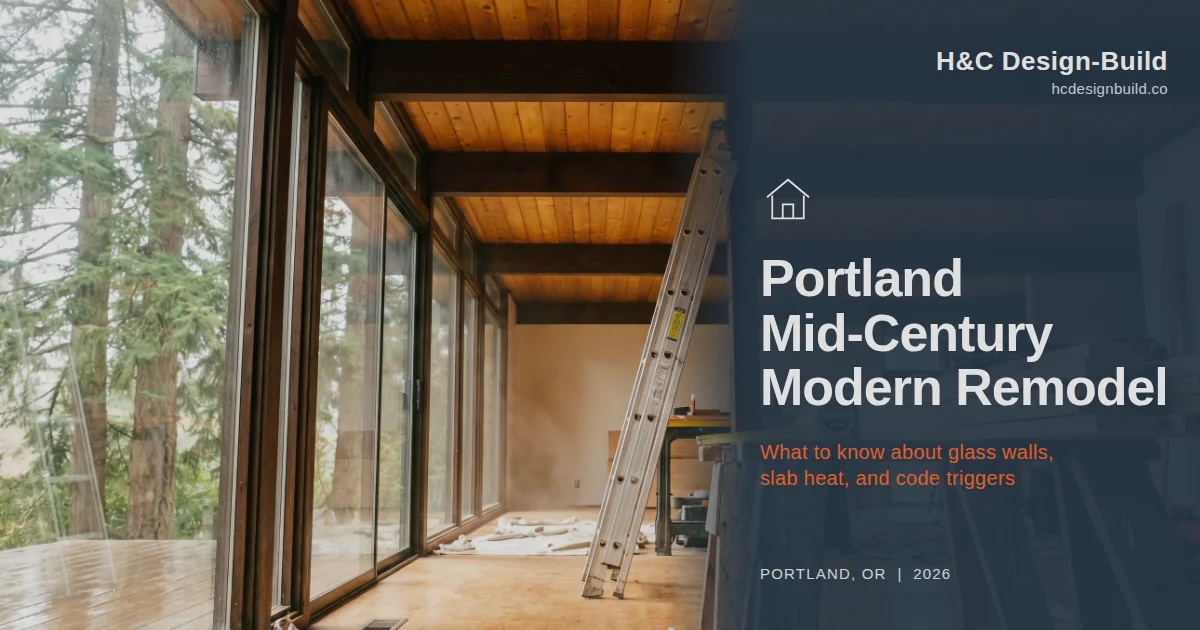
You bought the post-and-beam in Garden Home, or the Rummer in Oak Hills, or the cedar-clad ranch in Cedar Hills. The atrium, the tongue-and-groove ceiling, the wall of glass facing the firs. You love what makes it mid-century. You also just got a $3,200 heating bill, the radiant slab is hissing somewhere under the cork floor, and the inspector flagged the panel.
Portland mid-century modern remodels are their own animal. The assemblies, the failure modes, and the code triggers all behave differently from a Craftsman scope. Here's what to know before you start tearing into one.
Code requirements vary by project scope and permit type. This guide covers general 2026 conditions for Portland mid-century homes. Verify specifics with your contractor and Portland Permitting & Development before starting work. Cost figures throughout are based on Portland-area contractor estimates as of early 2026 and our recent project bids.
What you actually have
Portland's MCM stock spans roughly 1945 to 1975, with peak construction between 1950 and 1970. The biggest single producer was Robert Rummer, who built hundreds of atrium homes in and around Portland through the 1960s and 1970s. Most of his work clusters in Garden Home, Oak Hills (Beaverton), Lake Oswego, and Gresham.
Beyond Rummer, the Portland MCM map runs west through Cedar Hills, Raleigh Hills, Hillsdale, Bridlemile, and Dunthorpe. The east side has its own clusters: Glendoveer, Argay Terrace, Lorene Park, and Regency Park. The neighborhood inventories published by Restore Oregon (opens in new tab) are the most thorough public record of where these homes are concentrated.
Architect-designed examples (Pietro Belluschi, John Storrs, Saul Zaik, Van Evera Bailey) live mostly in the West Hills: Forest Park, Council Crest, Dunthorpe. Those are custom one-offs. The bulk of what we remodel are developer-built ranches, split-entries, and post-and-beam tract homes from the 1955-1970 sweet spot.
Common construction characteristics across the era:
- Flat or low-slope roof, often with no attic and no insulation
- Tongue-and-groove cedar or fir ceiling exposed from below
- Post-and-beam framing with no traditional stud cavity in some walls
- Single-pane floor-to-ceiling glass walls
- Slab-on-grade foundation, often with embedded radiant heat tubing
- 60- to 100-amp electrical service
- Aluminum branch-circuit wiring in homes built between 1965 and 1973
That last one is the era-specific surprise nobody warns you about. We pull it out of Portland MCM houses constantly.
What the code does to you the moment you open a wall
Two facts to internalize.
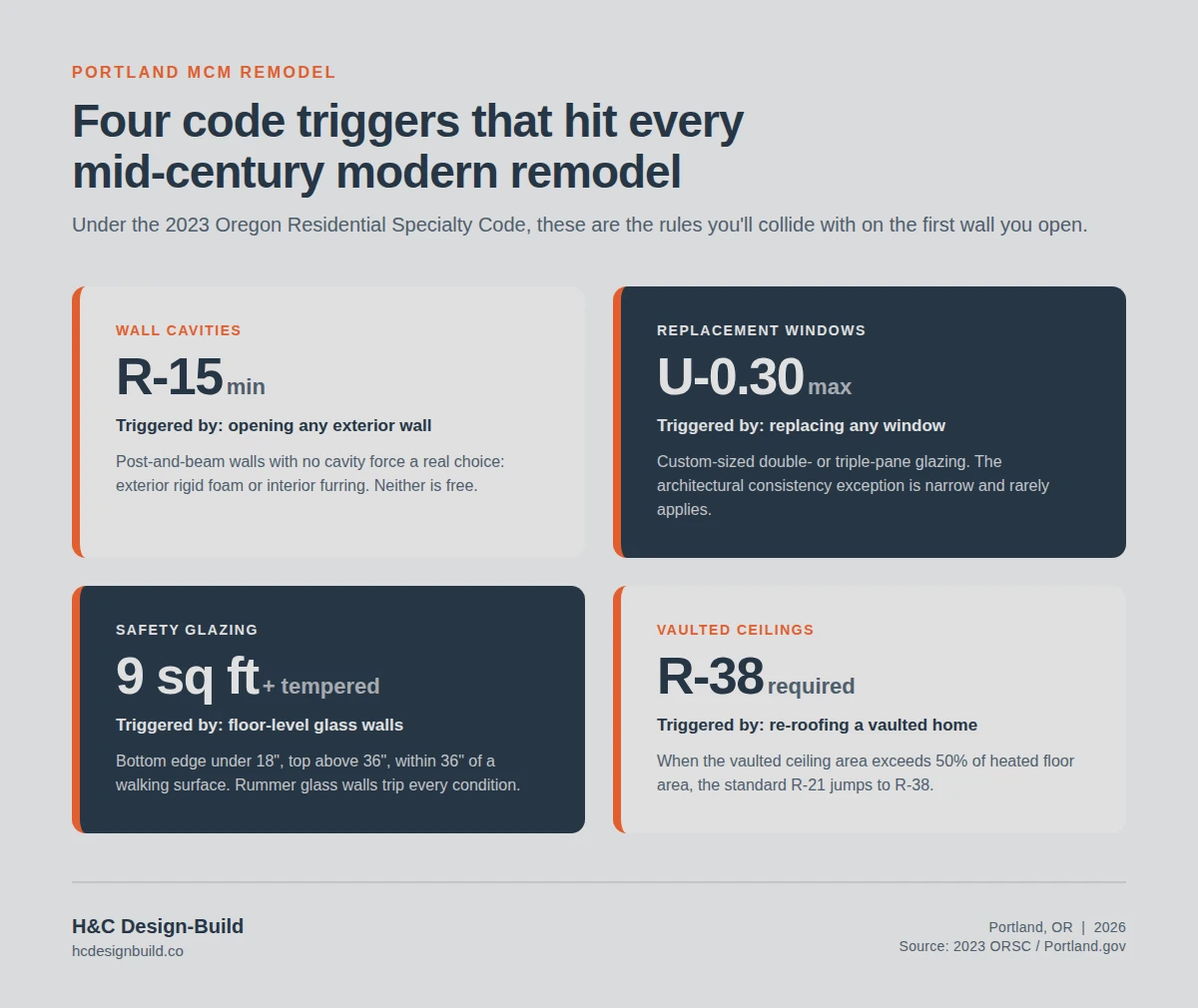
Any exposed exterior wall cavity has to be insulated to R-15 minimum under the 2023 Oregon Residential Specialty Code (opens in new tab). Open a wall for a kitchen layout change, and you owe the code R-15 in everything you exposed. On a stud-frame ranch this is annoying. On a post-and-beam wall with no cavity at all, it forces a real decision. Go exterior: rigid foam under new siding throws off trim, window depth, and overhang lines. Go interior: furring strips give you a thinner room and shift the wood ceiling and trim relationships.
Replacement windows must hit U-0.30 per the same code. The "architectural consistency" exception that lets you stay above that target is narrow. It applies where matching adjacent existing windows is genuinely necessary, not as a blanket out. For most MCM remodels, plan on real double-pane (or triple-pane) glazing in custom sizes. See our Portland window replacement cost guide for the baseline; on a glass wall house that baseline gets multiplied.
Safety glazing rules
Add safety glazing on top of the U-factor target. Any pane 9 square feet or larger has to be tempered or laminated when it meets a few hazardous-location conditions. The bottom edge sits under 18 inches from the floor, the top sits above 36 inches, and the pane is within 36 inches of a walking surface. Floor-to-ceiling MCM glass walls trip every condition. Portland.gov's residential windows page (opens in new tab) is the official starting point on permitting and glazing rules.
Glass-wall replacement on a Rummer-style elevation with 20 linear feet of opening typically lands somewhere between $15,000 and $45,000. The spread depends on frame system (slim-profile aluminum or fiberglass), glazing spec, and whether you're matching custom sightlines. There's no off-the-shelf version of this scope.
The radiant slab problem
Many Portland MCM homes (especially Rummer designs) heat the house through copper or PEX-A tubing embedded in the concrete slab. When the radiant slab system works, it's quiet and even. When a tube fails, you have a problem with no clean fix.
A leak repair means thermal imaging the slab, sawcutting through the floor finish, exposing the failed loop, splicing or re-tubing, patching the slab, and re-finishing on top. Realistic cost: $5,000 to $7,000 for a single-leak repair. More if multiple loops are involved or the floor finish is hard to source. Full slab system replacement runs $15,000 to $30,000 and up, and it requires removing every floor finish in the house.
That's why most Portland contractors who work on MCM homes regularly steer owners toward a different succession plan. Leave the slab loop in place (or formally abandon it), and add a multi-zone ductless heat pump system as the primary heating and cooling source. A 4 to 6 zone whole-house ductless install runs $10,000 to $20,000 in our recent Portland bids. You get cooling the original house never had, qualify for Energy Trust of Oregon (opens in new tab) rebates, and avoid breaking the slab.
The tricky part is hiding the linesets and indoor heads without stabbing your tongue-and-groove ceilings. Surface-mount in mechanical rooms, route exterior on the back elevation, use ceiling cassettes only where the framing allows. This is detail work. Installers who haven't done it before will improvise, and the ceiling pays the price.
Insulating without killing the ceilings
The signature MCM exposed wood ceiling has no insulation cavity. You can't just stuff R-38 batts above it because there is no "above it" you can reach. The standard solution during a re-roof is an over-roof assembly. Rigid polyiso or XPS foam goes on top of the existing deck, taped, then a new roof membrane, and often a sleeper system over the foam to take fasteners.
In our recent Portland bids, this adds $8 to $15 per square foot to a re-roofing scope on top of the membrane itself. Flat roof membranes around Portland run $7 to $12 per square foot for TPO or PVC, or about $18 per square foot for modified bitumen with code-compliant insulation built in. Plan the roof and the insulation as a single project. Doing them separately means tearing through the same assembly twice.
Vaulted ceiling code is also stricter than people expect. When more than 50 percent of your heated floor area sits under a vaulted ceiling, the Oregon energy code (opens in new tab) requires R-38 (U-0.026) instead of the standard R-21. Many MCM houses are majority-vaulted, which means a re-roof on most of these homes triggers the higher target.
Seismic: slab-on-grade is its own category
Portland's prescriptive seismic retrofit program (the bolt-and-brace plans) is built around homes with a continuous concrete perimeter foundation and a cripple wall. Slab-on-grade MCM homes don't have a cripple wall, which removes one failure mode entirely. The program does include a foundation-plate provision for some configurations, but most slab-on-grade Portland MCM homes still need an engineer-designed solution rather than a stock plan.
The total cost is often comparable. A typical engineer-designed retrofit runs $5,000 to $15,000 or more depending on scope. It does add a $1,500 to $4,000 engineering line item and 4 to 8 weeks of design time on top of the construction itself. Daylight-basement MCM homes with post-and-pier sections under the lower level are usually eligible for Portland's prescriptive seismic program (opens in new tab) instead.
For more on retrofit logistics, see our Portland seismic retrofit guide.
Hazmat: every MCM home is a hazmat home
Every Portland mid-century home pre-dates the 1978 lead paint ban, and most pre-date the 1981 phaseout of common asbestos building materials. Oregon requires an asbestos survey on any pre-2004 home before renovation or demolition. Asbestos commonly shows up in:
- 9x9 floor tiles and the black mastic under them
- Pipe insulation and duct wrap (white wrap with corrugated paper backing)
- Vermiculite attic insulation, where attics exist
- Original roofing material on the lowest layers
The Oregon DEQ asbestos page (opens in new tab) is the authoritative starting point. Friable materials (anything that crumbles by hand) require licensed abatement. Non-friable materials in good condition can sometimes stay in place, but anything you're disturbing needs handling. Our Portland asbestos testing and abatement guide walks through the survey-to-abatement workflow.
Lead paint adds the EPA RRP Rule on top of that. Disturb 6 square feet of interior painted surface (or 20 square feet of exterior) on a pre-1978 home, and you need an EPA-certified RRP contractor. Full containment, HEPA vacuuming, and post-work cleaning verification are all required. Oregon enforces it through the Oregon Health Authority's RRP page (opens in new tab).
Ask for the hazmat plan in the bid package, not after you sign.
What to keep and what to change
| Worth preserving | Worth replacing | |---|---| | Tongue-and-groove ceilings | Single-pane glazing | | Stone or Roman-brick fireplaces | 60-amp service and aluminum branch wiring | | Clerestory windows and rooflines | Failed radiant slab heat | | Atriums and indoor-outdoor circulation | Uninsulated walls and roof | | Built-in cabinetry and hi-fi millwork | Single-pane sliding doors | | Original galley layouts (often) | Knob-and-tube where it shows up | | Roman bath tile and original fixtures | Undersized panels |
The mistake we see most often: owners (or cheap contractors) tear out the ceiling to "open it up," then realize they've destroyed the single feature buyers pay a premium for. Tongue-and-groove cedar or fir is irreplaceable at any reasonable cost. New T&G doesn't match old T&G. Clean it, refinish it, run mechanicals around it. Don't drop a soffit through the middle of it.
The other mistake: walling off the atrium because heating it feels wasteful. The atrium is the structural and experiential center of a Rummer-style plan. Close it off and you have a dark hallway house with a glass roof. Re-glaze it, weatherstrip it, run a small dedicated ductless head into it if you must condition it.
What a Portland mid-century modern remodel actually costs in 2026
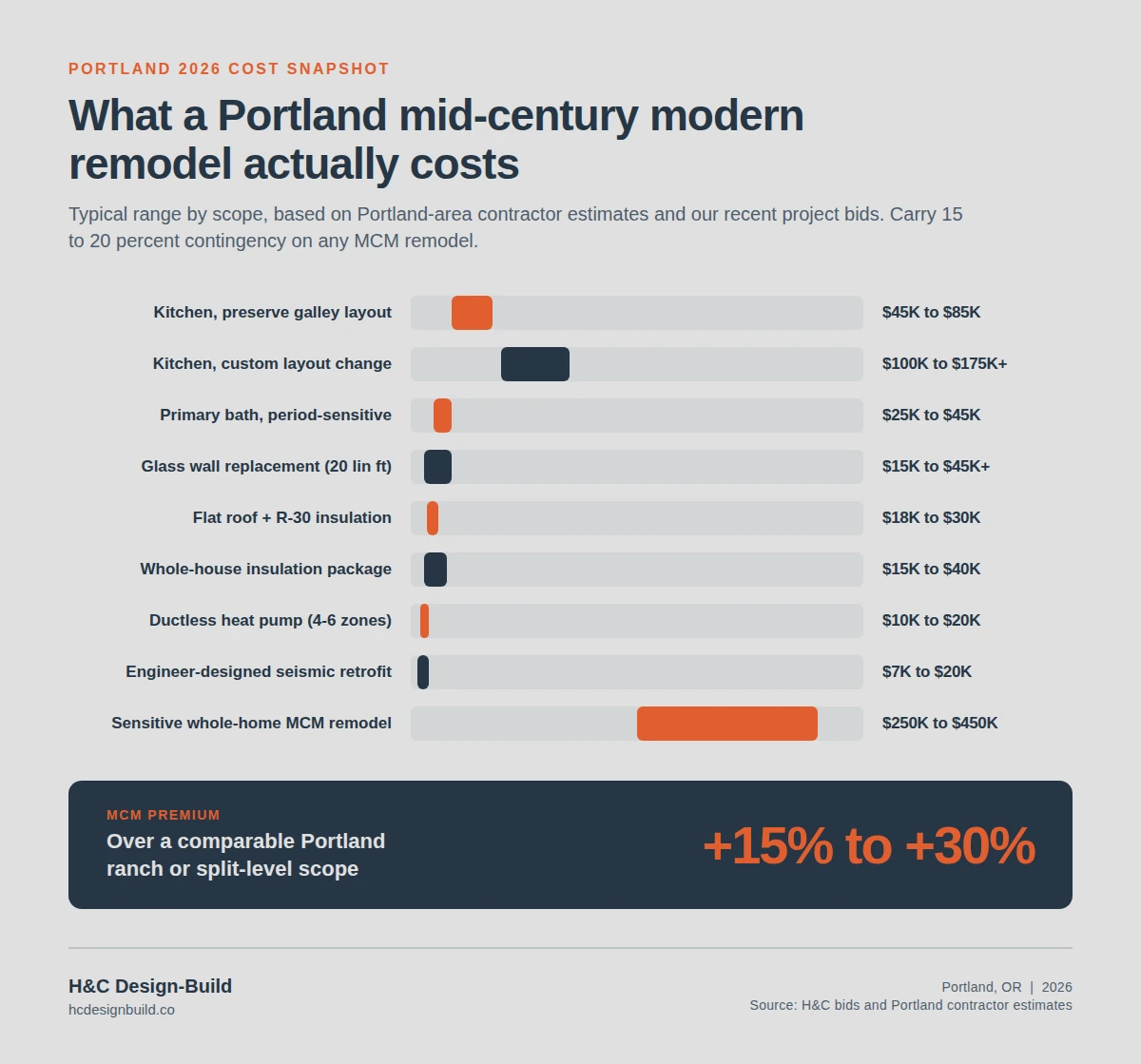
MCM remodels run a 15 to 30 percent premium over comparable scopes on a generic Portland ranch or split-level. The premium comes from custom glass sizing, specialty trim matching, and slab coordination. It's the kind of work a generalist remodeler will shortcut or skip.
| Scope | Typical Portland 2026 range | |---|---| | Kitchen remodel (preserve galley layout) | $45,000 to $85,000 | | Kitchen remodel (layout change, custom millwork) | $100,000 to $175,000+ | | Primary bath, period-sensitive | $25,000 to $45,000 | | Glass wall replacement (20 linear ft) | $15,000 to $45,000+ | | Flat roof with R-30 above-deck insulation | $18,000 to $30,000 | | Whole-house insulation package | $15,000 to $40,000 | | 200-amp panel upgrade | $2,000 to $3,500 | | Ductless heat pump (4-6 zone whole house) | $10,000 to $20,000 | | Engineer-designed seismic retrofit | $7,000 to $20,000 | | Sensitive whole-home MCM remodel | $250,000 to $450,000 |
Carry a 15 to 20 percent contingency. Hazmat findings, slab issues, and custom-glass lead times are the most common reasons MCM projects blow their first budget.
Picking a contractor for an MCM home
Not every Portland remodeler should be doing this work. What separates the contractors who handle MCM well from the ones who damage it:
- They've worked on flat or low-slope roof assemblies before, not just composition shingle
- Post-and-beam structural behavior is part of their vocabulary, not something they look up mid-job
- They can route mechanicals without penetrating the wood ceiling
- Custom glass sourcing is a real specialty, and most generalist remodelers haven't done it
- They can read the era and tell you what's worth preserving without you having to push
- The hazmat plan is in the bid package, not added later
The best filter is the portfolio. If a contractor's gallery has zero MCM houses on it, they probably don't specialize. There's nothing wrong with the generalist who built your friend's deck. They're just not the right team for a 1965 Rummer atrium house.
If you're working through a Portland mid-century scope and want a second set of eyes on it, reach out. We've pulled aluminum wiring out of these houses, re-roofed them, and sourced the glass.