You can feel the draft around the edges. Maybe there's fog between the panes, or the heating bill keeps climbing no matter what you set the thermostat to. You know the windows need replacing.
The problem is that window replacement cost in Portland ranges are all over the map. One site says $300 a window. Another says $2,000. Neither number means much without knowing the material, installation type, and what your house actually needs.
Here's what it costs, what rebates are still available, and what Portland-specific rules you need to know before you sign a contract.
Portland Window Replacement Cost by Material
The frame material is the biggest single cost driver. Here's how the four main options compare for Portland installations.
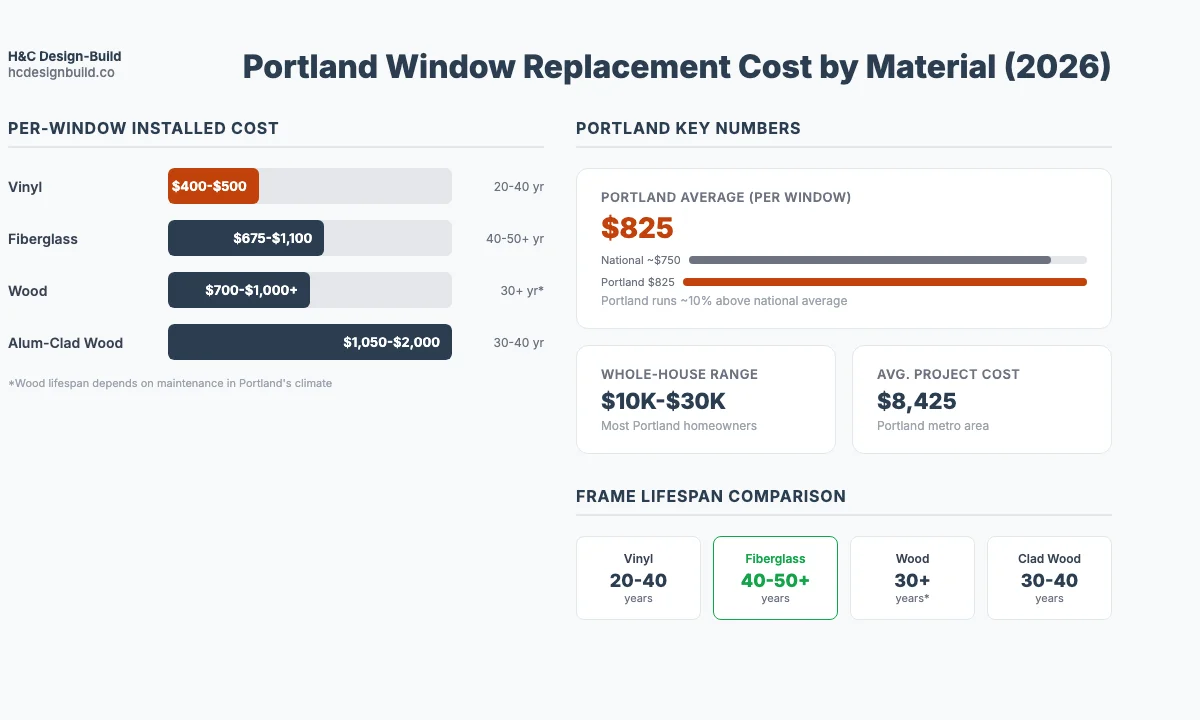
| Material | Per Window (Installed) | Lifespan | Portland Fit | | ------------------ | ---------------------- | ------------ | ------------------------------------ | | Vinyl | $400-$500 | 20-40 years | Good value, handles moisture well | | Fiberglass | $675-$1,100 | 40-50+ years | Best overall for Portland | | Wood | $700-$1,000+ | 30+ years\* | Historic districts, high maintenance | | Aluminum-clad wood | $1,050-$2,000 | 30-40 years | Premium remodels |
\*Wood lifespan depends on maintenance
Portland's average installed window cost runs about $825, roughly 10% above the national average. Pricing data from Angi Portland, Fixr, and HomeGuide (2025-2026 data) clusters in that range.
For a whole-house project, most Portland homeowners pay $10,000 to $30,000 depending on window count, material choice, and installation type. That range comes from local contractors including GreenSavers and My Window Man PDX.
What Drives Costs Up and Down
Insert vs. full-frame installation
Insert replacement fits a new window into the existing frame. It runs $400-$800 per window, about 20-30% less than full-frame. Full-frame replacement removes everything down to the rough opening and runs $800-$1,500+.
Portland's rain makes this choice critical. If there's any moisture damage, soft wood, or peeling paint around the frame, go full-frame. Insert replacement in a compromised frame traps moisture behind the new window. That trapped moisture leads to rot you won't see until the damage is extensive.
Window type matters
Not all window styles cost the same. Based on HomeGuide and Angi 2025-2026 pricing, double-hung windows run $300-$1,000. Casement windows run $400-$1,200. Bay windows run $1,500-$6,000. The style you're replacing determines your baseline.
Triple-pane: worth it?
For most Portland homes, no. Triple-pane glass adds 10-15% over double-pane but has a 15-25 year payback period in Portland's mild Climate Zone 4C, where heating loads are moderate. The wide payback range depends on your heating costs, window count, and how leaky the old windows were.
Where triple-pane does make sense is noise reduction. If your house is near a busy street, under airport flight paths, or along a MAX line, the sound dampening is noticeable and immediate. For thermal performance alone in Portland, double-pane with low-E coating (a thin metallic layer that reflects heat) meets code and performs well.
Pre-1978 homes
Older homes require lead-safe work practices per Oregon Health Authority's Renovation, Repair, and Painting (RRP) Rule (opens in new tab) whenever painted surfaces are disturbed. That applies to most window replacements in pre-1978 homes. Material pricing can shift fast. Our tariff exposure guide covers which categories move most.
Why Fiberglass Wins in Portland
Fiberglass expands and contracts at nearly the same rate as glass. Vinyl expands at roughly 4x that rate. Over years of Portland's temperature swings and wet-dry cycles, that mismatch degrades vinyl seals faster. You see it as fog between the panes or drafts at the sash joints.
Fiberglass is completely moisture immune. No rot, no warp, no mold. In a city that gets 36 inches of rain per year (National Weather Service Portland averages) and months of sustained dampness, that matters.
The lifespan gap tells the story: 40-50+ years for fiberglass versus 20-40 years for vinyl. Most fiberglass windows will outlast the next two rounds of vinyl replacements.
Milgard, manufactured in Tualatin just outside Portland, offers the industry's best warranty: full lifetime coverage on frame, glass, hardware, and labor, including glass breakage. No other major manufacturer matches this. Having the manufacturer local also means faster warranty service.
Fiberglass costs more upfront ($675-$1,100 vs. $400-$500 for vinyl), and color options are more limited than vinyl, though most manufacturers now offer 20+ standard colors. Over 40+ years in Portland's rain, the total cost of ownership favors fiberglass.
Energy Trust Rebates and What's Changed
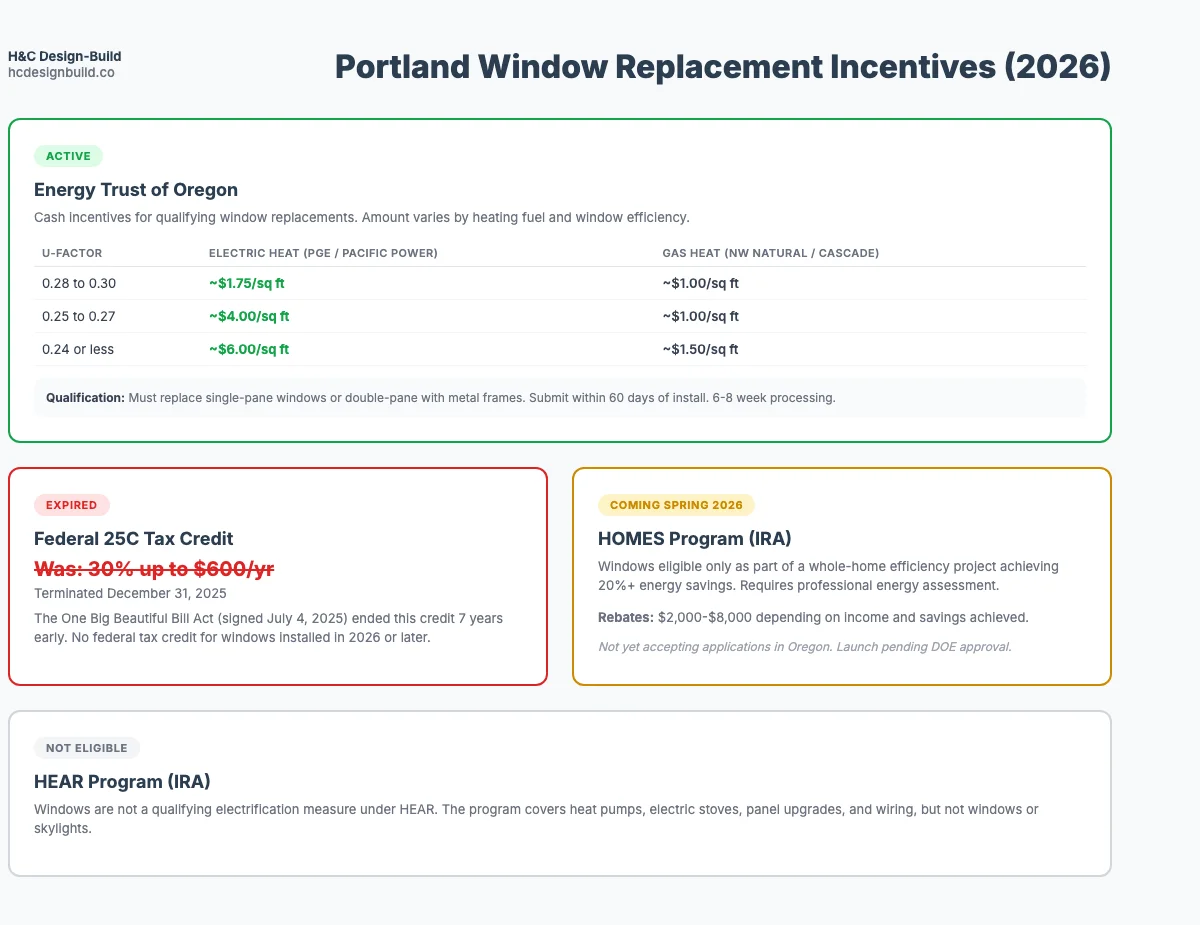
Energy Trust of Oregon (opens in new tab) offers cash incentives for qualifying window replacements. The amount depends on your heating fuel type and the U-factor of the new windows.
| U-Factor | Electric Heat (PGE/Pacific Power) | Gas Heat (NW Natural/Cascade) | | ------------ | --------------------------------- | ----------------------------- | | 0.28 to 0.30 | ~$1.75/sq ft | ~$1.00/sq ft | | 0.25 to 0.27 | ~$4.00/sq ft | ~$1.00/sq ft | | 0.24 or less | ~$6.00/sq ft | ~$1.50/sq ft |
To qualify, you must be replacing single-pane windows or double-pane windows with metal frames. Double-pane windows with non-metal frames do not qualify for Energy Trust incentives.
Submit your application within 60 days of installation. Processing takes 6-8 weeks. Amounts vary by utility and program year, so use the Energy Trust window page (opens in new tab) to check your specific incentive before budgeting around it.
Federal 25C tax credit: expired. The Section 25C Energy Efficient Home Improvement Credit was terminated by the One Big Beautiful Bill Act (opens in new tab) signed July 4, 2025. No federal tax credit is available for windows installed after December 31, 2025.
Oregon's Home Energy Rebate Programs (opens in new tab) (HOMES) can cover windows as part of a whole-home efficiency project, but the program is not yet live in Oregon. Launch is targeted for spring 2026. See our Portland energy rebates guide for the full rundown.
When You Need a Permit
Portland's residential window page (opens in new tab) spells this out clearly.
No permit needed: Like-for-like replacement. Same size, same location, no change to the header. This covers most standard window replacements.
Permit required: Enlarging, reducing, or adding window openings. Any change to the structural header triggers a building permit.
Even exempt work must meet building and zoning codes. Properties in historic districts or design zones may need additional review (more on that below).
When a permit is needed, Portland's minimum fee is $153 plus a 12% State of Oregon surcharge (2025-2026 fee schedule).
For the full permit process, see our Portland building permits guide.
Energy Code: The U-Factor Rule
The 2023 Oregon Residential Specialty Code (opens in new tab) tightened the maximum U-factor for replacement windows from 0.30 to 0.27 in Climate Zone 4C (Portland). Any new window installed in an existing home must meet this standard.
Exceptions exist for specific situations:
- Architectural consistency: Where matching remaining windows requires it, U-factor up to 0.65 is allowed.
- 25% rule: Replacing 25% or less of glazing in one wall requires matching or beating the existing glazing performance.
- Small decorative glazing: Up to 1% of heated floor area is exempt.
Energy Star v7.0 requires U-factor 0.22 or lower for the Northern Climate Zone. That practically requires triple-pane glass. Oregon code does not require Energy Star compliance, but qualifying opens up higher Energy Trust incentives.
Safety glazing (tempered or laminated) is required within 24 inches of doors, within 60 inches of wet surfaces, and near stairs.
Historic District Rules
Portland has three tiers of historic protection, and they affect windows differently.
Historic Districts (Alphabet, Irvington, Ladd's Addition, and 14 others): Window replacement requires Historic Resource Review. Vinyl is typically denied. Wood-frame windows matching original profiles are strongly preferred. Aluminum-clad wood is approved case by case. Street-facing facades face stricter scrutiny than rear or interior-facing windows.
Conservation Districts (Eliot, Kenton, Mississippi, Piedmont, Russell, Woodlawn): More flexibility here. Homeowners can meet Community Design Standards as an alternative to full review.
National Register Districts (Eastmoreland, Laurelhurst, Peacock Lane, and others): No design review required for window replacement.
2022 code changes loosened rules for non-original windows. If a previous owner already replaced the original wood windows, replacing those non-historic windows may now be exempt from review.
Window restoration runs $150-$400 per window based on Portland-area restoration contractors. Original old-growth wood frames last over a century with proper maintenance. A restored historic window paired with a storm window matches the thermal performance of a new double-pane unit at roughly one-third the cost. See our Craftsman bungalow remodel guide for more on preserving original character.
How to Decide: Replace All or Phase the Work
If most of your windows are single-pane or visibly failing, whole-house replacement makes financial sense. If only a few are drafty, phase the work. Start with the worst performers, then move to street-facing windows for curb appeal.
Before you budget, check three things. Your home's age: pre-1978 triggers lead-safe rules. Your district status: historic or conservation districts limit material choices. Your heating type: electric heat qualifies for higher Energy Trust incentives.
Get three bids from licensed Portland contractors. Compare scope, not just price. The lowest bid often excludes trim work, disposal, or full-frame installation where it's needed.
If windows are part of a larger remodel, bundling the work under one contractor usually saves on mobilization and coordination. Our whole-home remodel cost guide covers how to budget across rooms and systems.
Need help planning your window replacement? Contact H&C Design-Build for a project assessment.