If you searched tariffs remodeling costs 2026 because your bid suddenly changed, you're asking the right question.
Two Portland homeowners can start similar remodels in the same month and still get very different price movement. One project has imported appliances and specialty tile. The other uses domestic lines and keeps finish selections flexible. Same city, same season, very different cost pressure.
So skip the broad headline question. Ask a tighter one instead. Which parts of your project are exposed, and what can you control now?
What actually changed, and what stayed in place
As of February 2026, the main tariff framework isn't brand new. It's a stack of actions that started years ago and kept evolving.
- Section 232 (a U.S. national-security trade statute) keeps a 25% additional duty on covered steel imports under the 2018 proclamation (Federal Register, 2018-05478 (opens in new tab)). The same framework started at 10% for aluminum in 2018 (Federal Register, 2018-05477 (opens in new tab)), with a 2025 update raising treatment on covered products (Federal Register, 2025-02832 (opens in new tab)).
- Section 301 (a U.S. trade-law framework tied to unfair trade practice findings) changed for selected China-origin products during the four-year review. Staged effective dates started on September 27, 2024, with additional tranches moving into 2025 and 2026 (Federal Register, 2024-11193 (opens in new tab), Federal Register, 2024-21217 (opens in new tab)).
That means you shouldn't treat one headline number as your remodel forecast. Product code, country of origin, supplier inventory, and substitution options matter more than the headline.
Why your neighbor's project didn't move like yours
Homeowners often compare final totals and assume one side got overcharged. That isn't what happened.
Tariff exposure sits in specific line items. It doesn't spread evenly across labor, permit fees, framing, and finishes. If your project carries a lot of imported finish material, you'll see more movement even when broad local indexes look calm.
Federal tariff enforcement works at the product-code level, not by broad project labels. You can review current treatment through USTR tariff actions and the U.S. International Trade Commission tariff schedule tools (USTR Section 301 actions (opens in new tab), USITC HTS tool (opens in new tab)). Category exposure stays uneven for exactly this reason.
The Portland index from Mortenson showed a modest quarterly move in Q3 2025 at +0.78% (Mortenson Portland Cost Index (opens in new tab)). Nationally, the same update still showed higher year-over-year pressure. So yes, local conditions can look stable while your exact finish package still moves.
Producer Price Index data from the U.S. Bureau of Labor Statistics (BLS) tells the same story. December 2025 readings showed steel mill products up 6.8% month over month, while lumber was down 0.9% (BLS PPI latest numbers (opens in new tab)). Different materials moved in different directions at the same time.
One kitchen jumps. Another doesn't.
Material exposure map for Portland remodel planning
Use this as a planning tool, not a legal tariff classification. The goal is to spot where budget risk sits before final selections are locked. Impact labels reflect our contractor experience with active tariff treatment and recent PPI volatility, not precise percentages.
| Material category | Tariff exposure | Estimated price impact on a remodel budget | Why it moves | | --------------------------------- | --------------- | ------------------------------------------ | --------------------------------------------------------------------- | | Appliances | High | Higher sensitivity | Metal content and imported parts drive repricing | | Specialty tile and imported stone | High | Higher sensitivity | Mostly imported; limited domestic alternatives | | Windows and exterior doors | Medium to high | Moderate to higher sensitivity | Mixed domestic and imported components, aluminum and hardware content | | Plumbing and lighting fixtures | Medium | Moderate sensitivity | Imported subcomponents and supplier lead-time shifts | | Cabinet hardware and metal trim | Medium to high | Moderate to higher sensitivity | Steel and aluminum inputs with finish-specific imports | | Framing lumber | Low to medium | Lower to moderate sensitivity | Commodity swings and regional supply outweigh tariff headlines | | Labor, demolition, and site work | Low direct | Lower direct sensitivity | Driven by local labor rates and scope complexity |
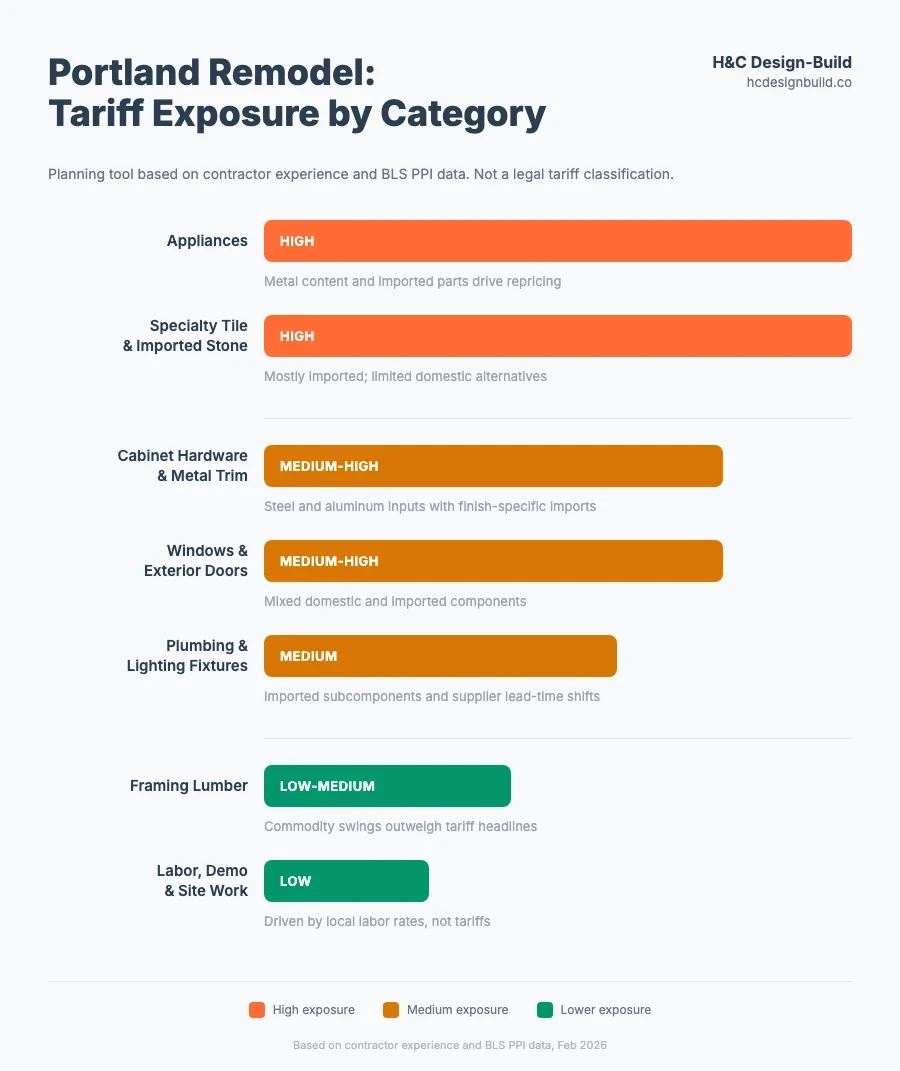
These exposure labels are based on how each category intersects with active product-code tariff treatment (USTR Section 301 actions (opens in new tab), USITC HTS tool (opens in new tab)) and recent material volatility data from BLS PPI releases (BLS PPI latest numbers (opens in new tab)).
If your scope is kitchen or bath heavy, this table matters even more. Finish density is highest in those rooms, and substitution can force design changes late in the process. Our Portland kitchen remodel cost guide and Portland bathroom remodel cost guide show how fast selections can change total spend.
Which project types are most exposed
Most exposed: finish-heavy interiors
High-end kitchens, primary baths, and projects with imported finish packages move first. When those projects include premium appliance suites or specific tile lines, costs can change between design approval and procurement.
Medium exposure: window and envelope upgrades
Window-heavy scopes can be stable with domestic product lines, then jump when specs shift toward imported assemblies or metal-heavy systems. This is one reason we ask clients to approve a primary option and a backup option early.
Lower direct exposure: labor-dominant scopes
Structural repairs, foundation corrections, and many site-heavy scopes still rise in cost. The main drivers are labor and hidden-condition discovery, not direct tariff pass-through. You still need contingency, just for different reasons.
If your project includes exterior work, weather and sequencing can add cost pressure too. Our Portland siding replacement cost guide covers material costs for re-siding, and our Portland deck building guide goes deeper on schedule risk tied to wet-season work.
Should you start now or wait? A decision framework
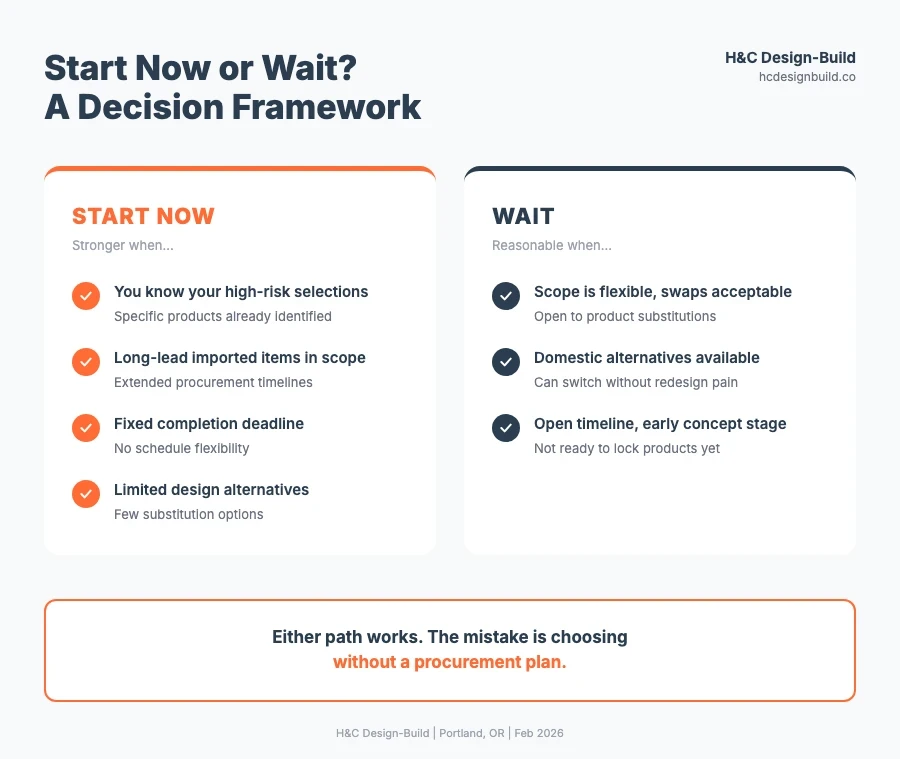
Trying to predict federal policy isn't a reliable remodel strategy. A better move is to run a short decision check against your own scope.
Start now is stronger when:
1. You already know your high-risk selections. 2. Your project depends on long-lead imported items. 3. You need construction completed by a fixed date. 4. Your alternatives are limited because of design constraints.
Waiting can be reasonable when:
1. Your scope is flexible and substitutions are acceptable. 2. You can use domestic alternatives without redesign pain. 3. Your timeline is open, you're still in early concept stage, and you're not ready to lock products.
The mistake isn't choosing one path or the other. It's choosing without a procurement plan.
Seven contractor moves that lower tariff risk
You can't control trade policy. You can control project structure.
1) Freeze key selections earlier
Appliances, specialty windows, and imported finish materials shouldn't be last-minute decisions in 2026.
2) Price two product paths at bid time
Ask for a preferred package and a pre-approved alternate package. You keep design intent while protecting schedule if one line moves. This takes more upfront design work, but it's one of the most effective ways to avoid mid-project pricing surprises.
3) Require country-of-origin visibility
For high-cost line items, you should know where products are sourced before the contract is signed.
4) Convert broad allowances into named products
Allowance drift is where many surprises start. A tighter schedule of values gives better budget control.
5) Pre-order long-lead items once design is locked
This shortens the window where supplier updates can hit you.
6) Use phased procurement if budget is tight
Lock structural and envelope scopes first, then commit to finish categories after updated quotes. This works well when your budget can't absorb locking everything at once, but it does mean your finish pricing stays exposed longer.
7) Keep a real contingency, not a token number
A contingency only works if it can absorb the specific categories that might move.
Trade-offs to expect with this approach
Risk control does have a cost. Early product locks can reduce your ability to change style late. Pre-ordering can tie up cash sooner. Alternate pricing takes more design time up front. A tighter process is worth it, but it asks for earlier decisions.
Portland factors that matter beyond tariffs
Tariff talk gets attention, but local execution still drives outcomes.
Permit path and scheduling matter. City services continue to use online permitting workflows and defined review steps for many residential projects (Portland permitting services (opens in new tab)). If permit timing extends, your procurement window extends too.
Trade availability also matters. A less expensive material option doesn't always save money if it pushes your project into a longer labor timeline.
So we pair cost planning with schedule planning. Price alone isn't the whole risk picture.
Where rebates can help, and where they cannot
Energy-focused incentives can reduce net cost on qualifying upgrades, especially in window, envelope, and equipment categories. They can soften pressure, but they don't erase all price movement.
If your scope includes energy upgrades, check our Portland energy efficiency rebates guide when you build your budget. Treat rebates as offset dollars, not a guarantee.
What to watch each quarter
For this topic, stale data is dangerous. Effective dates and treatment rules can change fast. We review these sources regularly:
- Federal Register proclamations and notices, the official federal rule publications, for Section 232 and Section 301 changes
- USTR (U.S. Trade Representative) tariff actions page for implementation and exclusions
- BLS (U.S. Bureau of Labor Statistics) PPI releases for material movement signals
- Mortenson Portland index for local cost direction
The goal isn't perfect prediction. The goal is fewer surprises between estimate and install.
Bottom line for Portland homeowners
If you're planning a remodel in 2026, don't anchor on one tariff headline. Build a project-specific exposure plan.
Lock high-risk selections earlier. Price alternates in advance. Keep contingency where exposure is real. That protects budget and timeline when policy, suppliers, and lead times keep moving.
This article is educational and current as of February 2026. It isn't legal, tax, or customs compliance advice.
If you want a line-by-line exposure review for your scope, contact H&C Design-Build.