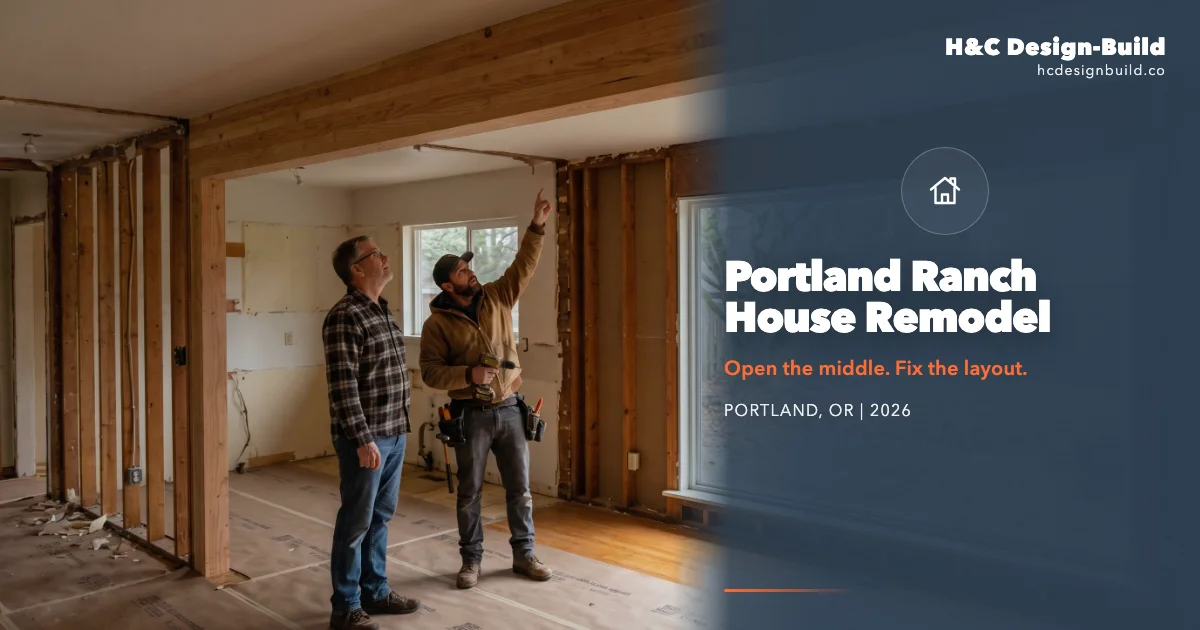
You bought the ranch because the neighborhood made sense, the yard was usable, and the house looked manageable. Then you lived in it for a year. Now the kitchen is too tight, the hall bath is always occupied, and the kitchen wall blocks every conversation in the house.
A Portland ranch house remodel is usually one of the cleaner remodeling plays in this city. These homes are simpler than a Craftsman bungalow and often cheaper to rework than a Foursquare. They are also easier to add onto than a house with a steep second-story roof stacked above everything. That does not mean they are automatic. The wrong wall removal, the wrong addition, or the wrong assumptions about the slab or crawlspace can erase that advantage fast.
Why ranch houses usually remodel well
Most Portland-area ranches were built in the late 1940s through the 1960s. The bones are straightforward: one story, low roof, attached garage in many cases, modest trim package, and a plan built around practical rooms instead of formal symmetry.
That simplicity matters on the job.
- One story means less demolition and less structural stacking.
- Simpler rooflines make additions easier to tie in.
- Crawlspace ranches give plumbers and electricians cleaner access than many pre-war houses.
- There is usually less ornate historic fabric to work around.
The other upside is layout honesty. A ranch does not pretend to be more than it is. The house is usually telling you what needs to happen. Open the middle, fix the kitchen, add a second bath, improve the envelope, and stop wasting square footage on awkward circulation.
The wall everybody wants gone
The most common ranch-house move is still the best one: open the kitchen to the living and dining area.
Postwar ranch homes across Portland usually rely on a center bearing wall because the original framing spans were modest. The kitchen often feels boxed in even when the footprint is decent. On a single-story ranch, opening that wall is usually easier than on a two-story house, but it is still structural work. It needs engineering, a permit, temporary shoring, and the right beam.
In our recent Portland bids, most single-story bearing-wall removals with an LVL beam land between $2,500 and $5,000 for the structural scope itself. If the wall also carries plumbing, electrical, or HVAC, the number climbs.
The practical ranch advantage is that this scope changes the house more than almost any other dollar you can spend. The kitchen feels bigger, sightlines improve, and the whole main living area starts working like a current house instead of a 1955 one. If you want the deeper breakdown, our Portland load-bearing wall removal guide covers the permit and beam side in detail.
One caution: not every ranch should go fully open. A wide cased opening or partial wall can preserve cabinet runs and keep the room from turning into one giant furniture problem. Some of the best ranch remodels improve flow without flattening the entire floor plan.
The bathroom problem is usually next
Most ranch houses were built for a smaller family and a simpler daily routine. That usually means one hall bath and maybe a powder room if you are lucky.
There are three common ways to fix it.
1. Borrow from the existing footprint. A hall closet, an oversized laundry, or part of a bedroom can become a second bath if the plumbing path is reasonable. 2. Rework a garage-adjacent zone. Some ranch plans have dead utility space near the garage entry that can support a powder room, mudroom, or compact bath. 3. Add on. When the lot allows it and the family is staying long-term, a rear primary suite addition solves the bathroom problem and the bedroom problem together.
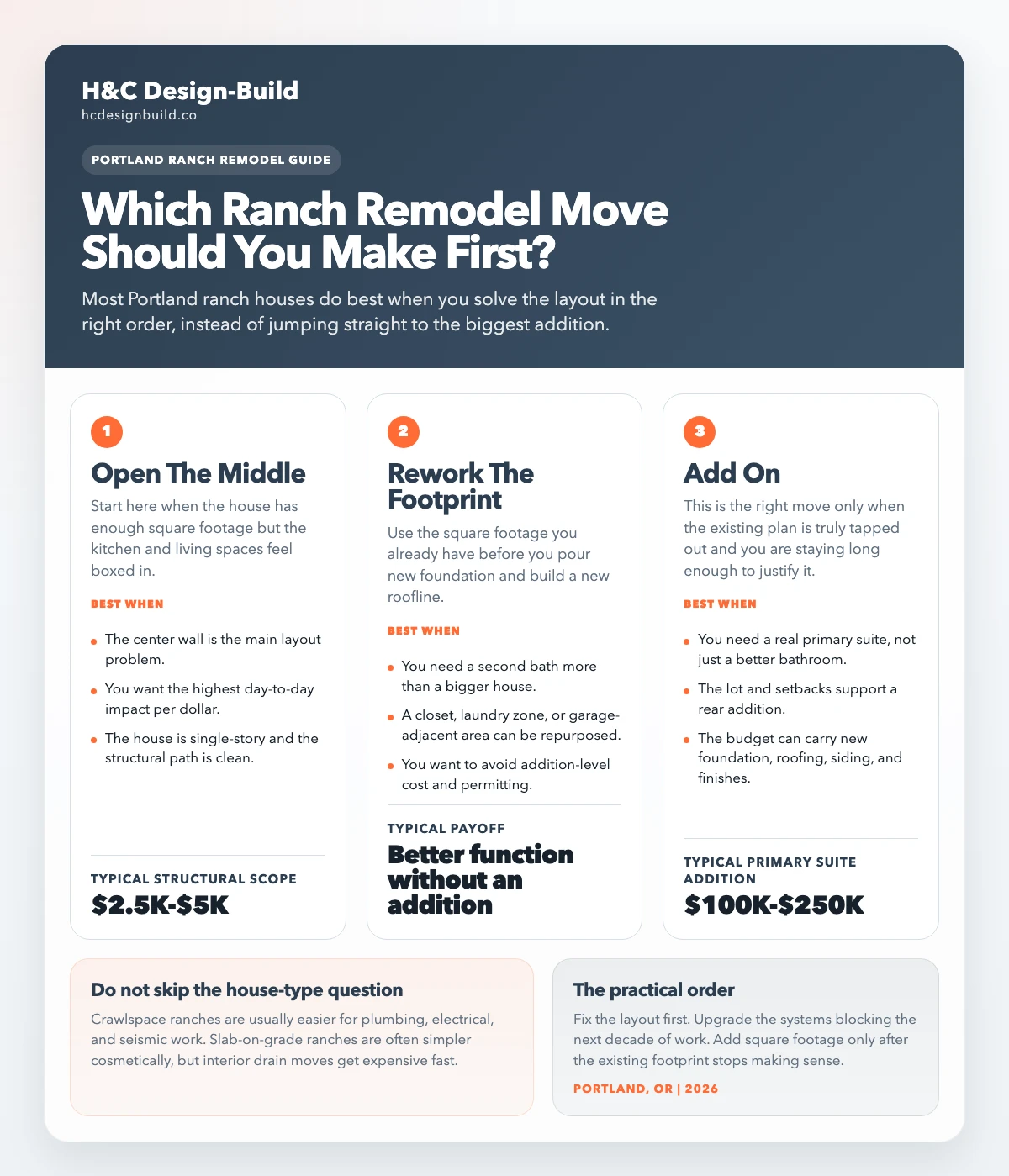
Ranch houses reward restraint here. If you can solve the bathroom count inside the existing footprint, do that first. Once you add foundation, roofing, siding, and a new exterior wall assembly, the budget changes categories. A primary suite addition in Portland typically runs about $100,000 to $250,000, so that move needs to solve a real long-term need. It should not be a costly answer to a temporary annoyance. Our Portland home addition cost guide covers when that jump makes sense.
Hidden conditions still matter
Ranch houses are simpler than pre-war homes, but they are not surprise-free.
What we see most often depends on the decade.
- Earlier ranches can still have galvanized supply piping.
- Many have 60- or 100-amp service that is too small for a modern kitchen, heat pump, and future EV charging.
- Homes from the late 1960s and early 1970s can have aluminum branch wiring (opens in new tab).
- Original windows are usually drafty and underperforming.
- Any pre-1978 ranch needs lead-safe planning.
- Any ranch with suspect flooring, ceiling texture, duct wrap, or old mastic needs asbestos planning.
The hazmat side is the hard gate. Oregon DEQ says (opens in new tab) homeowners should hire an accredited inspector to perform an asbestos survey before renovation, and demolition of a residence built before 2004 requires a survey. For contractor work in pre-1978 homes, Oregon's RRP rule (opens in new tab) stops treating the work as minor repair once it disturbs 6 square feet or more of interior painted surface in a room. The exterior threshold is 20 square feet or more. On a ranch remodel, you cross those thresholds almost immediately.
The right bid package includes the hazard plan before demo starts. Not after.
Spend the first energy dollars in the right places
Ranch owners often want to replace every window first because that is what they feel every winter. Sometimes that is the right call. Often it is not the first one.
On a typical Portland ranch, attic work is usually the cleaner early win. In H&C planning ranges, attic insulation on a 1,200 square foot ranch often runs about $2,500 to $4,500. That is a much smaller step than a whole-house window package, and the comfort gain is often immediate.
Windows matter too, but the code matters with them. Portland says (opens in new tab) replacement windows in an existing house need a U-factor of 0.30 or less. If you are replacing large panes near the floor, safety glazing rules can also apply. Ranch houses with big picture windows and low sill heights hit those triggers more often than people expect.
The other energy budget trap is the panel. A lot of ranch owners want a heat pump, induction range, and maybe an EV charger, then find out the original service cannot carry it. In H&C planning ranges, panel upgrades commonly run about $3,000 to $5,000 depending on scope. That line item is not glamorous, but skipping it can stall the whole electrical plan.
Crawlspace ranches and slab ranches are not the same project
This is one of the most important distinctions in a ranch remodel.
Crawlspace ranches are usually easier for system upgrades. You have access for drain lines, water lines, electrical reroutes, and seismic work. If the house also has a continuous concrete perimeter foundation and a short cripple wall, it may fit Portland's prescriptive seismic criteria. That can keep the retrofit simpler and cheaper.
Slab-on-grade ranches are a different animal. They can be efficient for a straightforward cosmetic remodel, but the moment you start moving drains or cutting in new plumbing locations, the slab starts dictating cost. Additions can still make sense, but interior reconfiguration is less forgiving.
Portland's seismic page is useful here. The City's prescriptive path is built around houses with a continuous concrete perimeter foundation and cripple-wall conditions within its stated limits. If your ranch does not fit that profile, you are likely in engineer territory. Our Portland seismic retrofit guide walks through that decision path.
Historic review is usually lighter, but do not assume
One quiet advantage of many ranch houses is that they sit outside the strictest local historic-review conditions that shape older inner-Portland work.
That said, "usually" is not the same as "always." Portland requires Historic Reviews for certain proposals affecting landmarks and for work in Historic and Conservation Districts. If your ranch is in an overlay area, visible exterior changes can trigger review. Before you assume a new front window package, garage conversion facade, or front addition is straightforward, check PortlandMaps.
The safest default is this: ranch houses often give you more freedom than pre-war historic homes. Exterior work still needs a zoning and permit sanity check before design gets too far.
What is worth keeping, and what is worth changing
| Keep when you can | Change without guilt | |---|---| | Original roofline and low horizontal profile | Drafty original windows | | Good brick fireplaces and masonry accents | 60- or 100-amp electrical service | | Any original post-and-beam or interesting mid-century ceiling detail | Galvanized piping and worn supply lines | | Solid hardwood floors | Cramped kitchen layout | | A garage that still functions well for storage or work | One-bathroom floor plans | | Outdoor connection to patio or yard | Failing insulation and air sealing |
Ranch houses are not precious in the same way a stained-wood Craftsman interior is precious. That is part of their appeal. You can improve them aggressively without wrecking what made them good in the first place. Respect the profile, the light, and the practical logic of the plan.
What a Portland ranch house remodel actually costs
These are the H&C planning ranges that matter most for ranch owners in Portland right now:
| Scope | Typical Portland range | |---|---| | Bearing-wall opening in a single-story ranch | $2,500 to $5,000 | | Kitchen refresh | $15,000 to $30,000 | | Mid-range kitchen remodel | $45,000 to $85,000 | | Full kitchen gut with layout changes | $85,000 to $150,000+ | | Attic insulation on a typical 1,200 sq ft ranch | $2,500 to $4,500 | | Panel upgrade | $3,000 to $5,000 | | Primary suite addition | $100,000 to $250,000 |
Those numbers are broad on purpose. Ranch houses are more predictable than older two-story homes. But when the job includes windows, a panel, kitchen rework, a bath addition, and finish upgrades, the budget stacks quickly.
The right way to think about a ranch remodel is not room by room. Think by decision:
- Are you staying in the house long enough to justify the addition?
- Can the bathroom count be fixed inside the footprint?
- Is the kitchen wall worth opening?
- Is this a crawlspace house or a slab house?
- Do the panel and windows need to be in phase one, or can they wait?
A Portland ranch usually gives you a cleaner path than most old houses. Use that advantage. Solve the layout first, fix the systems that block the next decade of upgrades, and only add square footage when the existing footprint is truly tapped out.
If you are planning a ranch remodel and want help sorting the structural work from the cosmetic wish list, reach out. We can help you figure out what is worth moving, what is worth keeping, and where the budget actually needs to go.