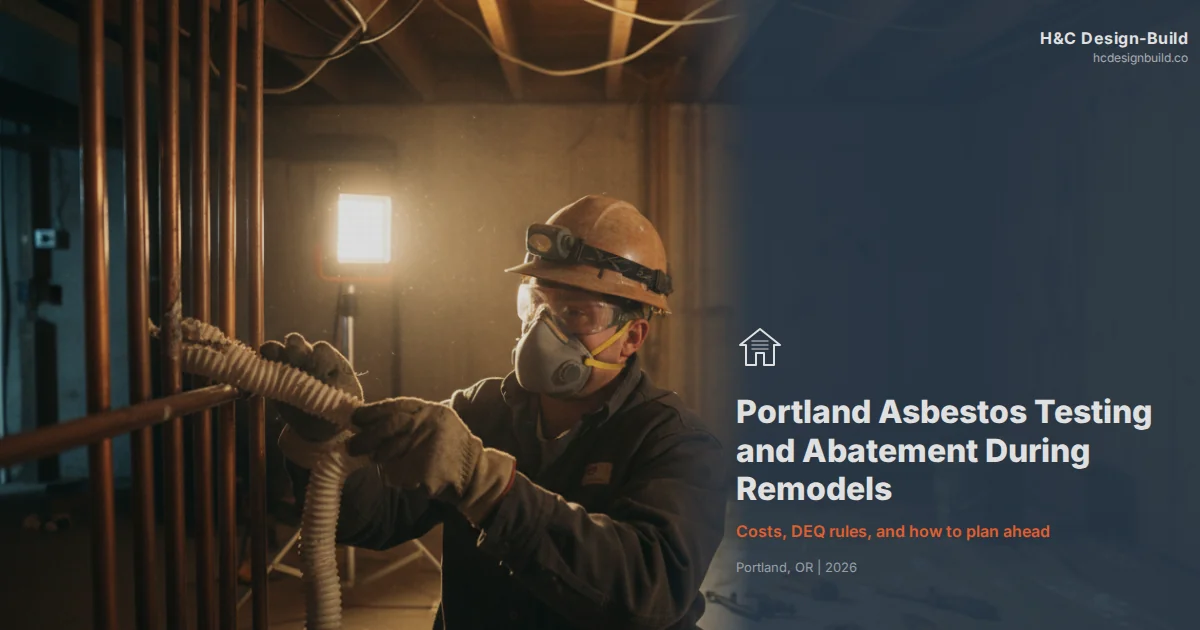
You are tearing out a kitchen ceiling in a 1960s ranch house in Northeast Portland and the texture coat starts crumbling into gritty chunks. Or the demo crew pulls up old 9x9 vinyl tiles and finds black adhesive underneath that nobody accounted for. Either way, the job stops.
Portland asbestos abatement cost ranges from about $1,500 for a small contained job to $20,000 or more for a multi-room ceiling removal. The city has a huge stock of mid-century homes. Nearly every material category from that era can contain asbestos: ceiling texture, floor tiles, pipe wrap, siding, duct insulation, even the joint compound in the walls. The difference between a manageable line item and a project-derailing surprise comes down to when you find it.
For site-specific exposure concerns, health questions, or complex multi-material projects, work directly with a DEQ-accredited inspector and a licensed abatement contractor. Regulations change: verify current requirements with Oregon DEQ (opens in new tab) before starting work.
Where asbestos hides in Portland homes
Asbestos was mixed into dozens of building products from the 1920s through the early 1980s. In Portland's housing stock, these are the materials we encounter most often during remodels.
Popcorn and acoustic ceilings are the single most common find. If the ceiling texture went up between the mid-1950s and 1980, assume it contains asbestos until a lab says otherwise. Scraping or sanding this material releases fibers immediately.
The next most frequent discovery is 9x9 vinyl floor tiles. Virtually all tiles in that size from the 1950s through 1970s contain asbestos. The black cutback adhesive (mastic) underneath often does too, even if the tile itself tests clean. We see this in kitchens, basements, and utility rooms in pre-1940 Portland homes and mid-century ranches alike.
Pipe and boiler insulation carries the highest risk. The white or gray corrugated wrap on heating pipes and boiler surfaces is typically friable, meaning it crumbles under hand pressure and sheds fibers easily. Common in homes with older radiator systems or hydronic heat.
If your Portland home has vermiculite attic insulation, treat it as asbestos-containing until testing says otherwise. This lightweight, pebble-like material was poured loose into attic cavities. Most vermiculite sold before 1990 came from mines in Libby, Montana that were contaminated with a particularly hazardous asbestos fiber type. Do not disturb it.
Other materials worth testing in pre-1980 homes:
- Transite (fiber cement) siding panels on mid-century homes
- Pre-1977 joint compound and drywall texture
- Roofing felt and some 1960s-era asphalt shingles
- Window glazing putty
- HVAC duct wrap and flexible connectors
If the home was built before 1980, any demolition or renovation should start with testing.
How testing works
The process is straightforward:
1. An accredited inspector visits the site and identifies suspect materials. 2. The inspector pulls small bulk samples, typically a 1-3 cm plug or scraping from each material type in the work area. 3. Samples go to a certified laboratory for Polarized Light Microscopy (PLM) analysis. 4. Results come back in 3 to 7 business days. Most Portland labs offer 24 to 48 hour rush service for an extra fee.
For a typical kitchen remodel or bathroom renovation in a pre-1980 home, expect 4 to 8 samples and a total testing cost in the $350 to $700 range based on Portland-area inspector quotes (as of 2026). A full pre-renovation survey covering an entire house runs $600 to $1,200.
Oregon law requires a pre-renovation asbestos survey before any contractor-performed work on residential buildings constructed before January 1, 2004 (opens in new tab). The survey must be conducted by an accredited inspector, and the report must be on-site during work. For a partial remodel, only the affected area needs to be surveyed.
Owner-occupants doing their own renovation work are exempt from the mandatory survey requirement, though DEQ strongly recommends testing regardless. That exemption doesn't apply to demolition projects.
Portland asbestos abatement costs by material
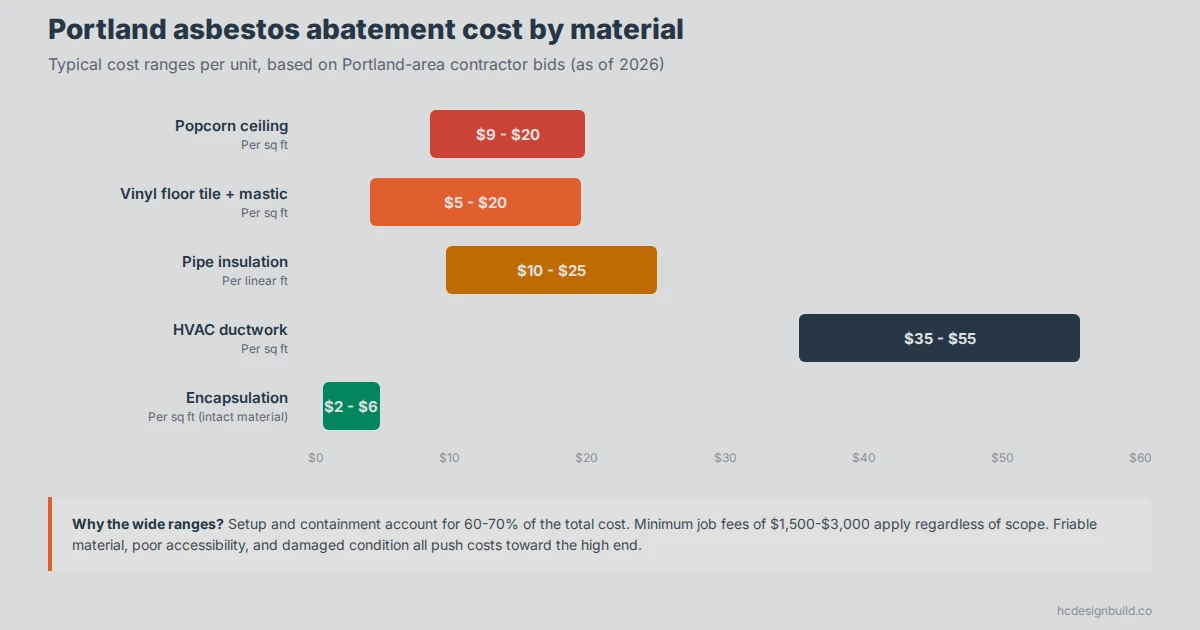
Setup and containment account for 60 to 70 percent of the total cost on most residential jobs. Building the enclosure and running HEPA filtration under negative pressure is expensive no matter how little material you're pulling. That's why minimum job fees of $1,500 to $3,000 are standard across Portland-area abatement contractors, even for a single pipe section.
Typical cost ranges by material type, based on Portland-area contractor bids and project data (as of 2026):
| Material | Unit | Typical Range | |----------|------|---------------| | Popcorn ceiling | Per sq ft | $9 to $20 | | Vinyl floor tile + mastic | Per sq ft | $5 to $20 | | Pipe insulation | Per linear ft | $10 to $25 | | HVAC ductwork | Per sq ft | $35 to $55 | | Encapsulation (intact material) | Per sq ft | $2 to $6 |
A 1,000 square foot popcorn ceiling removal typically runs $9,000 to $20,000. A 200 square foot kitchen floor tile job falls in the $1,000 to $4,000 range. Whole-house abatement covering multiple materials can reach $15,000 to $33,000 or more.
These ranges move based on accessibility (crawlspaces and high ceilings cost more), whether the material is friable or nonfriable, overall quantity, and material condition. Damaged or water-stained material gets treated as friable regardless of its original classification, which bumps the cost up.
Clearance air testing adds $200 to $400 per event and is required by DEQ for friable projects.
Oregon DEQ rules for remodels
Oregon's asbestos program runs under OAR Chapter 340, Division 248 (opens in new tab), which adds state requirements on top of federal hazardous air pollutant rules. The Oregon DEQ Asbestos Program is the primary enforcement agency.
Two categories matter for remodels:
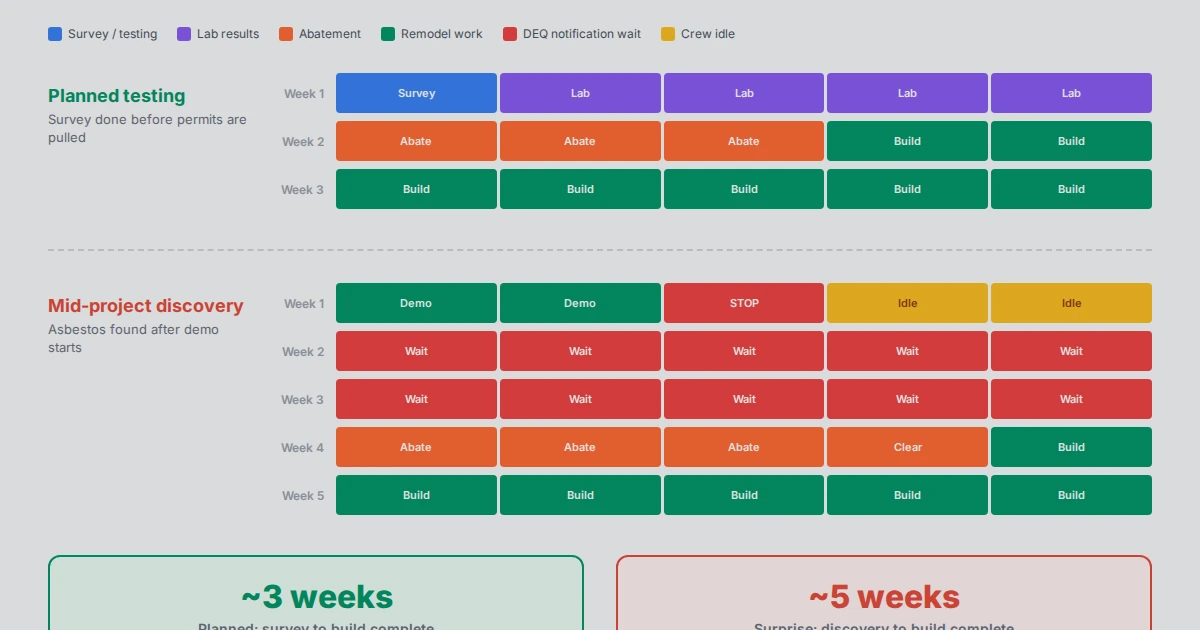
Friable asbestos (the crumbly, fiber-shedding kind) can only be removed by a DEQ-licensed asbestos abatement contractor. The contractor must file an ASN-1 notification form with DEQ at least 10 business days before work begins. That 10-day wait is non-negotiable and is the single biggest reason surprise discoveries blow up project timelines.
Nonfriable asbestos (intact material that doesn't crumble) can be removed by a DEQ-licensed contractor, a CCB-licensed general contractor, or the owner-occupant. A shorter ASN-6 notification is required 5 days before work starts. The catch: if nonfriable material gets rendered friable during removal (cutting, grinding, breaking it apart), it falls under the friable rules.
All notification forms go through the Your DEQ Online (opens in new tab) system.
Owner-occupants doing their own renovation work in their primary residence are exempt from both the survey and notification requirements. But they must still follow all waste packaging, transport, and disposal rules. And the exemption doesn't cover demolition projects.
Encapsulation vs. removal
Encapsulation applies a sealant over intact asbestos-containing material to bind fibers and prevent release. Removal takes it out permanently. Here is how they compare:
| | Encapsulation | Removal | |---|---|---| | Cost per sq ft | $2 to $6 | $5 to $20+ | | Best for | Intact material that won't be disturbed | Any material in the renovation path | | DEQ notification | ASN-6 (nonfriable, 5 days) | ASN-1 (friable, 10 business days) | | Long-term | Material stays in place; future work inherits it | Permanent solution |
Encapsulation works when the material is in good condition, won't be disturbed, and sits in a low-traffic area. Intact transite siding being painted over or undamaged floor tile going under new flooring are reasonable candidates.
For remodels, removal is almost always the right call. If you're cutting into or demolishing a surface, encapsulation doesn't solve the problem. The material stays in place, and the next contractor or owner inherits it. During a renovation where containment and crew are already on site, paying the difference for full removal is usually worth it.
What happens when you find it mid-project
This is the expensive scenario. A crew opens a wall or pulls up flooring and hits something that looks like asbestos. Oregon rules require immediate work stoppage in the affected area.
The right response:
1. Stop all work in the affected area. 2. Keep the exposed material wet. 3. Cover it with 6-mil poly sheeting. 4. Seal any HVAC vents in the area to prevent fiber migration. 5. Don't run the forced-air system until the area is cleared. 6. Call a DEQ-licensed abatement contractor and Oregon DEQ at 503-229-5982.
If the material is friable, that 10-business-day notification wait kicks in before abatement can even start. Add the abatement work itself and clearance testing, and you're looking at two to three weeks of dead time on the project. Your general contractor's crew is sitting idle. Sequential trades (tile, drywall, paint) all get pushed. Emergency scheduling often carries a premium.
Compare that to a pre-renovation survey that costs $350 to $700 and takes a week to come back. When abatement is planned into the project from the start, the contractor bids it as part of the scope. No surprise mobilization, no crew downtime, no emergency pricing.
DIY: legal but risky
Oregon is one of the more permissive states here. Owner-occupants can legally remove even friable asbestos from their own primary residence. No survey requirement, no notification requirement for renovation work.
But "legal" and "safe" aren't the same thing. The EPA classifies asbestos as a known human carcinogen (opens in new tab) with no safe exposure threshold. Mesothelioma can take 20 to 50 years to develop after exposure. Proper removal requires a P-100 respirator (not a dust mask), full Tyvek suit, 6-mil poly containment, HEPA-filtered negative air, and amended water (water mixed with a surfactant to keep fibers from going airborne) throughout. You still have to double-bag waste in labeled 6-mil poly, transport it to a DEQ-permitted landfill, and complete an ASN-4 waste shipment record (a DEQ waste tracking form).
If containment fails and fibers spread through the home, professional remediation costs far more than the original abatement would have. For most homeowners, that math is simple: hire a licensed contractor.
Portland resources
The Oregon DEQ Asbestos Program (opens in new tab) (503-229-5982) is the primary regulatory resource and maintains lists of licensed contractors and accredited labs. The City of Portland (opens in new tab) has local guidance and permitting contacts for both asbestos and lead paint. For waste disposal, Metro's transfer stations (503-234-3000) accept small residential quantities: up to two 25-pound double-bagged loads from non-commercial customers.
Test before you demo
A $500 asbestos survey before permits are pulled is cheap insurance against a $5,000 surprise mid-project. If you're planning a renovation on an older Portland home, build asbestos testing into your pre-construction checklist and carry a 10 to 15 percent contingency for abatement. Reach out to H&C Design-Build and we'll help you scope the full picture before the first wall comes open.