You pull back the vanity in a 1970s bathroom in Southeast Portland and find the drywall behind it black and soft to the touch. Or the crew opening up a basement wall in a Beaverton split-level hits framing covered in fuzzy white growth that wasn't visible from the finished side. The remodel just got more complicated. If this is your first time dealing with mold, the cost and process questions hit all at once.
Portland mold remediation cost ranges from about $500 for a small surface cleanup to $30,000 or more for large-scale structural remediation. All cost figures in this guide are based on Portland-area contractor estimates as of early 2026.
This guide covers health-related topics for educational purposes only. For mold exposure concerns, consult your physician. If the job needs professional containment, look for IICRC or NORMI certification: those contractors are trained on containment protocols and clearance standards. Oregon doesn't require a dedicated mold remediation license, but contractors performing work over $1,000 must hold an active Oregon CCB license (opens in new tab).
Why Portland homes grow mold
Portland gets 36 to 40 inches of rain per year, most of it between October and May (per NOAA climate normals). During those months, outdoor relative humidity averages 75 to 85 percent. That moisture finds its way inside through foundation walls, crawl space soil, roof leaks, window condensation, and plumbing failures. Once indoor humidity stays above 60 percent for more than a day or two, mold colonizes any organic surface: wood framing, drywall paper, carpet backing, insulation facing. The EPA (opens in new tab) recommends keeping indoor humidity between 30 and 60 percent to prevent growth.
The problem is worse in older homes. Pre-1970 Portland houses typically have no vapor barriers in crawl spaces, no mechanical ventilation, and single-pane windows that sweat all winter. Plaster walls absorb moisture without showing visible damage for years. We see the worst mold conditions in unventilated crawl spaces in Northeast and North Portland. Hillside basements in Southwest Portland and Lake Oswego are another hot spot, where hydrostatic pressure pushes water through foundation walls. Attics are a third: bathroom exhaust fans that vent into the attic cavity instead of outside are one of the leading causes of attic mold here.
Newer homes aren't immune. Tight construction with inadequate ventilation traps moisture just as effectively as old construction that leaks. But mold problems in Portland are concentrated in pre-1980 housing.
Common mold types in Portland homes
The type of mold matters for both health risk and remediation approach. Here's what we find most often in Portland homes.
Cladosporium
The most common indoor mold in our area. Olive-green to black, it grows on wood, textiles, and damp drywall. It triggers allergies and respiratory irritation but isn't considered toxic.
Penicillium
Blue-green growth on water-damaged insulation, drywall, and wood. It spreads fast in cool, damp conditions, which describes a Portland crawl space from October through April. Known allergen and asthma trigger.
Aspergillus
Common in HVAC ducts and on decaying organic material. We see it most often in forced-air systems in older homes. Most species cause allergic reactions. Some are dangerous for people with compromised immune systems.
Stachybotrys chartarum (black mold)
This is what most people mean when they say "black mold." It requires sustained moisture on high-cellulose materials like drywall paper or wood. It produces mycotoxins (toxic compounds from fungal metabolism) linked to respiratory distress and more severe reactions. Stachybotrys is less common than the other types listed here. It needs weeks of constant moisture to establish. When it does show up, professional remediation with full containment is the only safe approach.
What professional mold remediation involves
The process follows the same sequence regardless of mold type or location:
1. Inspection and testing. A qualified inspector assesses the extent of contamination and identifies the moisture source. Air sampling runs $250 to $350 per test location. Surface sampling costs $200 to $300 per sample. A full inspection in Portland runs $300 to $500 for a typical home. The Oregon Health Authority (opens in new tab) notes there are no established standards for "safe" indoor mold levels. Testing is most useful for identifying the species, confirming contamination behind finished surfaces, and establishing a baseline for post-remediation clearance.
2. Moisture source repair. No remediation lasts if the water source stays active. This could mean fixing a roof leak, repairing plumbing, improving drainage, or addressing basement waterproofing. The remediation contractor handles the mold; the moisture source fix may involve a roofer, plumber, or general contractor.
3. Containment. The work area is sealed with 6-mil polyethylene sheeting and zipper entry barriers. HEPA-filtered negative air machines exhaust contaminated air outside, keeping airflow moving into the containment zone rather than out of it.
4. Removal. Porous materials that can't be cleaned (drywall, insulation, carpet, some wood) get cut out and double-bagged in 6-mil poly. Non-porous surfaces are scrubbed with antimicrobial agents. Every surface in the containment area gets HEPA-vacuumed and wiped down.
5. Clearance testing. An independent party (not the remediation contractor) takes air and surface samples to verify the work is complete. This runs $150 to $500 and adds 1 to 3 days for lab results. Oregon doesn't require independent clearance testing, but it's the best way to verify work quality and protect against future liability.
6. Reconstruction. Replacement of drywall, insulation, framing, and finishes. This is often handled by a general contractor rather than the remediation crew.
Portland mold remediation costs by location
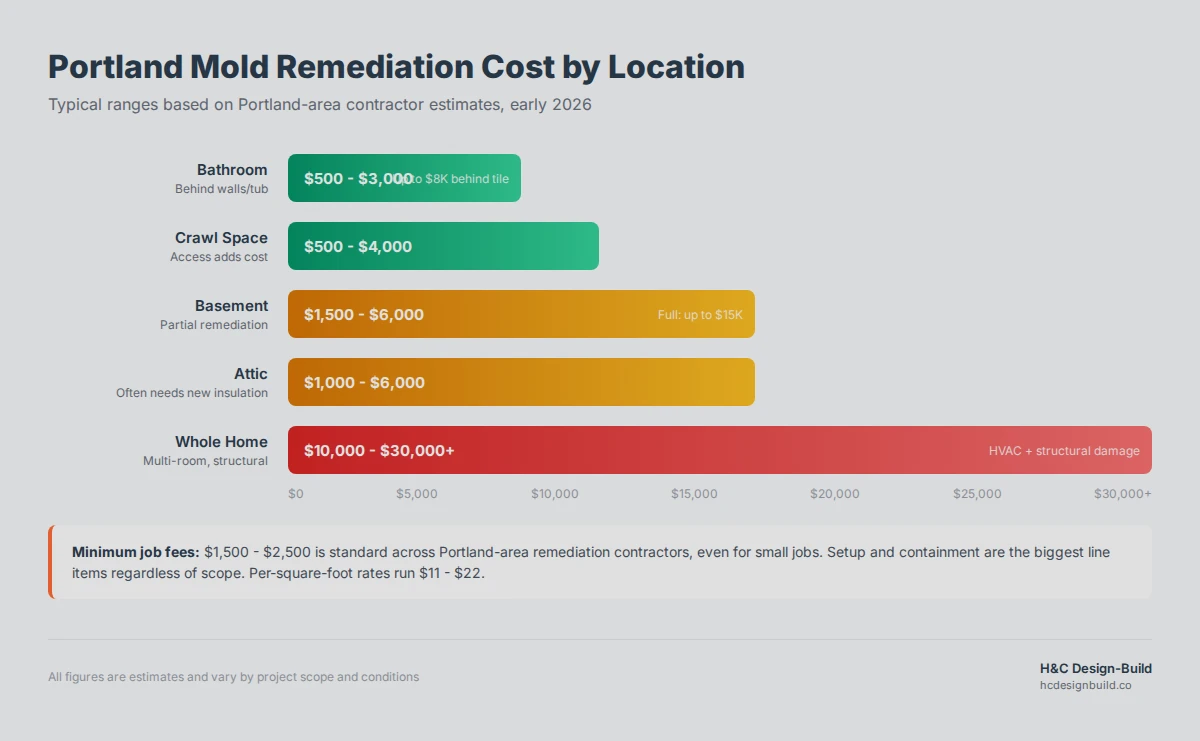
Setup and containment are the biggest line items on most residential jobs. Building an enclosure and running HEPA filtration is expensive regardless of how much material gets removed. That's why minimum job fees of $1,500 to $2,500 are standard, even for a single closet wall.
Typical cost ranges by location, based on H&C estimates and current Portland-area remediation contractor pricing:
| Location | Typical Range | Notes | |----------|---------------|-------| | Bathroom (behind walls/tub) | $500 to $3,000 | Can reach $8,000 if mold extends behind tile | | Crawl space | $500 to $4,000 | Access difficulty adds cost; full encapsulation separate | | Basement (partial) | $1,500 to $6,000 | Full basement remediation up to $15,000 | | Attic | $1,000 to $6,000 | Insulation replacement often needed | | Whole home (multi-room) | $10,000 to $30,000+ | Structural damage, HVAC involvement |
Per-square-foot rates in Portland run $11 to $22. The spread comes down to what's involved: surface cleaning on accessible walls versus full containment removal in tight spaces.
Clearance testing adds $150 to $500 per event. If a project requires multiple rounds of testing because the first clearance fails, each retest adds to the total.
Insurance: what's covered and what's not
Oregon homeowners insurance covers mold remediation in a narrow set of circumstances. If the mold resulted from a sudden, covered event, the remediation is typically part of that claim. A burst pipe that floods a wall and grows mold within days: covered. A storm that tears off roof shingles and lets rain soak the attic: covered.
What's almost never covered: mold from gradual leaks, condensation, high humidity, or deferred maintenance. A slow drip under the kitchen sink that went unnoticed for six months, causing mold behind the cabinet: not covered. Crawl space mold from years of ground moisture wicking up through soil: not covered.
Even when coverage applies, many policies cap mold claims. Check your specific policy for the fungi or microbes coverage limit. It's common for the cap to fall well short of actual remediation costs on anything beyond a small job. Some insurers offer endorsements that raise the limit.
Document everything from the start: photos of the water damage, dates you discovered it, professional inspection reports. If you're filing a claim, an independent inspection report from before remediation begins strengthens your position.
When to DIY and when to call a pro
The EPA (opens in new tab) says homeowners can handle mold cleanup if the area is under 10 square feet (roughly a 3-by-3-foot patch) and the mold is on a non-porous surface. Use an N-95 respirator, goggles, and gloves. Clean with soap and water or a diluted bleach solution. No containment needed for this scale.
Here's how the two approaches compare:
| | DIY | Professional | |---|---|---| | Area size | Under 10 sq ft | Over 10 sq ft | | Material type | Non-porous surfaces only | Porous materials (drywall, insulation, wood, carpet) | | Containment | Not required | Full 6-mil poly + HEPA negative air | | Typical cost | Under $100 in supplies | $1,500 to $30,000+ | | When required | Simple surface mold, no health concerns | Stachybotrys, HVAC contamination, sewage/flood water, recurring mold, or household members with respiratory conditions |
In Portland's older homes, what looks like a small patch of bathroom mold often extends behind the finished wall where moisture has been collecting for years. Surface cleaning addresses what you can see. It doesn't address what's behind the drywall, under the subfloor, or between the studs.
Mold found during a remodel
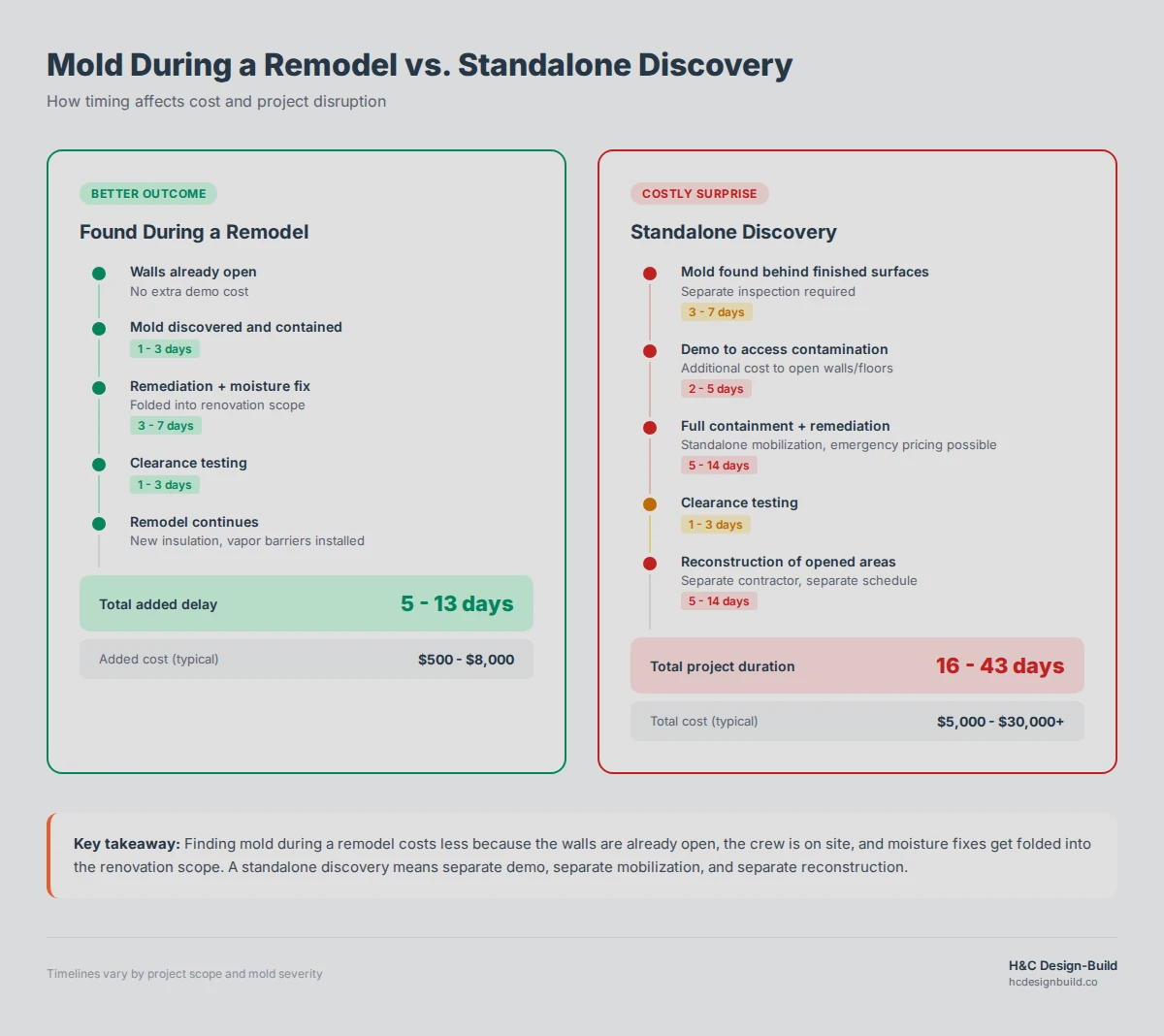
This is one of the most common scenarios we deal with. A crew opens a wall for a bathroom remodel or pulls up flooring and finds mold that was invisible from the finished side. Work stops in the affected area until remediation is complete.
The timeline impact depends on severity:
- Minor surface mold on framing: 1 to 3 day delay, $500 to $2,000 added to the project
- Moderate contamination requiring drywall and insulation removal: 1 to 2 week delay, $2,000 to $8,000 added
- Severe structural contamination: multi-week delay, $10,000 to $30,000+, possible change in project scope
The upside: finding mold during a remodel is actually the least expensive way to deal with it. The walls are already open, so you're not paying separate demo costs. Moisture problems can be fixed as part of the renovation scope. New insulation, vapor barriers, and ventilation go in before the walls close back up. A standalone remediation project on a finished home costs more because the contractor has to open and then re-close everything.
If you're renovating a pre-1980 Portland home, carry a 10 to 15 percent contingency for unexpected conditions. Mold is one of the most common surprises, alongside asbestos in older materials.
Preventing mold in Portland's climate
Prevention costs less than remediation. These are the measures that matter most in Portland's wet climate.
Moisture and ventilation
Keep indoor humidity between 30 and 60 percent. A hygrometer costs under $20 and tells you where you stand. Run dehumidifiers in basements and crawl spaces during the wet season, targeting 45 to 55 percent.
Every bathroom and kitchen needs an exhaust fan that vents outside, not into the attic. Older Portland homes commonly have fans that dump humid air into the attic cavity. That's one of the leading causes of attic mold here. Make sure dryer vents are clear and connected.
Crawl space encapsulation
A full vapor barrier sealed to the foundation walls with a dedicated dehumidifier is the most effective approach for Portland crawl spaces. Costs range from $1,500 to $15,000 depending on size and condition. Traditional vented crawl spaces with loose poly on the ground don't cut it in Portland's climate.
Exterior maintenance
Clean gutters at least twice a year (after fall leaf drop and again in spring). Extend downspouts at least 6 feet from the foundation. Grade soil to slope away from the house at 1 inch per foot for the first 6 feet.
Respond fast and inspect often
Mold can begin growing within 24 to 48 hours of water intrusion, per the EPA (opens in new tab). In Portland's ambient humidity, wet materials dry slower than in drier climates. Fans and dehumidifiers speed the process. Anything that can't be dried within 48 hours should be treated as a mold risk.
Check the crawl space, attic, and any areas with prior water damage at least once a year. Catching mold early at a few square feet is a completely different problem than finding it after it's spread through a wall cavity.
Portland resources
The Oregon Health Authority (opens in new tab) publishes guidance on mold health risks and moisture management for homeowners.
The Oregon CCB (opens in new tab) maintains contractor license records. Verify that any remediation contractor holds an active license before signing a contract. Multnomah County (opens in new tab) provides housing quality resources and connections to weatherization programs that address moisture problems at their source.
Portland's Title 29 administrative rule (opens in new tab) (effective October 2020) requires rental properties to be maintained free of visible mold growth. Major violations must be addressed by a contractor certified by ACAC, IICRC, NORMI, or an equivalent body.
Fix the water, then fix the mold
Every mold problem is a moisture problem first. The remediation contractor removes what's already growing, but the mold comes back if the water source isn't fixed. Whether that means a roof repair, a plumbing fix, crawl space encapsulation, or better ventilation, the moisture fix is the actual solution. The remediation is cleanup. Budget for both and handle them together. Reach out to H&C Design-Build and we'll help you scope the full picture before demo day.