You're three days into a kitchen remodel when the crew pulls off a section of baseboard trim and finds layers of chipped, chalky paint underneath. The house was built in 1927. That paint almost certainly contains lead.
This happens constantly in Portland. Roughly a third of the city's housing stock was built before 1950, and homes from that era used paint with lead concentrations far higher than anything made after the mid-1970s. If you're remodeling a pre-1940 Portland home, lead paint isn't a maybe. It's a near certainty.
The good news: lead paint is manageable when you plan for it. The cost and disruption drop when you address it during a renovation instead of as a standalone project.
This covers the remodeling side of lead paint. For health assessments, legal questions, or abatement planning on a complex project, work with a certified lead inspector and your own advisors directly. Regulations change: verify current requirements with the CCB and OHA before starting work.
Where Lead Paint Hides
Lead paint can be on any surface in an older home, but certain spots are worse than others.
The highest-risk surfaces are friction and impact points: windows, doors, baseboards, and stair railings, among others. Every time you open a window or close a door, painted surfaces rub together and generate fine dust. That dust settles on floors, sills, and hands.
Windows are the single biggest lead dust source in most homes. The sash slides against the frame thousands of times over the life of the window. If you're planning a window replacement project, expect to encounter lead paint on pre-1978 windows and the surrounding trim.
Exterior surfaces are also common carriers: wood siding, fascia, soffits, porch railings, and deck paint. Exterior lead paint weathers into soil around the foundation, which creates a secondary exposure path.
Lead paint sitting undisturbed under newer layers is not the immediate hazard. The hazard starts when you sand it, scrape it, cut through it, or demolish the surface it's on. A remodel is the trigger.
How to Test
Testing before you start work is cheaper than dealing with surprises mid-project. Three options, depending on what you need.
XRF inspection ($150 and up): A certified inspector uses a handheld X-ray fluorescence (XRF) analyzer to scan painted surfaces without damaging them. Results are instant and surface-by-surface. This is the most reliable method and the one we recommend for remodel planning. In Portland, expect to pay around $150 for the site visit plus per-surface analysis. A full-home inspection runs $240 to $650 depending on size and number of surfaces tested.
Paint chip lab analysis (~$50 per sample): Your contractor or inspector collects small paint chip samples and sends them to an accredited lab. Turnaround is about four days. Less expensive per surface than XRF if you only need a few spots tested, but more disruptive since it requires cutting into the paint.
Home test kits ($10 to $30): Available at hardware stores. These use chemical reagents that change color in the presence of lead. They're fast and cheap, but the EPA notes limitations in accuracy (opens in new tab). A negative result from a home kit does not definitively rule out lead. If you get a positive, confirm with XRF or lab analysis before scoping your project.
For remodel planning, spend the money on an XRF inspection. Knowing exactly which surfaces contain lead lets you plan demo, containment, and disposal before the crew shows up. Surprises during demo cost more than testing upfront.
What the Federal Rules Require
The EPA's Renovation, Repair, and Painting (RRP) Rule (opens in new tab) applies to any paid renovation work in a pre-1978 home. It kicks in when work disturbs more than 6 square feet of interior painted surface per room, or more than 20 square feet of exterior painted surface. Any window replacement triggers the rule regardless of area.
What that looks like on a job:
1. The contractor must be an EPA-certified renovation firm, and a certified renovator must be assigned to the project. 2. Before work starts, the contractor must give you a copy of the EPA's "Renovate Right" pamphlet. 3. The work area must be sealed off with polyethylene sheeting to prevent dust and debris from spreading. 4. No open-flame burning of paint. No power sanding, grinding, or cutting without HEPA (high-efficiency particulate air) exhaust control. 5. After work, the area must be thoroughly cleaned and verified to meet clearance standards.
The homeowner exemption only applies if you're doing the work yourself in your own home. The moment you hire a contractor, the RRP rule is in effect.
Federal penalties (opens in new tab) for violations run up to $48,762 per violation per day (as of 2026). That's the contractor's problem, not yours, but it's a good reason to verify their certification before signing anything.
In practice, a compliant job looks like this: poly sheeting taped over doorways, HEPA vacuum running during any sanding or cutting, and wet methods to keep dust down. After work, a thorough wipe-down and verification pass before the containment comes down. On most Portland kitchen or bathroom remodels in pre-1978 homes, these steps add a day or two to the schedule but keep dust exposure near zero.
Oregon-Specific Requirements
Oregon enforces the RRP rule through two agencies: the Oregon Construction Contractors Board (CCB) (opens in new tab) and the Oregon Health Authority (OHA) (opens in new tab).
Every Oregon contractor working on pre-1978 homes needs two things beyond their standard CCB license:
1. 8-hour RRP training from an EPA or OHA-accredited provider. The course covers lead-safe work practices, containment setup, cleaning procedures, and waste handling. The certificate is valid for five years. Training runs $200 to $300. 2. CCB Lead-Based Paint Renovation (LBPR) license. This is a $50 annual add-on to the contractor's existing CCB license.
Oregon penalties for non-compliant contractors are up to $5,000 per violation per day under ORS 431A.355 (opens in new tab). Lower than the federal ceiling, but still enough to matter.
Portland itself does not add requirements beyond state and federal rules. Portland City Code 24.55.205 covers dust and site control for building activities generally, but lead-specific enforcement runs through the CCB and OHA.
How to verify your contractor: Ask for their CCB license number and LBPR certification. You can look up both on the CCB license search (opens in new tab). If they can't produce an LBPR number, they're not qualified to do lead-disturbing work on your home.
Stricter Dust Standards Starting in 2026
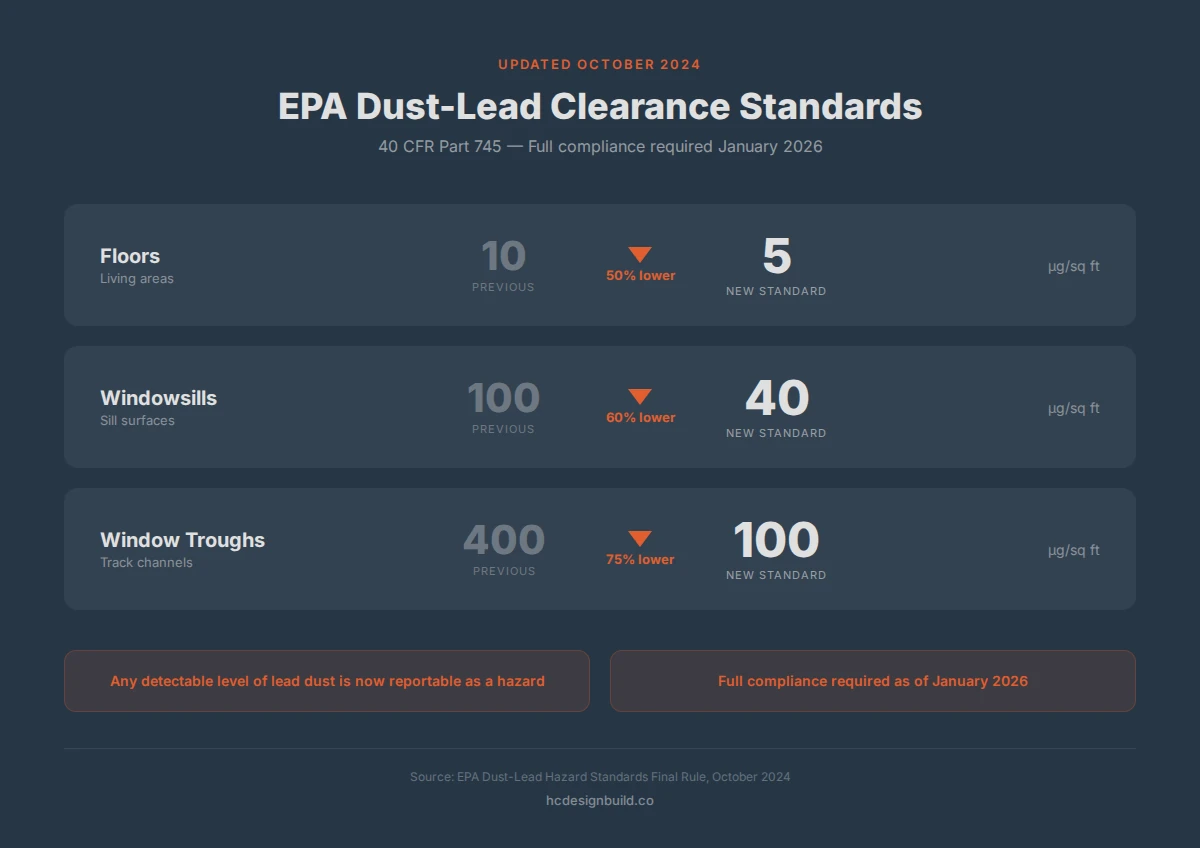
The EPA tightened its dust-lead hazard standards and clearance levels (40 CFR Part 745) (opens in new tab) in late 2024, with full compliance required as of January 2026. The new limits are tighter across the board:
| Surface | Old Standard | New Standard | |---------|-------------|-------------| | Floors | 10 ug/sq ft | 5 ug/sq ft | | Windowsills | 100 ug/sq ft | 40 ug/sq ft | | Window troughs | 400 ug/sq ft | 100 ug/sq ft |
Any detectable level of lead dust is now reportable as a hazard. The practical impact: post-renovation cleanup must be more thorough than what was acceptable a few years ago. Contractors need better containment and more careful HEPA vacuuming to meet clearance.
If your contractor hasn't mentioned these updated standards, ask about them. It's a simple way to gauge whether they're current on lead-safe practices.
What Removal and Remediation Cost
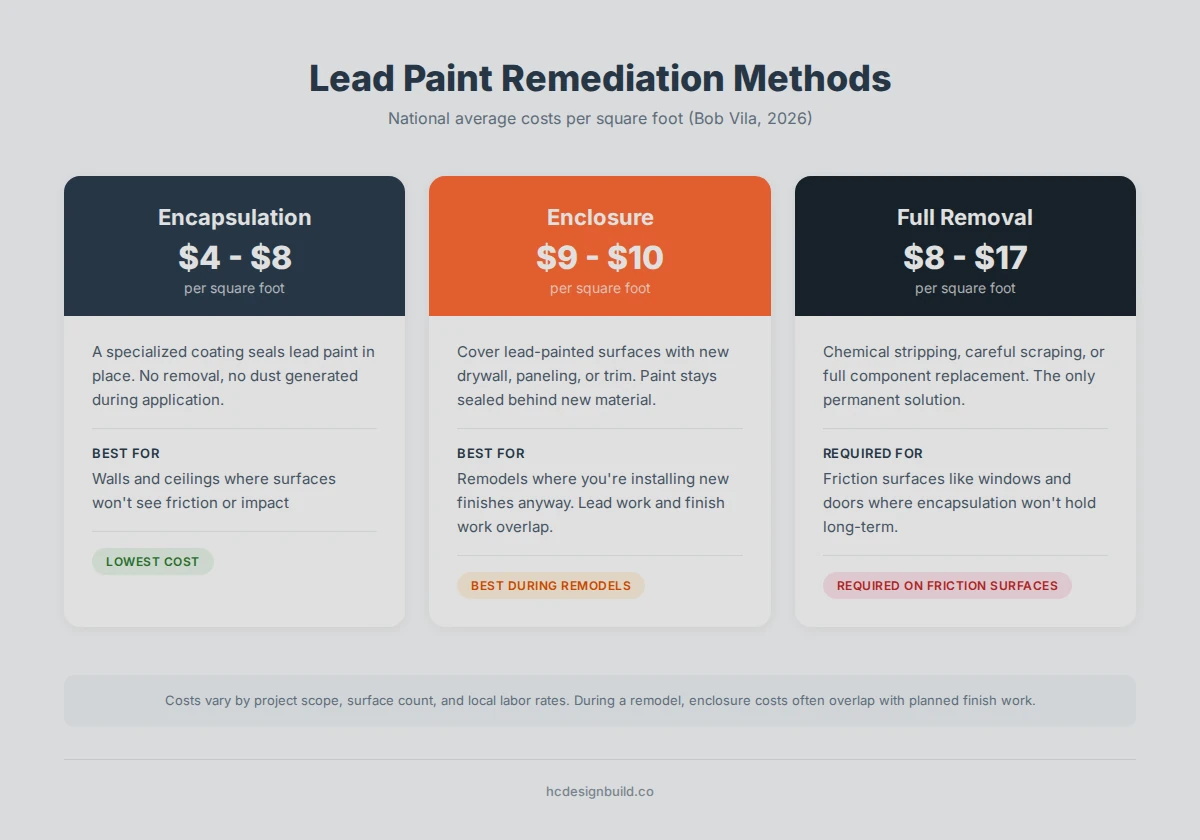
Three approaches, each with different costs and trade-offs. These are national averages (Bob Vila, 2026) (opens in new tab): your project cost depends on scope, surfaces, and method.
Encapsulation ($4 to $8 per square foot): A specialized coating seals the lead paint in place. No removal, no dust. Works on surfaces that won't see friction or impact. Good for walls and ceilings. Not appropriate for windows, doors, or surfaces that get scraped or bumped.
Enclosure ($9 to $10 per square foot): The lead-painted surface is covered with new material: drywall over walls, new trim over old trim. The lead paint stays in place but is physically separated from the living space. This is the method we reach for most often on Portland remodels, because the homeowner is usually installing new finishes anyway. The lead work and the finish work overlap.
Full removal ($8 to $17 per square foot): Chemical stripping, careful scraping, or component replacement. The most expensive option but the only permanent solution. Required on friction surfaces like windows and doors where encapsulation won't hold.
On a recent kitchen remodel in Southeast Portland, we enclosed lead-painted walls with new drywall and replaced all the original window trim rather than stripping it. The lead scope added about $2,800 to a project where those surfaces were getting replaced regardless. A standalone abatement on the same surfaces, with its own mobilization and containment, would have run closer to $5,000.
Labor for certified lead abatement contractors runs $50 to $120 per hour nationally. The certification and containment overhead makes this more expensive than standard painting or demo.
The Remodel Timing Advantage
If you're already tearing out windows, stripping trim, or replacing siding, most of the lead remediation work overlaps with your existing scope. Containment, disposal, and crew mobilization are already in place.
A standalone lead abatement project means a separate crew, separate containment, separate mobilization. That overhead disappears when lead work is folded into a renovation.
We see this most often on Craftsman bungalow remodels in inner Portland. A 1920s bungalow getting new windows, refinished trim, and a kitchen renovation will have lead paint on nearly every surface the crew touches. Test upfront, plan the containment into the project scope, and have a lead-certified crew handle it during demo. The cost stays marginal rather than a separate line item.
The opposite scenario is a homeowner who discovers lead paint mid-project, stops work, brings in a separate abatement contractor, waits for clearance testing, then restarts the remodel. That sequence adds weeks and thousands of dollars.
Portland Resources
Multnomah County Leadline (503-988-4000): Free information, referrals, and home assessments for lead concerns. Interpreters available.
Portland Lead Hazard Control Grant (opens in new tab): Free lead evaluation and financial assistance for income-qualified households (at or below 80% Area Median Income) with children under 6 or pregnant occupants. Covers homes built before 1978 within Portland city limits.
Oregon Health Authority Lead-Based Paint Program (opens in new tab): Maintains lists of certified inspectors, risk assessors, and abatement professionals in the Portland area. Also the enforcement arm for non-contractor RRP violations.
Plan for Lead Before You Start
An XRF inspection costs a fraction of what a mid-project surprise will run you. In pre-1980 homes, lead paint often shares the stage with asbestos in ceiling texture, floor tiles, and pipe insulation. Testing for both before demo starts is the cheapest way to avoid schedule blowups.
If you're planning a renovation on an older Portland home, reach out to H&C Design-Build for a project assessment. We'll scope the lead work alongside the rest of the project so there are no surprises once the walls come open.