You have an unfinished basement. Concrete walls, exposed joists, a water heater and furnace in the corner. You see space that could become a family room, guest suite, home office, or rental area. (If you're also eyeing the attic, our attic conversion guide covers the costs and code requirements for going up instead of down.) If the plan is a multigenerational living space, the zoning and permit path matters before you start.
But Portland basement finishing comes with complications that don't exist in drier climates. Moisture management and radon planning matter early. Hidden moisture behind finished walls can create mold issues that are expensive to fix.
Here's what it actually involves.
Portland Basement Finishing Permit Triggers
Portland requires a building permit (opens in new tab) any time you convert a basement to habitable space. No exceptions. Even framing walls and adding drywall counts as creating livable area.
You'll also need trade permits for electrical, plumbing (if adding a bathroom), and mechanical work (if extending HVAC). These can be bundled into a residential combination permit.
One exception worth knowing: if you're only adding a bathroom to an otherwise unfinished basement, you may qualify for a simpler process. That route doesn't trigger full egress and insulation requirements for the rest of the space.
Already have a finished basement without permits? You need to apply retroactively. That means opening walls for inspection. For details on how the process works, see our Portland building permits guide.
Building Code Requirements
Converting a basement to habitable space triggers specific code requirements. Portland's Building Code Guide 96-12 (opens in new tab) provides alternative standards for existing homes that are more forgiving than new construction.
Ceiling Height
Portland allows reduced ceiling clearances for many existing homes under Building Code Guide 96-12 (opens in new tab). New-construction standards are stricter. Confirm your clearances with plan review before design is finalized.
Many older homes need careful planning around ducts, beams, and soffits to keep code-compliant headroom after framing and drywall.
Egress Windows
Every bedroom needs an emergency escape window. Portland follows Oregon Residential Specialty Code Section R310 (opens in new tab):
- Minimum 5.7 square feet clear opening (5.0 at grade level)
- At least 24 inches tall and 20 inches wide
- Sill no more than 44 inches above the floor
Below-grade windows also need compliant window wells and, when required, fixed ladders or steps per Section R310 (opens in new tab).
Most existing basement windows do not meet these requirements. Plan for concrete cutting and full egress assembly work.
Electrical
Basement conversions often require new circuits, protected receptacles, and panel capacity checks. Confirm current requirements with the Oregon electrical code page (opens in new tab) and your plan reviewer.
Many older homes also need panel upgrades to support new basement loads.
Plumbing
Adding a basement bathroom often means concrete cutting for drain lines. Some projects require ejection systems when fixtures sit below sewer elevation.
Drain-waste-vent layout and fixture clearances must comply with current Oregon plumbing rules. Verify details on the Oregon plumbing code page (opens in new tab).
Stairs
Existing homes may qualify for alternative stair standards under BCG 96-12 (opens in new tab). Confirm which stair standard applies to your project with plan review.
Insulation and Fire Protection
Basement walls, slab edges, and thermal assemblies must meet current energy requirements. Fireblocking and thermal barriers are also required where applicable.
Confirm insulation and fire-protection details with your reviewer before rough-in inspections.
Moisture: The Portland Problem
This section matters more than anything else. Portland's wet climate and neighborhood soil variation can keep foundations damp for long periods.
A USGS study (opens in new tab) mapped Portland's water table and found depths varying dramatically by neighborhood and elevation. Use it to understand local groundwater conditions before finalizing design assumptions.
Start Outside
Building Science Corporation's research (opens in new tab) is clear: the strategy is "drain the site and drain the ground," not rely on membranes alone. Before finishing, address these:
- Grading: Slope soil away from the foundation on all sides
- Gutters and downspouts: Move roof water well away from the foundation
- Footing drains: Exterior perimeter drains wrapped in filter fabric
- Sub-slab drainage: Include drainage paths tied into the foundation drainage strategy
Waterproofing scope varies by conditions and access. Exterior systems usually perform better but require excavation. Interior systems manage water after entry.
The Vapor Barrier Mistake
Building Science Corporation warns (opens in new tab) against one common mistake. Do not install interior polyethylene over insulated basement walls. This traps moisture between concrete and insulation and can create mold conditions.
The correct approach: rigid foam insulation against the concrete wall. It acts as both insulation and vapor retarder. Frame in front of it.
The concrete dries to the exterior. The foam prevents warm interior air from reaching the cold concrete where condensation forms.
Under the slab, use a code-compliant vapor-retarder and drainage assembly for your permit scope.
Flooring That Survives
Traditional hardwood and standard carpet don't belong in Portland basements. Moisture migrates through concrete even with good waterproofing.
Luxury vinyl plank (LVP) is usually the safest finish option in basements because it handles moisture and humidity well. Porcelain tile is another strong choice. Epoxy can also work in utility-heavy spaces.
Avoid standard laminate, solid hardwood, and carpet directly on concrete. If you want carpet in a basement bedroom, install it over LVP or use a moisture-resistant underlayment. Plan to replace it eventually.
Test for Radon Before You Finish
Portland-area homes show measurable radon risk on the Oregon Health Authority's Radon Risk in Oregon map (opens in new tab). The Oregon Health Authority (opens in new tab) recommends testing homes with basements.
Test before finishing. If levels meet or exceed 4 pCi/L (opens in new tab), install mitigation before closing walls. Our radon mitigation guide covers testing methods, system types, and why it costs a fraction of the retrofit price when done during a remodel.
Homes built after April 2013 in Multnomah County already have radon-resistant construction per Oregon statute ORS 455.365 (opens in new tab). Older homes don't. Finishing a basement can change air pressure dynamics and draw more radon indoors.
What It Costs
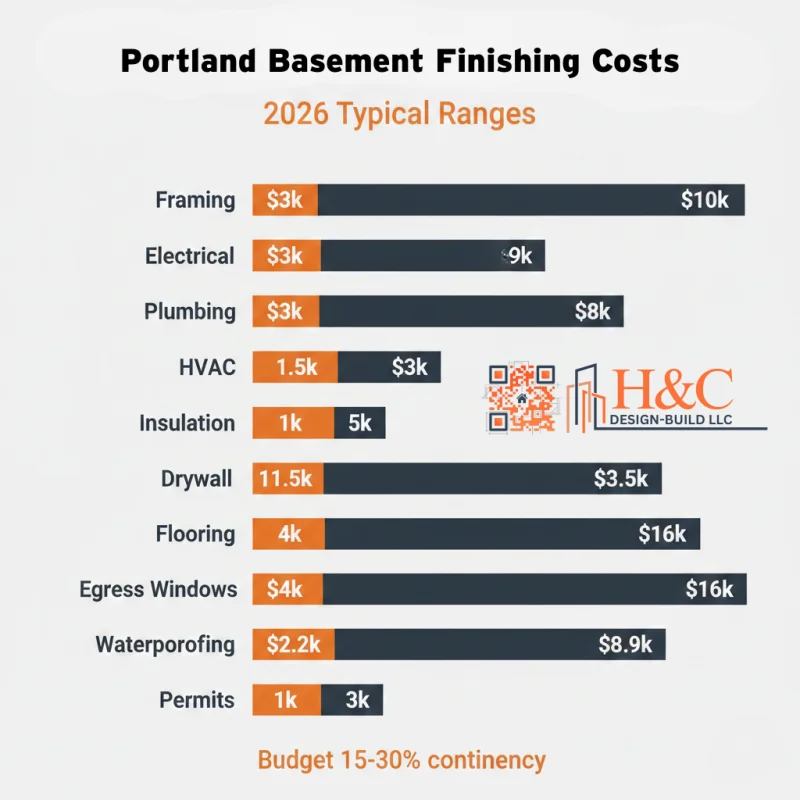
Basement finishing costs vary widely in Portland. Scope, moisture conditions, code upgrades, and finish level drive most of the range.
Main Cost Drivers
- Moisture-control and drainage scope
- Egress and life-safety upgrades
- Electrical capacity and panel work
- Bathroom or kitchenette plumbing complexity
- Finish selections and built-ins
- Permit and inspection requirements
Scope Patterns
Basic finish: Keep the existing layout, focus on durable flooring, simple lighting, and minimal utility relocation. In our Portland bids, basic finishes typically run $25 to $50 per square foot.
Mid-range finish: Add improved insulation, upgraded lighting, and potentially a bathroom. Expect $50 to $85 per square foot in Portland.
High-end finish: Include premium materials, detailed millwork, and expanded plumbing scope. These start around $85 per square foot and go up from there.
Common Surprise Costs
Egress work. Concrete cutting and full code-compliant window/well assemblies can materially increase budget.
Below-grade plumbing. Some basement bathrooms need ejection systems and more complex drain routing.
Panel upgrades. Older homes often need electrical capacity upgrades.
Hidden structure or moisture issues. Demo can reveal conditions that must be corrected before finishes continue.
Include contingency in your budget. Basements regularly uncover unknowns once walls and slabs are opened.
The ROI
Basement finishing can improve usable living space and resale appeal, but results depend on neighborhood comps, finish quality, and project scope.
In most appraisals, below-grade finished space is valued differently from above-grade living area.
Property taxes can increase when you add legal habitable space. Review local assessment guidance with your county before final budgeting.
When Not to Finish
Don't finish a basement with unresolved problems:
- Active water intrusion. Fix the source first. Finishing over moisture guarantees mold.
- Foundation cracks or movement. Walls curving inward or bulging need engineering evaluation before anything else.
- Ceiling clearance below code minimums. Verify clearances under BCG 96-12 (opens in new tab) before design.
- Unmitigated radon at or above action levels. Install mitigation first.
- Hazardous materials concerns. Address asbestos or lead hazards before finish work.
If structural and moisture corrections dominate your budget, pause and re-evaluate total return before committing to finishes.
The Inspection Sequence
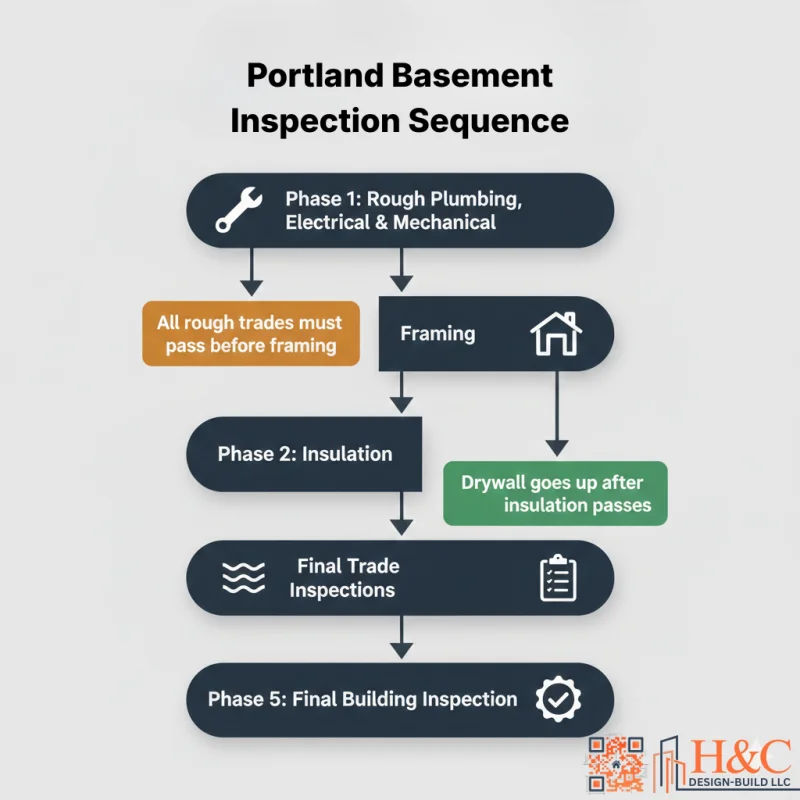
Portland requires inspections in a specific order. You can't proceed until the previous phase passes:
1. Rough plumbing, electrical, and mechanical (all three must pass before framing) 2. Framing inspection 3. Insulation inspection 4. Final trade inspections (electrical, plumbing, mechanical) 5. Final building inspection
Keep approved plans on site for every inspection. Don't cover any work before it's inspected. Drywall goes up only after insulation inspection passes.
For the full permit process and what inspectors focus on, see our Portland building permits guide.
Making the Decision
A basement finish makes financial sense when your foundation is sound, moisture is managed, and ceiling height works. Portland's climate makes waterproofing non-negotiable. Spend the money upfront on drainage and moisture control, or spend more later tearing out moldy drywall.
Get a moisture assessment and structural evaluation before committing. A few hundred dollars for professional eyes can save tens of thousands in surprises.
If a basement doesn't work for your situation, a garage ADU conversion is another way to expand livable space on your property. Need help with the financial side? Our remodel financing guide compares every option from HELOCs to contractor financing.
Need help evaluating your basement? Contact H&C Design-Build for a project assessment. We'll tell you honestly whether your basement is a good candidate and what it will realistically cost.