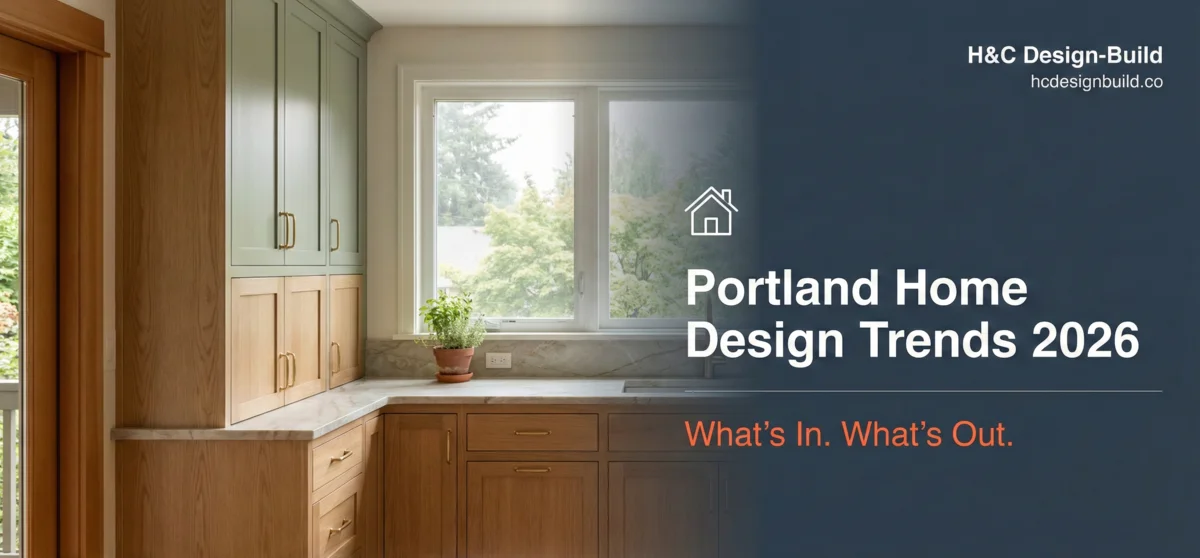
Cool gray is gone. All-white kitchens are fading. The farmhouse look has run its course.
Portland homeowners are choosing warmth, natural materials, and spaces that feel collected rather than decorated. That shift makes sense here. You live in a city with 220 overcast days a year. A warm wood kitchen with sage green accents feels right when the sky is gray from October through June. A sterile white box does not.
These are the Portland home design trends we're seeing in projects right now. The industry data backs them up. We'll also cover a few trends we'd skip.
What's In and What's Out
The macro shift is simple: cold and minimal is out, warm and textured is in.
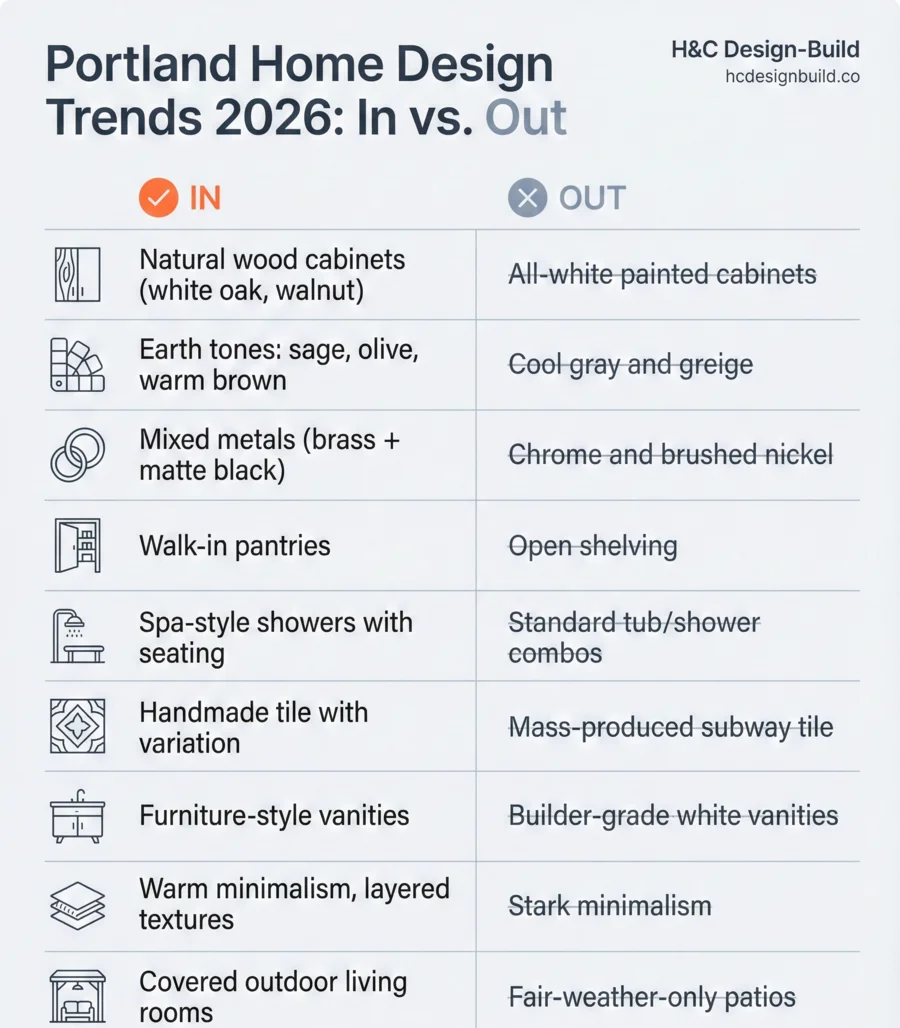
| In for 2026 | Out for 2026 | | ----------------------------------------------- | ------------------------------------- | | Natural wood cabinets (white oak, walnut) | All-white painted cabinets | | Earth tones: sage, olive, warm brown, off-white | Cool gray and greige | | Mixed metals (brushed brass + matte black) | Chrome and brushed nickel everywhere | | Walk-in pantries and concealed storage | Open shelving | | Spa-style showers with built-in seating | Standard tub/shower combos | | Handmade tile with natural variation | Mass-produced subway tile | | Furniture-style bathroom vanities | Builder-grade white vanities | | Warm minimalism and layered textures | Stark minimalism and sterile surfaces | | Covered outdoor living rooms | Fair-weather-only patios |
This tracks nationally and locally. NKBA's 2026 kitchen trends report (opens in new tab) surveyed 634 industry professionals. Transitional style hit 72% popularity. Wood-grain cabinets are growing for 59% of respondents. Portland's design culture adds its own filter: sustainability as a baseline, biophilic materials, and spaces designed for our light conditions.
Color: Earth Tones Replace Gray
Every major paint brand picked an earthy neutral or green for 2026. That is not a coincidence.
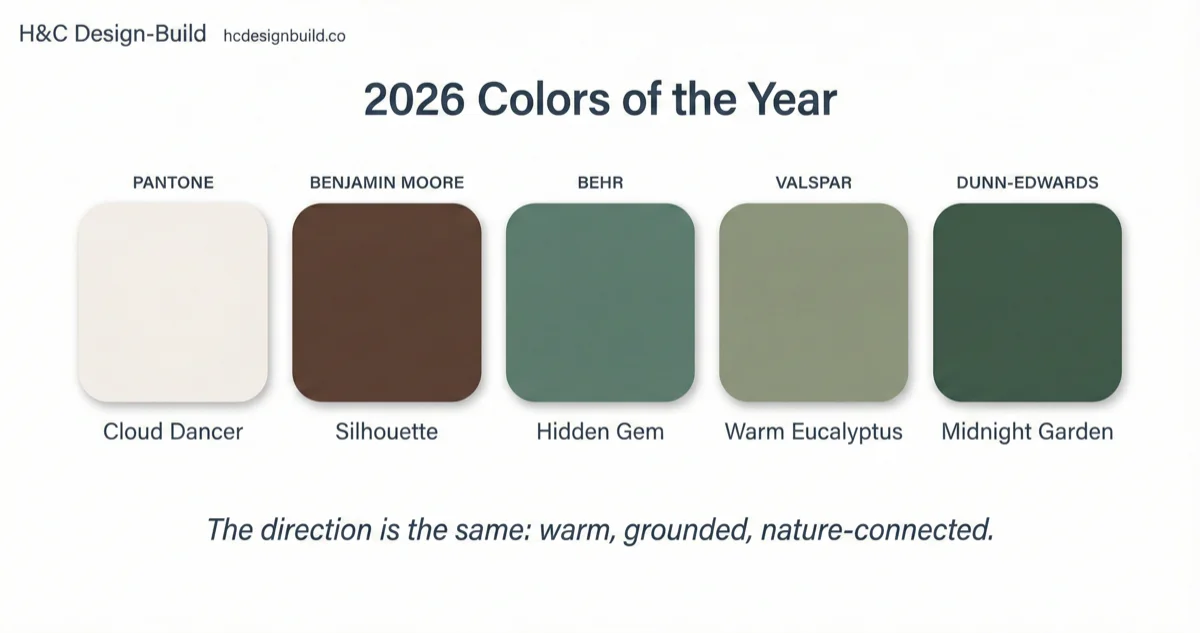
Pantone chose Cloud Dancer (opens in new tab), a soft off-white. Benjamin Moore chose Silhouette (opens in new tab), a burnt umber with charcoal undertones. Behr went with Hidden Gem (opens in new tab), a smoky jade. Valspar picked Warm Eucalyptus (opens in new tab). Dunn-Edwards chose Midnight Garden (opens in new tab), a deep muted green.
The direction is the same across brands: warm, grounded, and nature-connected. For once, the paint companies are catching up to what we've been recommending in Portland for years. Warm tones simply work better under overcast skies.
For Portland homes, this palette works harder than it does nationally. Our gray skies diffuse light rather than block it. That means warm tones on walls and cabinets glow under overcast conditions instead of looking flat. Cool grays, by contrast, go dead when there's no direct sunlight to animate them.
Colors gaining ground in Portland remodels right now:
- Sage and olive greens for kitchen cabinets and accent walls
- Warm off-whites (not cool/blue whites) for trim and ceilings
- Burnt umber and caramel for vanities and furniture pieces
- Soft brown and taupe replacing greige as the go-to neutral
Colors losing ground: cool gray, stark white, bright citrus accents, and the burgundy zellige tile that peaked last year. Amber and caramel zellige are taking its place.
Kitchen Trends Portland Homeowners Are Choosing
Kitchens are getting bigger even as homes stay the same size. NKBA reports 76% (opens in new tab) of industry professionals expect kitchen footprints to increase. Portland homeowners are reallocating space from formal dining rooms and underused living areas into the kitchen.
Here's what we're building:
Wood cabinets have overtaken white. Natural wood grain is the top choice nationally, with white oak leading at 51% per NKBA data. In Portland, this trend lands especially well. White oak and walnut complement Craftsman-era woodwork that already exists in most inner-neighborhood homes. If your 1920s bungalow has original fir trim, warm wood cabinets feel like they belong. White paint always fought that character.
Two-tone kitchens are standard. Dark lowers with lighter uppers, or wood base cabinets with painted upper cabinets. This adds depth to small Portland kitchens where a single color can make the room feel like a box.
Oversized islands do triple duty. Seating, storage, and prep space in one piece. NKBA data shows dedicated beverage areas (85%) and eat-in kitchen features (59%) both growing. The island handles most of that.
Quartz holds the top spot for countertops at 78% per NKBA, but natural quartzite is closing the gap (opens in new tab) at 62%. Green stone countertops are showing up more often. They function as a near-neutral depending on tone and pair well with the wood-and-earth palette.
Induction cooktops are gaining real momentum. Portland's clean electricity grid (mostly hydropower) makes induction a natural fit. Pair it with Energy Trust of Oregon incentives for electrification, and the switch from gas makes financial sense too.
Walk-in pantries have replaced open shelving. Homeowners want concealed storage, not decorative displays that collect dust and demand constant curation.
For Portland kitchen costs, layouts, and permit details, see our kitchen remodel cost guide. For a deeper dive into 2026 cabinet, countertop, and layout data from Houzz and NKBA, see our kitchen design trends guide.
Bathroom Trends: The Spa Is the Standard
Portland bathrooms are getting larger and more deliberately designed. NKBA's bath trends report (opens in new tab) shows 72% of professionals expect bathroom footprints to grow. Another 77% see homeowners chasing a hotel or resort feel at home.
Larger showers are replacing tubs. More than half of homeowners prefer a bigger shower over keeping a bathtub. Built-in seating, wall niches for products, and layered lighting make it more than a quick rinse. Steam features and curbless entries are growing fast.
Warm neutrals have taken over. NKBA data shows 96% of designers pick neutrals as the top bathroom palette. Off-whites lead at 58%, followed by light brown and tan (54%) and white (40%). Greens maintain strong support, with sage at 64% and olive at 43%.
Furniture-style vanities are replacing builder-grade. Rich stained wood, fluted detailing, and floating silhouettes. Wall-mounted faucets save counter space and give the vanity a cleaner look. The days of a basic white vanity with a chrome faucet are ending.
Handmade tile adds character. Zellige-style tile with slight imperfections and natural variation is replacing uniform, factory-perfect surfaces. Large-format porcelain is gaining share too. Fewer grout lines make small bathrooms feel bigger.
Accessibility is becoming standard, not special. NKBA reports 80% of designers say aging-in-place design is now mainstream or nearly mainstream. Curbless showers, grab bars, wider doorways, and lever handles work for everyone. Portland's older homes, with their narrow doorways and single bathrooms, benefit from this approach during any remodel. Our aging in place remodel guide covers modifications, costs, and permits in detail.
For bathroom costs and Portland permit requirements, see our bathroom remodel cost guide.
Outdoor Living for Portland's Climate
National "indoor-outdoor living" content assumes sunshine. Portland gets rain eight months a year. The design challenge here is creating outdoor spaces that work in October, not just July.
Covered structures are the baseline. Any outdoor living space that's only usable three months a year is a poor investment. Covered patios, extended rooflines, and pergolas with louvered or skylight panels let you sit outside during a drizzle. Skylight panels let filtered daylight through while keeping rain off. Skylights capture more light than wall windows because they face the full sky dome, which stays bright even on overcast days.
Year-round features seal the deal. Fire pits, outdoor heaters, and retractable glass or screen walls for wind protection extend the season through fall and early spring. Composite decking from recycled materials handles Portland's moisture better than wood and aligns with the city's sustainability expectations.
Hardscaping creates outdoor rooms. Low hedges, planters, trellises, and pathways divide larger yards into zones for dining, lounging, and play. Large-format pavers that match interior flooring blur the line between inside and out. Portland's characteristically sloping lots often call for multi-level layouts.
For deck-specific costs and Portland permit rules, see our deck building guide. For a deeper look at covered patios, hardscaping, drainage, and phased outdoor builds, see our outdoor living spaces guide.
Portland's Design Advantage: Working With What You Have
Portland's housing stock gives homeowners a head start on several national trends.
Craftsman meets warm minimalism. The national shift toward "warm minimalism" (clean lines, natural materials, handcrafted details) describes what Craftsman homes already do. Quarter-sawn oak built-ins, fir trim, and mission-style hardware are the original version of this trend. The goal in a Portland Craftsman remodel is to build on what's there, not cover it up.
Biophilic design is native here. National trends talk about "bringing nature inside" as something new. Portland homeowners live in a city surrounded by forests, rivers, and mountains. Douglas fir, Western red cedar, and reclaimed barn wood are locally sourced materials, not imported trend pieces. Honed stone, raw wood, and textured plaster wall finishes all feel at home in PNW interiors.
Sustainability is policy, not just preference. Portland's green building policies increasingly target embodied carbon in construction. The Portland Clean Energy Fund subsidizes home energy upgrades. Energy Trust of Oregon incentives cover heat pumps, insulation, and windows. Heat pumps have become the default HVAC choice in Portland remodels since the 2021 heat dome. They handle both heating and cooling, which matters in a city that now plans for summer heat events alongside its long wet winters.
Trends We'd Skip
Not every national trend translates to Portland.
Color drenching an entire room in a bold hue. Deep green or burgundy accent walls look great. Painting every surface, trim, and ceiling in the same saturated color can feel like a cave. Portland's limited natural light makes it worse. Test with a single wall first.
Ultra-modern finishes in a Craftsman home. High-gloss white lacquer, waterfall quartz, and handleless cabinetry fight the character of a 1920s bungalow. They can work in a mid-century ranch or a newer home. In a Craftsman, lean into the warmth that's already built in.
Open shelving in old Portland homes. Plaster dust, cooking grease, and Portland's ambient moisture mean open shelves need constant cleaning. Walk-in pantries and closed cabinetry are more practical. The trend is already fading nationally.
Trendy hardware finishes without thinking ahead. Brushed brass and champagne gold look current, but replacing every knob, pull, faucet, and light fixture to match a single finish gets expensive. Mixed metals (matte black pulls with brushed brass faucets, for example) are more forgiving and more interesting.
---
Portland's 2026 design direction comes down to warmth, natural materials, and spaces that work with this climate rather than pretending it doesn't exist. The trends that stick here solve real problems. They make rooms feel bright on gray days. They keep outdoor spaces usable in rain. And they modernize older homes without erasing their character.
If you're planning a remodel and want to see how these trends fit your home, reach out for a consultation.