You're remodeling your bathroom and want design direction before you commit to tile, fixtures, and finishes. Smart move. Portland bathroom design trends in 2026 are shifting in ways that will affect how your space looks and functions for the next decade.
The data is clear. Houzz surveyed 1,737 homeowners (opens in new tab) who recently completed or are planning bathroom remodels. The National Kitchen & Bath Association (NKBA) polled 688 industry professionals (opens in new tab) on what they're specifying. Both sources agree: bathrooms are getting warmer and showers are getting bigger, while all-white fades.
Bigger Showers, Fewer Tubs
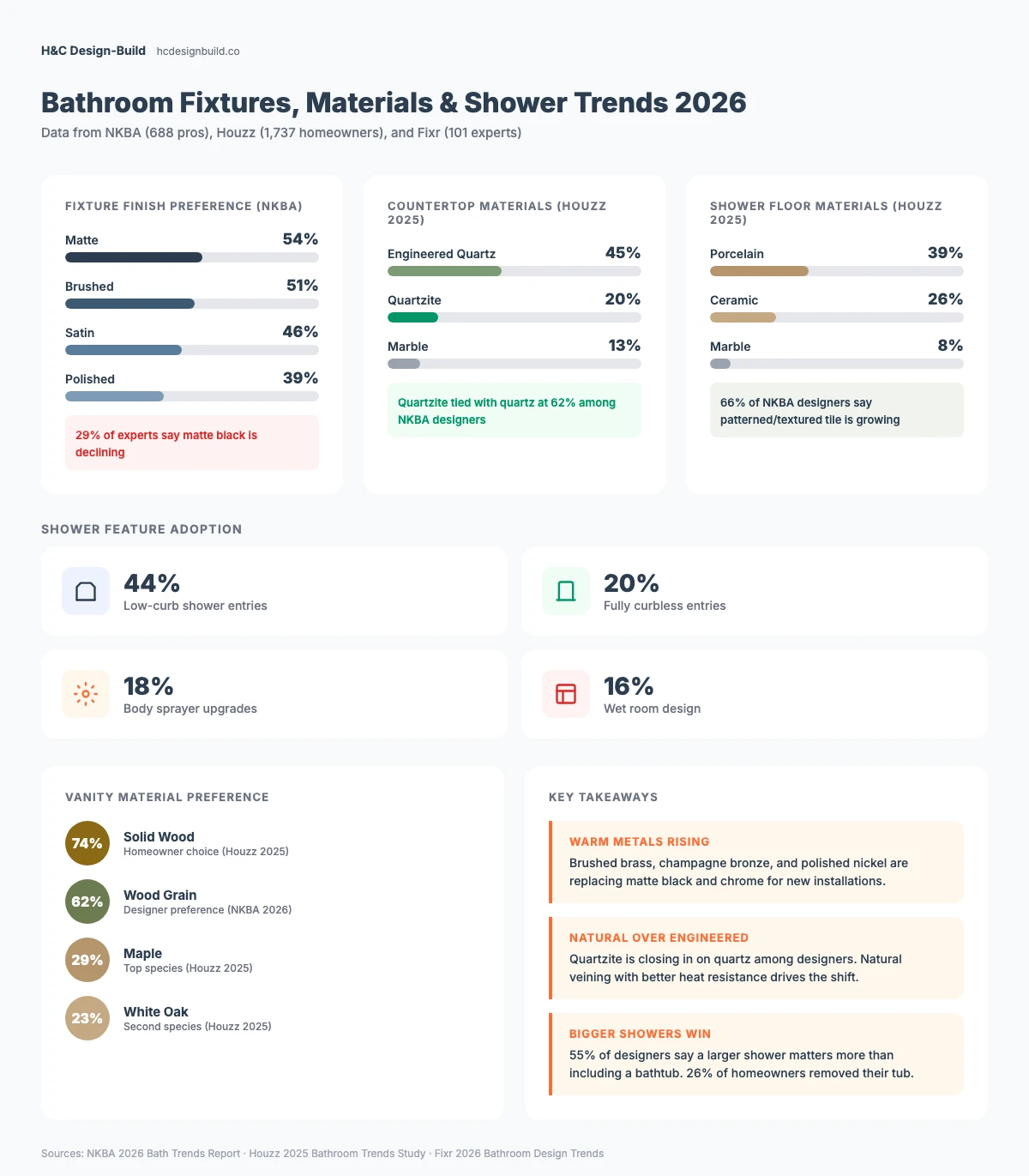
The biggest change: NKBA's 2026 report found 55% of designers say a larger shower matters more than including a bathtub. Homeowners agree: 26% removed their tub during their last remodel, and 82% of those enlarged the shower in its place (Houzz 2025).
We see it on every project. A homeowner walks us through their bathroom, points at the tub they haven't used in years, and asks what else they could do with that space. The answer is almost always a bigger shower.
Entry styles are changing too. Low-curb showers lead at 44% of remodels. Fully curbless entries sit at 20% and rising. Fixr's panel of 101 design experts (opens in new tab) identifies slab showers as a top trend for 2026. Inside the shower, body sprayers appear in 18% of upgrades. Mood lighting is next: 51% of NKBA designers predict it will grow.
Sixteen percent of renovated bathrooms now feature a wet room design, up three points year over year (Houzz 2025).
When homeowners do keep a tub, freestanding flat-bottom models lead at 45%. Alcove tubs follow at 40%. The claw-foot look has faded to 4%.
For Portland's older homes with small bathrooms, this trend makes practical sense. A 5x8 bathroom with a tub-shower combo wastes half its floor area. Replace the tub with a walk-in shower using a curbless entry and linear drain, and the room opens up. In a Craftsman bungalow with a 40-square-foot bathroom, every inch counts.
Portland Bathroom Trends Favor Warm Over White
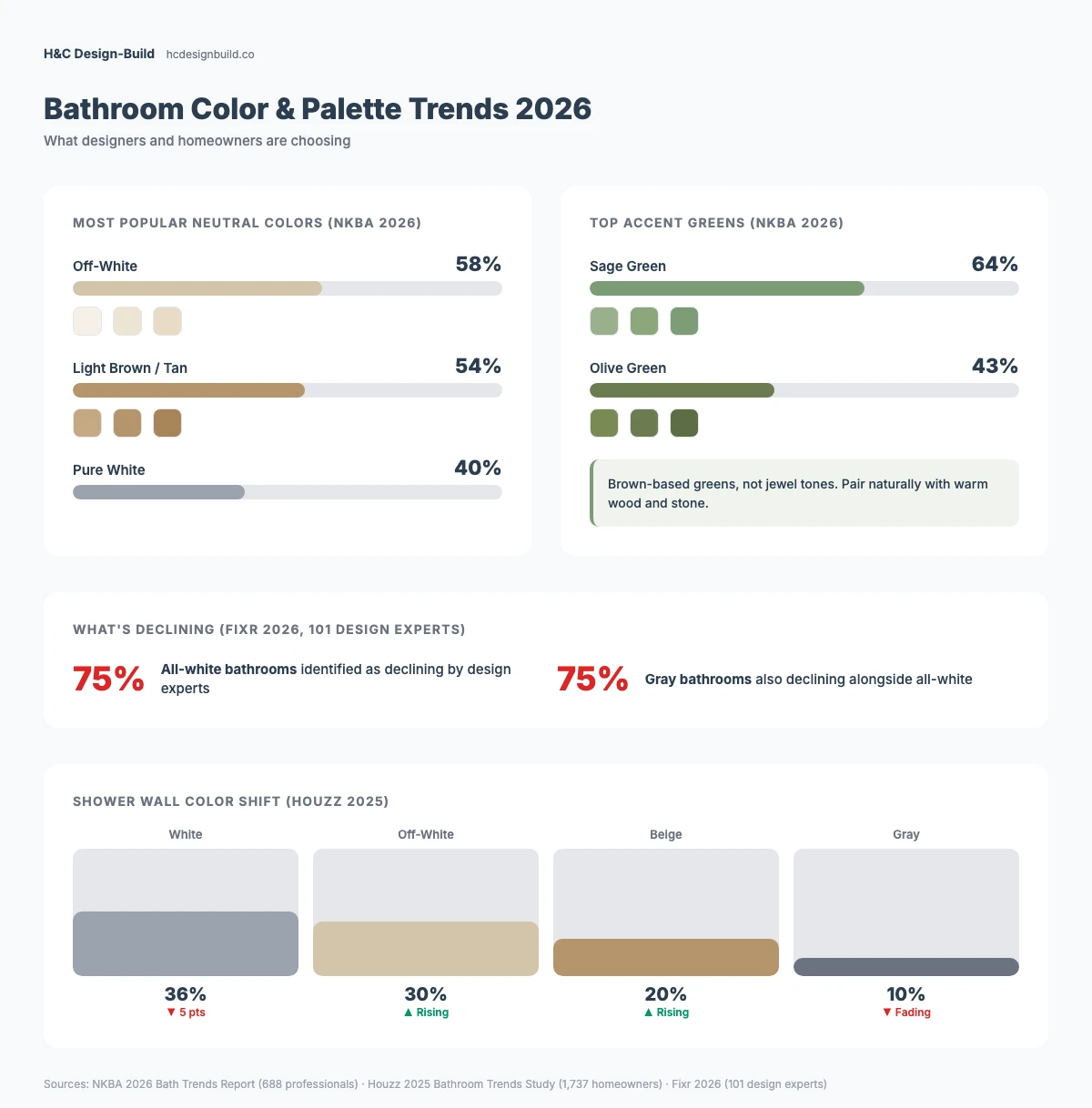
The all-white bathroom is losing ground. NKBA's data shows 96% of designers identified neutrals as the most popular bath colors. But the shade has shifted. Off-white leads at 58%. Light brown and tan follow at 54%. Pure white sits at 40%, third place.
Seventy-five percent of Fixr's 101 design experts support warm, earthy tones for 2026. The same percentage say all-white and gray bathrooms are declining.
Shower wall colors tell the same story. White dropped to 36% of homeowners, down five points from the prior year. Off-white and beige are filling the gap.
We've been steering Portland clients toward warm neutrals for a few years now. The difference shows up in person: a warm greige tile in a north-facing bathroom catches whatever light comes through the window. A cool white tile in the same spot just looks dingy by February.
Among accent colors, greens dominate. Sage green leads at 64% of NKBA designers, followed by olive at 43%. These are brown-based greens, not jewel tones. They pair naturally with warm wood and stone.
In Portland, warm colors have a functional edge. The city averages roughly 220 overcast days a year. Cool whites go flat under diffused gray light. Warm neutrals and sage accents actually glow when the sun stays behind clouds.
Tile and Countertops: Natural Over Engineered
Large-format tile is the direction. Eighty percent of NKBA professionals expect it to dominate bathroom flooring. Eighty-nine percent say homeowners want smaller or no grout lines. Fewer grout lines mean less cleaning and a cleaner look.
We've been installing more large-format porcelain in showers over the past two years than in the previous five combined. The look is cleaner and the maintenance difference is real.
Countertops mirror what's happening in kitchens. Engineered quartz still leads at 45% of homeowners, but quartzite has climbed to 20% (Houzz 2025). Marble sits at 13%. On the designer side, quartzite is closing in on quartz. It offers natural veining with better heat and scratch resistance than engineered options.
Shower floors favor porcelain at 39%, ceramic at 26%, and marble at 8%. Patterned and textured tiles are growing: 66% of NKBA designers say they're seeing more of them.
For Portland's climate, material durability matters as much as aesthetics. Winter humidity averages 83%. Non-porous surfaces resist mold with less upkeep than natural marble, which needs regular sealing. Porcelain on shower floors and quartz or quartzite on countertops handle Portland's moisture well.
Vanities: Wood Wins
Wood-faced vanities have overtaken painted. NKBA puts wood at 62% of designer preferences versus 53% for painted. Among homeowners, solid wood leads at 74%. Maple (29%) and white oak (23%) are the top species (Houzz 2025).
Vanity colors follow the same warm shift. Wood tones lead at 28%, passing white at 20%. Green is at 5% and growing. Gray dropped to 9%.
Floating vanities hold 11% of homeowner installations, but 26% of Fixr's experts identify them as a rising trend. They make small bathrooms feel larger by exposing floor space underneath.
Door styles: shaker leads at 49%, flat-panel at 26%. Matte and hand-rubbed finishes dominate across all styles. High-gloss has dropped off.
In Portland, white oak vanities alongside original fir trim create the same warm, connected feeling that's driving kitchen design trends toward natural wood. It fits the existing woodwork.
Fixture Finishes: Warm Metals Replace Matte Black
Matte and brushed finishes lead overall. NKBA data shows matte at 54%, brushed at 51%, satin at 46%. Polished finishes trail at 39%.
The shift within that: matte black is losing momentum. Twenty-nine percent of Fixr's experts call it a declining trend for 2026. The replacements are warm metals: brushed brass, champagne bronze, and polished nickel. At the Kitchen & Bath Industry Show (KBIS) 2026, major manufacturers showed expanded warm-metal lines across faucets, showerheads, and accessories.
Chrome still holds 43% of the faucet market by revenue, but new installations are trending warmer.
Mixed metals work in bathrooms. A brushed brass vanity faucet with a matte black shower fixture reads as intentional. NKBA data confirms mixed metals are on the rise. It's also easier to swap one fixture later without redoing everything.
For Craftsman and older Portland homes, warm metals pair better with original fir and oak woodwork than chrome or matte black. Brushed brass reads as classic, not trendy.
Lighting Gets Layered
Most bathrooms we tear out have one overhead fixture and nothing else. That's changing. Ninety-two percent of NKBA designers say task lighting belongs in every primary bath. Eighty-eight percent list natural light as a top priority. Eighty percent include nighttime-specific lighting.
Lighted mirrors are popular: 22% of homeowners chose them, up three points year over year. NKBA designers are further ahead at 47% favoring integrated mirror lighting.
The practical breakdown from Houzz:
- Recessed (40%)
- Sconces and ceiling lights (34%)
- Shower lights (29%)
- Lighted mirrors (22%)
In Portland, where winter daylight runs roughly 8:30 a.m. to 4:30 p.m. from November through January, layered lighting matters more than in sunnier cities. A lighted mirror plus recessed overhead plus a dimmable sconce gives you even light for grooming and a softer setting for evening.
Wellness Features and Smart Technology
Seventy-seven percent of NKBA designers say tying bathroom design to a hotel or resort experience is becoming standard. Seventy-two percent expect the bath footprint to increase for wellness, storage, and universal design.
The most requested tech features per the NKBA x CEDIA (Custom Electronics Design and Installation Association) technology report (opens in new tab): digital shower systems with custom temperature presets top the list at 71% of designers, followed by heated floors (56%) and smart toilets (51% predicted growth).
Adoption still lags behind desire. Only 2% of current remodels include steam features. Only 7% add shower mood lighting. These are early-adopter features, not mainstream yet.
Heated floors make particular sense in Portland. Tile without radiant heat feels cold from October through April. Electric radiant mats under tile are one of the highest-satisfaction upgrades we install. They run $500 to $8,000 depending on bathroom size, and the comfort difference is immediate.
What Portland Bathrooms Get Right
Portland's housing stock and climate shape how these national trends actually play out.
Moisture drives material decisions. With winter humidity averaging 83% and months of sustained rain, bathroom materials need to resist mold without constant upkeep. Porcelain tile, quartz countertops, and properly waterproofed shower systems aren't optional here. Oregon building code mandates mechanical exhaust in all bathrooms and nonabsorbent shower walls to at least six feet. If your project requires a building permit, these come up during plan review.
Accessibility runs ahead of the national curve. Sixty-eight percent of homeowners nationally now factor accessibility into bathroom projects. Portland's older homes with narrow doorways and raised thresholds make this more pressing. Curbless entries, comfort-height toilets, and grab bars built into the initial design cost less than retrofitting later. See our aging in place guide for the full picture.
Sustainability is the baseline. Eighty-three percent of bathroom remodelers include eco-friendly features nationally. In Portland, the bar is higher. Local incentives from Energy Trust of Oregon and the Portland Clean Energy Fund, plus the hydropower grid, make heat pump water heaters and efficient ventilation practical. If you're gutting the bathroom, it's the right time to upgrade.
What to Skip
All-white palettes. Seventy-five percent of experts say it's declining. If you like white, use it on countertops or upper walls. Pair it with warm wood and earth tones.
Polished chrome everywhere. Chrome is the default, not the direction. If you're picking new fixtures, warm metals will age better visually.
Open storage. Portland's humidity makes open shelving impractical in bathrooms. Medicine cabinets are back, up three points to 32% of remodelers. They hide clutter and protect products from moisture.
Cold plunge tubs. Social media makes them look essential. Actual adoption in bathroom remodels is 1%. The space and plumbing requirements are real. If wellness is the goal, heated floors and a well-built steam-ready shower enclosure deliver more daily value.
Portland bathrooms in 2026 are warmer and more functional than what we were building five years ago. That's the test we use on every project: will this hold up in Portland's climate and still look right in this house?
For a detailed breakdown of what bathroom remodels cost in Portland, see our bathroom remodel cost guide. For the broader picture on Portland home design trends, we cover kitchens, outdoor spaces, and whole-home direction there.
Ready to start planning your bathroom? Get in touch.