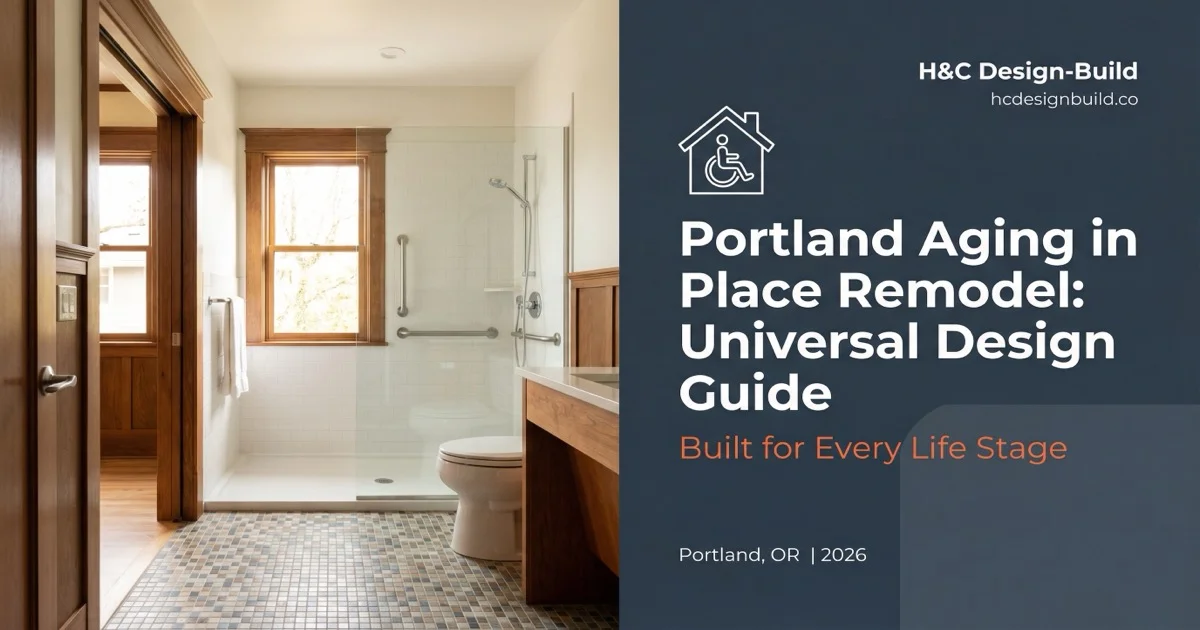
Half of Portland's housing was built before 1960. That means raised front porches, steep staircases, 28-inch doorways, one small bathroom upstairs, and laundry in the basement.
None of that works well when mobility changes. And mobility always changes eventually.
Aging in place remodeling in Portland starts with understanding what your house was built to do and what it needs to do next. The modifications that matter most come down to four things: what to change, what it costs, when you need a permit, and how to offset the bill.
Code and cost references in this article are current as of February 27, 2026.
This article is for educational purposes only and is not legal, tax, or medical advice. Confirm current requirements with Portland Permitting & Development and consult a tax professional for deduction questions.
Universal Design: Built for Every Life Stage
Good aging-in-place work is invisible.
A curbless shower is a luxury feature in high-end bathrooms. Wider doorways make it easier to carry furniture and groceries. Lever handles are simpler for kids and adults alike. These are universal design principles: one design that works for everyone at every life stage.
Ron Mace at NC State (opens in new tab) formalized this in 1997 with seven principles. Build spaces that don't require adaptation later, because according to NAHB-certified aging-in-place professionals, retrofitting accessibility features later can cost 15 to 30 percent (opens in new tab) of the original build investment.
The market has caught up. Houzz's 2025 bathroom study (opens in new tab) found that 68 percent of bathroom renovators now factor in accessibility, up four points year over year. Common additions include grab bars, non-slip flooring, low-curb showers, and extra lighting. Accessibility is mainstream remodeling now.
What Portland Homes Are Working Against
Portland's most common housing styles were built with narrow hallways, steep stairs, and compact bathrooms. Here's what that looks like by home type:
| Home Style | Era | Typical Challenges | | ------------------ | ----------- | --------------------------------------------------------------------------------------------------------------------- | | Craftsman bungalow | 1910s-1930s | 28-30" doorways, raised front porch (3-5 steps), small single bathroom, steep attic staircase, basement laundry | | Foursquare | 1900s-1920s | All bedrooms upstairs, steep central staircase, one bathroom on second floor, raised first floor (2-4 ft above grade) | | Mid-century ranch | 1950s-1960s | Best baseline (single-story), but often has split-level steps, narrow hallways, small original bathrooms |
Craftsman bungalows and Foursquares dominate Portland's inner neighborhoods. Both present the same core problem: essential rooms on the wrong floor with no easy way to change that.
For more on remodeling Portland's most common home type, see our Craftsman bungalow remodel guide.
Bathroom: The Room That Matters Most
According to CDC data, falls cause roughly 80 percent of all nonfatal bathroom injuries among older adults, making this the highest-risk room in the house. Start here.
Curbless Shower
A curbless (roll-in) shower eliminates the step-over that causes most shower-entry falls. Two construction methods are common:
- Recessed subfloor: Lower the floor joists to create slope toward the drain. More invasive, higher cost.
- Build-up method: Raise the surrounding floor slightly, use a linear drain at the shower entrance. Saves roughly $1,000 and a day of framing labor.
Both require continuous bonded waterproofing membrane across floor and wall surfaces. A linear drain allows single-direction slope at 1/4 inch per foot.
Cost: $6,000 to $24,000 depending on method and finish materials. For current finish and fixture direction, see our 2026 bathroom design trends guide.
Grab Bars
Grab bars should be stud-mounted stainless steel, 1.25 to 1.5 inches in diameter, rated for 250 pounds. Mount them 33 to 36 inches above the finished floor.
Modern grab bars look like towel bars or shelf brackets. We've installed bars that visitors never notice until someone points them out. The "medical equipment" aesthetic is gone. Budget $50 to $300 per bar installed.
Other Bathroom Upgrades
- Comfort-height toilet: 17 to 19 inches (standard is 14 to 15 inches). Easier to sit and stand. $350 to $800 installed.
- Non-slip tile: Look for a Dynamic Coefficient of Friction (DCOF) above 0.60. Small mosaic tiles (2x2 inch or smaller) add traction through extra grout lines.
- Lighting: The Illuminating Engineering Society (opens in new tab) notes that by age 60, you need roughly three times more light than at age 20. Target 75 to 100 lumens per square foot. Add motion-activated night lighting for the 2am path to the toilet.
- Open-bottom vanity: Wall-mounted vanities allow wheelchair access. ADA countertop maximum is 34 inches; insulate exposed pipes underneath.
Kitchen: Safer Cooking, Easier Reach
Kitchen modifications focus on reach, safety, and usability from both seated and standing positions.
Counter Heights and Storage
Standard kitchen counters are 36 inches. For seated use, 28 to 34 inches works. The practical approach: design one section at 30 to 32 inches for prep work while keeping the rest at standard height.
Replace deep upper cabinet shelves with pull-out drawers in base cabinets ($140 to $350 per cabinet). Pull-down shelf systems for uppers run $300 to $600 each.
Induction Cooktops
Induction is among the safest cooking surfaces for any household. No open flame, the surface stays cool (it heats the cookware, not the burner), and most units shut off automatically when a pan is removed.
If the home currently has gas, switching to induction may qualify for up to $840 through Oregon's upcoming HEAR rebate program (opens in new tab). That applies to income-eligible households under 150 percent of area median income.
Faucets, Ovens, and Task Lighting
- Lever faucets or touchless: No grip strength required. $50 to $600 depending on type.
- Wall oven at counter height: Eliminates bending to a floor-level oven. $1,000 to $5,000 installed.
- Under-cabinet task lighting: LED strips reduce shadows on work surfaces. $20 to $50 per linear foot.
Entry, Hallways, and Doors
Getting into and moving through the house matters as much as any single room.
Zero-Step Entry
Portland's raised front porches are the single biggest barrier for aging in place. Options:
- Landscaped ramp: Integrated into the yard grading so it reads as a garden path, not a medical ramp. ADA slope is 1:12 (one foot of ramp per inch of rise). A 24-inch porch requires a minimum 24-foot ramp. Cost: $1,100 to $10,000.
- Side or rear entry at grade: Many Portland homes have a side or back door closer to grade. Regrading to create a zero-step entry there is often cheaper than ramping the front. $1,000 to $5,000.
- Threshold ramps: For transitions of 1/2 inch to 2 inches, a small wedge ramp costs $50 to $300.
Wider Doorways
ADA minimum clear width is 32 inches. Universal design calls for 36 inches. Most pre-1960 Portland homes have 28- to 30-inch interior doors.
Before reframing, try offset hinges. They swing the door clear of the frame and add roughly 2 inches of clearance for $15 to $30 per pair. If that isn't enough, reframing a non-load-bearing wall runs $700 to $2,500 per opening. Load-bearing walls: $2,500 to $8,000 per opening.
Smart Access
Lever door handles replace round knobs for $25 to $70 per door. Smart locks with keypads eliminate the need for key manipulation entirely ($129 to $300 per lock). Motion-sensor exterior lighting illuminates walkways automatically.
What It Costs: Small Fixes to Full Remodel
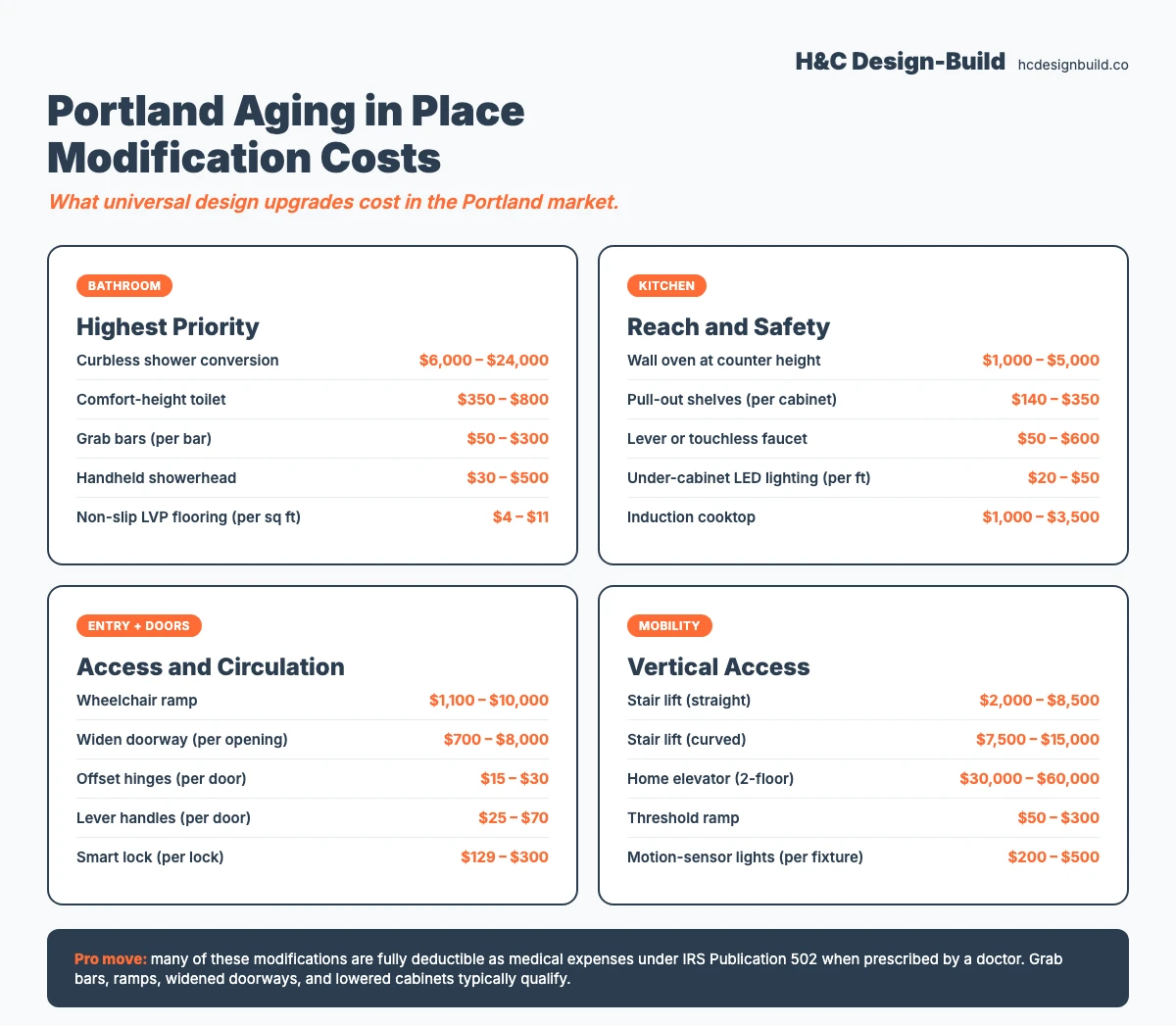
Aging-in-place work scales from a weekend of handle swaps to a six-figure whole-home retrofit. Here are the ranges:
| Modification | Low | High | | -------------------------------------- | ------ | ------- | | Grab bars (per bar) | $50 | $300 | | Lever handles (per door) | $25 | $70 | | Comfort-height toilet | $350 | $800 | | Handheld showerhead | $30 | $500 | | Offset hinges (per door) | $15 | $30 | | Pull-out cabinet shelves (per cabinet) | $140 | $350 | | Curbless shower conversion | $6,000 | $24,000 | | Widen doorway (per opening) | $700 | $8,000 | | Wheelchair ramp | $1,100 | $10,000 | | Stair lift (straight) | $2,000 | $8,500 | | Stair lift (curved) | $7,500 | $15,000 | | Non-slip LVP flooring (per sq ft) | $4 | $11 |
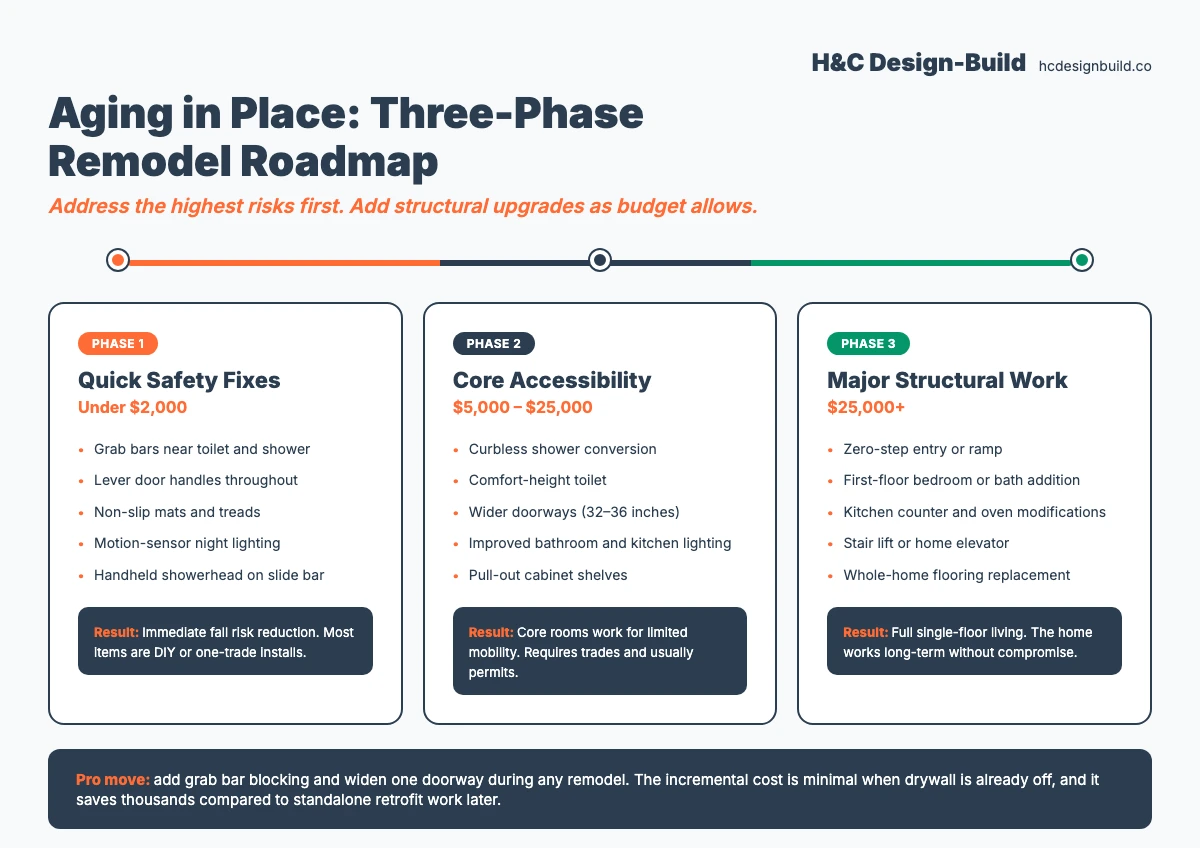
Phase the Work
You don't need to do everything at once.
1. Phase 1 (under $2,000): Grab bars, lever handles, non-slip mats, motion-sensor lights, handheld showerhead. This addresses the highest fall risks immediately. 2. Phase 2 ($5,000 to $25,000): Curbless shower, comfort-height toilet, wider doorways, improved lighting. These require trades (plumbing, electrical, framing) and usually permits. 3. Phase 3 ($25,000+): Zero-step entry, first-floor bedroom or bathroom addition, kitchen modifications, stair lift or elevator, whole-home flooring. This is full-remodel territory.
If the goal is creating a separate living space for an aging parent, our multigenerational home remodel guide covers Portland zoning rules, conversion options, and costs. For whole-home project planning, see our whole-home remodel cost guide.
Financial Help: Tax Deductions and Rebates
IRS Medical Expense Deduction
IRS Publication 502 (opens in new tab) lists specific home modifications that are fully deductible as medical expenses because they typically don't increase home value:
- Entrance and exit ramps
- Widened doorways and hallways
- Grab bars and railings
- Lowered or modified cabinets
- Relocated electrical outlets
- Porch lifts
- Modified door hardware
The deduction applies to expenses exceeding 7.5 percent of your adjusted gross income. You must itemize, and a doctor's letter documenting medical necessity is required.
Oregon offers an additional medical subtraction for taxpayers 66 and older: up to $1,800 per person, depending on income.
Energy Rebates During an Accessibility Remodel
When walls are already open for doorway widening or bathroom remodeling, adding insulation and air sealing costs little extra. That work may qualify for HOMES rebates (opens in new tab) of up to $10,000 for projects achieving 20 percent or greater energy savings.
HEAR rebates cover specific electrification upgrades: heat pump water heaters (up to $1,750), induction ranges (up to $840), and electrical panel upgrades (up to $4,000). Both programs are income-tiered and expected to open for applications in spring 2026.
For a full breakdown of available programs, see our energy efficiency rebates guide.
When Portland Permits Apply
Portland requires permits for any work involving structural framing changes, plumbing, or electrical modifications. Cosmetic accessibility upgrades like grab bars and fixture swaps typically don't need one.
Permits Required
- Widening doorways (structural framing changes)
- Moving or adding plumbing (new shower location, adding a bathroom)
- Electrical work (new circuits, relocated outlets)
- Adding a bathroom or converting space to habitable use
- Exterior ramps attached to the structure
No Permit Typically Needed
- Grab bar installation (stud-mounted, no structural changes)
- Replacing fixtures in the same location (toilet swap, showerhead)
- Lever handles and door hardware
- Interior painting, flooring, cabinet shelving
- Non-structural interior changes
Portland offers a Simple Bathroom Permit (opens in new tab) for adding a new bathroom or legalizing an existing unpermitted one. For updates to an existing permitted bathroom involving only trade work (plumbing, electrical, mechanical) without structural changes, trade permits purchased online through DevHub are typically sufficient.
For the full permit process, see our Portland building permits guide.
Start Before You Need It
The best time to plan for accessibility is during a remodel you are already doing. Adding grab bar blocking inside walls costs almost nothing when the drywall is already off. Widening a doorway during a bathroom renovation adds a fraction of what it costs as a standalone project.
According to NAHB-certified aging-in-place professionals, building universal design from the start adds roughly 1 to 2 percent to total construction cost. Retrofitting those same features later costs 15 to 30 percent of the original build investment.
How do you know it's time to start planning?
1. You're already remodeling. Add blocking, widen one doorway, choose a curbless shower. The incremental cost is small. 2. Someone in the household is over 55. Plan now, build in phases. The modifications that help at 75 also improve daily life at 55. 3. A fall or diagnosis happens. At this point, the work becomes urgent and more expensive. Proactive planning avoids emergency-pace pricing.
When to Bring in Design-Build
If your project involves structural changes, plumbing relocation, and permit coordination, design-build keeps everything under one team. You avoid the gap between what a designer draws and what a contractor can actually build in a 1920s Craftsman with plaster walls and balloon framing.
For projects that combine accessibility with energy upgrades, a single contractor can sequence the work so walls open once, trades stack efficiently, and rebate documentation stays coordinated.
Our bathroom remodel cost guide and kitchen remodel cost guide cover room-specific costs in detail.
When you're ready to evaluate your home, contact H&C Design-Build for a site walk and a phased plan that fits your timeline and budget.