
You bought the Portland Craftsman bungalow. The built-in buffet, the box-beam ceilings, the wide front porch with tapered columns. You love what makes it a Craftsman. You just need the kitchen to work for this century.
Portland Craftsman bungalow remodels are unpredictable. Every wall you open reveals 100 years of modifications, shortcuts, and materials that don't exist anymore.
Here's what you need to know before you start.
What Makes These Homes Unique
Portland's Craftsman bungalows were built between 1905 and 1930. The 1905 Lewis and Clark Exposition doubled the city's population and created massive housing demand. Builders answered with bungalows by the thousands.
They're the most common house style in Portland. You'll find them concentrated in Irvington, Ladd's Addition, Laurelhurst, Alameda, Sunnyside, Hawthorne, and Sellwood.
Most are 1,200 to 1,800 square feet. One and a half stories. Two or three bedrooms. One bathroom. A full or partial basement. And construction details that define the era:
- Balloon framing with studs running continuously from foundation to roof
- Old-growth Douglas fir woodwork, trim, and built-ins
- Pier-and-post or unreinforced concrete foundations
- Knob-and-tube wiring
- Galvanized steel supply pipes and cast iron drains
- Little to no insulation in walls or floors
The old-growth fir in your trim and box beams is tighter-grained and more rot-resistant than anything at a modern lumber yard. That's what makes these homes worth keeping and hard to work on.
What You'll Find Behind the Walls
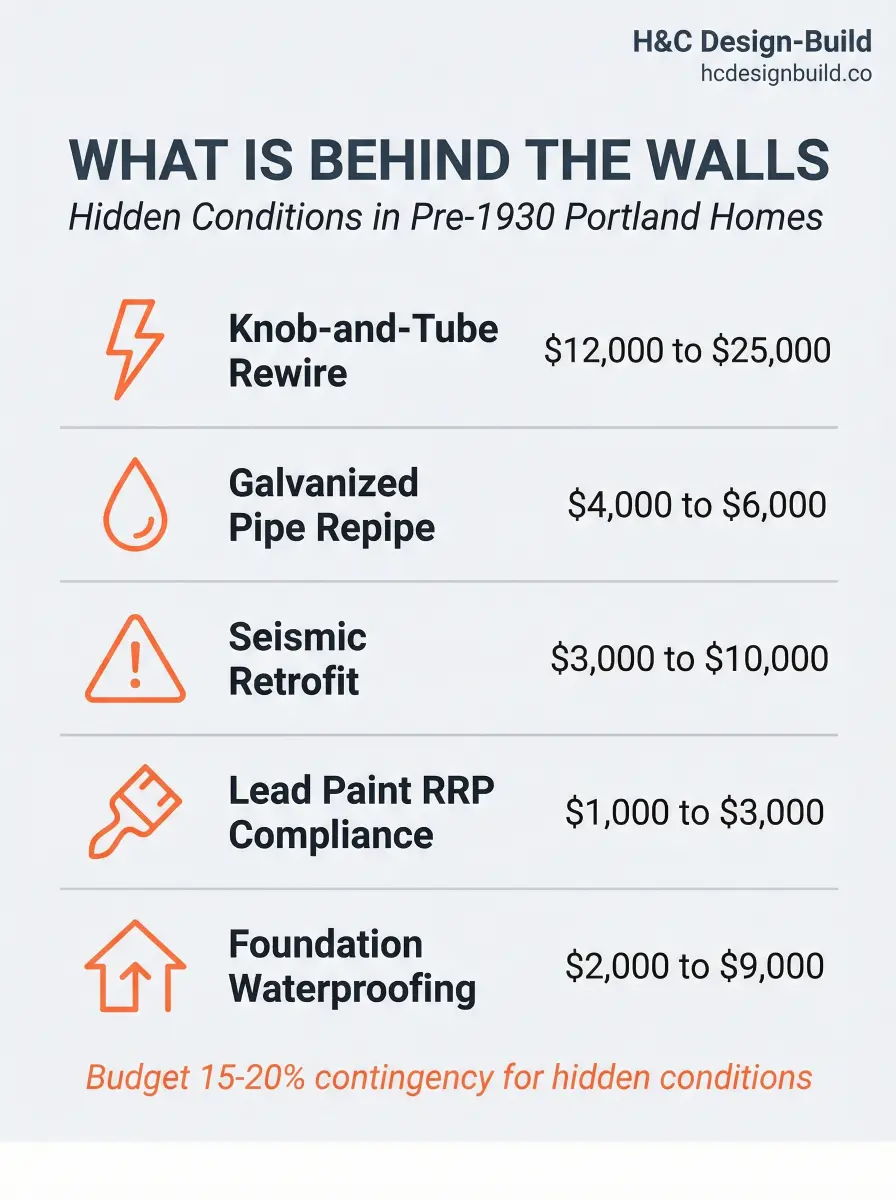
Open a wall in a 1920s Craftsman and you'll find conditions that no home inspection catches from the surface. Common discoveries include knob-and-tube wiring, galvanized pipes, balloon framing without fire blocks, lead paint, asbestos, and unreinforced foundations. Here's what Portland contractors pull out of these houses regularly.
Knob-and-Tube Wiring
Nearly every pre-1930 Portland home has it. Copper conductors strung between porcelain knobs, with rubber insulation that cracks and crumbles after 100 years. The original system powered a few lights and a radio. It was never designed for a modern kitchen pulling 40 or more amps across multiple appliances.
The bigger concern is decades of amateur splices. Previous owners tapped into K&T circuits with modern Romex (plastic-sheathed cable), often without junction boxes. These DIY connections are the primary fire risk.
Oregon doesn't require removing K&T wiring based on age alone under the Oregon Residential Specialty Code. But if you open walls during a remodel, Portland inspectors will require any exposed wiring to meet current code. Insurance is often the practical trigger. In our experience, many carriers won't write policies on homes with active knob-and-tube.
Full rewire for a typical Craftsman bungalow runs $12,000 to $25,000. A panel upgrade from 100 to 200 amps adds $1,500 to $4,000.
Galvanized Pipes and Cast Iron Drains
Galvanized steel supply lines corrode from the inside out. After 90 years, a 1-inch pipe can restrict to the flow of a cocktail straw. You'll notice it as declining water pressure and rust-colored water when you first turn on a faucet.
Cast iron drain lines develop bellies, offset joints, and root intrusion. A sewer scope inspection ($200 to $300) reveals the true condition before you start any work. Whole-house repipe with PEX (flexible plastic piping) runs $4,000 to $6,000.
Balloon Framing Surprises
Balloon-framed walls have no fire blocks between floors. The continuous stud bays act as chimneys in a fire, channeling flames from basement to attic in minutes. Stud spacing ranges from 17 to 26 inches instead of the standard 16. Headers over windows and doors are often undersized by current standards.
One upside: balloon framing makes rewiring easier. You can fish new cables through the open stud bays without cutting into every floor.
Lead Paint and Asbestos
Pre-1930 homes have both. Lead paint covers virtually every surface that was originally painted. Asbestos shows up in pipe insulation, floor tiles (especially 9x9 inch tiles), and sometimes vermiculite attic insulation.
Oregon requires a full asbestos survey (opens in new tab) before any renovation of pre-2004 homes. The EPA RRP Rule (opens in new tab) requires certified contractors for work disturbing more than 6 square feet of painted surface per room.
Foundations and Seismic Risk
Your foundation is a concern too. Most Craftsman bungalows sit on unreinforced concrete or pier-and-post systems. These were never bolted to the structure above them.
Portland is the only Oregon jurisdiction with prescriptive seismic retrofit standards (opens in new tab). A basic seismic retrofit runs $3,000 to $10,000.
The Kitchen: Every Craftsman Owner's First Project
Original Craftsman kitchens are small. Eighty to 120 square feet, galley-style, with a narrow doorway to the dining room. They were work rooms, not gathering spaces.
The wall between the kitchen and dining room is almost always load-bearing. Removing it requires a structural engineer, an engineered beam (laminated veneer lumber or steel), and a Portland building permit. Our load-bearing wall removal guide covers the full process. Budget $4,000 to $12,000 for the structural work alone.
A smart alternative: create a wide cased opening (6 to 8 feet) with Craftsman-style columns. You can see into the dining room and move through it without losing the defined rooms that make a Craftsman feel like a Craftsman.
The Built-In Buffet Question
The dining room built-in buffet often sits right on or next to the wall you want to open. Contractor consensus: preserve it. Based on our project comps and appraiser feedback, original built-in cabinetry adds $15,000 to $25,000 in appraised value. It's old-growth fir with leaded glass doors, and you can't replicate it at any reasonable cost.
If the buffet sits on the wall being removed, a skilled carpenter can integrate it into the new layout. Salvage the doors, hardware, and glass at minimum. One approach: replicate the buffet's molding profiles in the new kitchen millwork to maintain visual continuity.
Kitchen Cost Ranges
Portland kitchen remodel costs in a Craftsman typically run higher than in newer homes. Hidden conditions and system upgrades behind the walls drive the difference.
| Scope | Typical Range |
|---|---|
| Cosmetic refresh (keep layout) | $15,000 to $30,000 |
| Mid-range (new cabinets, counters, appliances) | $45,000 to $85,000 |
| Full gut with layout changes | $85,000 to $150,000+ |
Based on our recent bids, Portland runs 12 to 18 percent above national construction cost averages. Add 15 to 20 percent contingency for a pre-1930 home.
Solving the One-Bathroom Problem
Most Craftsman bungalows have a single bathroom. For modern families, this is the biggest functional gap. Adding a second bath is what buyers look for first.
Three strategies work in these homes:
-
Convert part of a bedroom. Locate the new bath on the opposite side of the existing bathroom wall. Pipes meet through the shared wall, cutting plumbing costs significantly. You need about 25 square feet minimum for a half bath.
-
Add a basement bathroom. If you have a full or partial basement, the plumbing layout is straightforward. You can route supply and drain lines through open framing. Watch the vertical clearance for proper drain slope, or you'll need a sewage ejector pump ($1,500 to $3,000 extra).
-
Build a bump-out addition. When you can't sacrifice bedroom space, a small addition off the back works. This triggers a full permit review and costs $50,000 to $100,000 or more. In a historic district, exterior additions also require Historic Resource Review.
For complete cost breakdowns, see our Portland bathroom remodel guide.
What to Preserve and What to Change
Not everything in a Craftsman bungalow needs updating. Some features are worth more than anything you could replace them with.
| Preserve | OK to Change |
|---|---|
| Original woodwork, trim, plate rails | Kitchen layout and cabinetry |
| Built-in bookcases and cabinets | Bathroom fixtures and tile |
| Box-beam ceilings | Electrical, plumbing, HVAC |
| Original windows and hardware | Enclosed rear porches |
Always Preserve
- Original woodwork and trim. Old-growth Douglas fir wainscoting, plate rails, and window trim are irreplaceable. The wood is tighter-grained and more durable than anything milled today.
- Built-in bookcases and cabinets. The craftsmanship and old-growth materials are irreplaceable, and they add real appraised value.
- Box-beam ceilings. Signature Craftsman feature. The hollow beams also make great channels for running new wiring and low-voltage cables.
- Original windows. Old-growth wood frames last well over a century with basic maintenance. Vinyl replacements last 15 to 25 years.
- Hardware. Original doorknobs, hinges, and cabinet pulls. Portland Architectural Salvage carries period-correct replacements for missing pieces.
OK to Modify
- Kitchen layout and cabinetry
- Bathroom fixtures and tile
- Mechanical systems (electrical, plumbing, HVAC)
- Enclosed rear porches (often already poorly modified by previous owners)
What to Never Do
Don't paint original stained woodwork. Once you paint old-growth fir, getting the paint off is brutal and often damages the wood. If the trim is stained, keep it stained.
Don't go fully open-concept. Removing all interior walls destroys the Craftsman sense of defined, connected rooms. Cased openings and columns maintain the character while improving flow.
Don't install vinyl windows. They look wrong on a Craftsman and they last a fraction as long as the original wood frames. Restore and weatherstrip the originals, then add storm windows for energy performance.
Energy Efficiency Without Destroying Character
Craftsman bungalows were built with little to no insulation. Portland averages about 37 inches of rain per year (NOAA 30-year normals (opens in new tab)), and the long gray winters make energy upgrades a priority. But the wrong approach causes more damage than it prevents.
Here's the priority order that protects both your energy bills and your walls:
- Air seal the attic. This is the single biggest energy loss in most old homes.
- Insulate the attic floor to R-38 or higher.
- Seal basement and crawlspace rim joists.
- Weatherstrip all windows and doors. Often pays for itself in one heating season.
- Add storm windows. In our projects, a restored historic window with a storm matches the thermal performance of a new double-pane window at roughly one-third the cost.
- Wall insulation last. Dense-pack cellulose blown into plaster-and-lath walls risks moisture trapping and plaster failure. Get expert guidance before insulating walls in a pre-1930 home.
As of early 2026, Energy Trust of Oregon (opens in new tab) offers incentives for insulation and qualifying windows. Check current rates on their site because amounts change periodically. See our Portland energy rebates guide for the full list of available incentives.
Historic District Rules
If your Craftsman sits in Irvington or Ladd's Addition (opens in new tab), you're in a City-designated historic district. Exterior changes require Historic Resource Review (opens in new tab) before you can pull a building permit.
Rules to know:
- Interior work does not trigger historic review. Kitchen and bathroom remodels proceed through standard permits.
- Exterior changes do. Window replacements, porch modifications, siding changes, dormers, and additions all require review.
- Vinyl windows are typically denied. Wood-frame replacements that match the original character are required.
- Paint color is not regulated. You can paint your house any color without review.
- Review adds time and cost. Expect 1 to 6 months on top of standard permit timelines. Fees range from $65 for minor work to nearly $9,000 for major alterations.
Laurelhurst is on the National Register but is not a City-designated district. That means no local Historic Resource Review for most projects. Same for Eastmoreland and Sunnyside. Always check PortlandMaps.com (opens in new tab) before planning any exterior work.
Portland Craftsman Remodel Costs
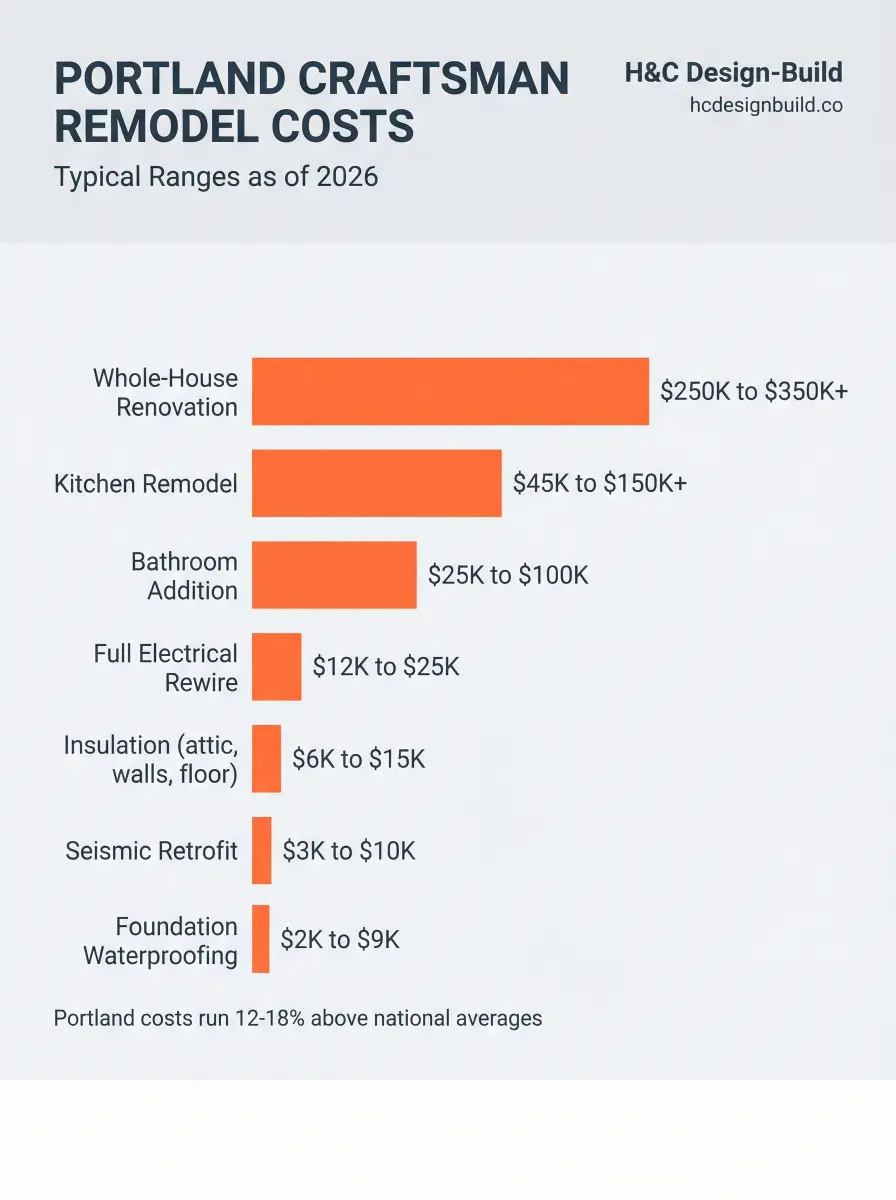
Every Craftsman remodel is different, but here's what Portland homeowners typically spend as of 2026:
| Project | Typical Range |
|---|---|
| Kitchen remodel (mid-range to full gut) | $45,000 to $150,000+ |
| Bathroom addition | $25,000 to $100,000 |
| Full electrical rewire + panel upgrade | $12,000 to $25,000 |
| Seismic retrofit | $3,000 to $10,000 |
| Foundation waterproofing | $2,000 to $9,000 |
| Insulation (attic + walls + floor) | $6,000 to $15,000 |
| Whole-house renovation | $250,000 to $350,000+ |
Based on our project history, Portland construction costs run 12 to 18 percent above national averages. Craftsman-specific factors push costs higher still: hazardous material abatement and structural engineering for wall removal add scope that newer homes don't carry.
Budget for Surprises
A 10 percent contingency works for newer homes. For a pre-1930 Craftsman, budget 15 to 20 percent. Hidden conditions are not a question of "if" but "when."
Common mid-project discoveries:
- Knob-and-tube wiring behind a wall you just opened, requiring the entire circuit to be upgraded
- Galvanized plumbing that looked fine from outside but is corroded shut inside
- Asbestos pipe insulation that requires licensed abatement before work continues
- Foundation cracks that weren't visible from the crawlspace
A design-build approach helps manage these surprises. When one team handles design and construction, they adjust scope and budget as conditions emerge. No finger-pointing between separate architects and contractors.
Your Craftsman bungalow has stood for 100 years of Portland rain. Keep the fir trim and the box beams. Fix the wiring and the pipes. If you're planning a Craftsman renovation, reach out for a conversation about your project.
Frequently Asked Questions
How much does a Portland Craftsman bungalow remodel cost?
Targeted projects like a kitchen or bathroom typically run $45,000 to $150,000. Whole-house renovations covering multiple rooms and systems usually land between $250,000 and $350,000, depending on scope and hidden conditions.
What hidden problems do Craftsman bungalows have?
Knob-and-tube wiring, galvanized steel plumbing, unreinforced foundations, balloon framing without fire blocks, lead paint on virtually every surface, and asbestos in pipe insulation and floor tiles. Budget 15 to 20 percent contingency.
Do I need a permit to remodel in a Portland historic district?
Interior work uses standard building permits with no historic review. Exterior changes in City-designated districts like Irvington and Ladd's Addition require Historic Resource Review, adding 1 to 6 months and $65 to $9,000 in fees.
Should I replace the original windows in my Craftsman?
Restore and weatherstrip them instead, then add storm windows. A restored window with a storm matches a new double-pane window's efficiency at roughly one-third the cost. Old-growth wood frames last well over a century with basic maintenance.
Can I open up the floor plan in a Craftsman bungalow?
Yes, but the kitchen-to-dining-room wall is almost always load-bearing. Removal requires a structural engineer, an engineered beam, and permits. Consider a wide cased opening with columns to preserve Craftsman spatial character.
