
We replaced a 1998 Lennox gas furnace in a Sellwood bungalow last month with a Daikin ducted heat pump. The homeowner's heating bills dropped by a third. If your furnace is aging and your energy costs keep climbing, here's what a Portland heat pump installation actually costs and how to stack Oregon's rebates.
Heat Pump Types for Portland Homes
Three types work well here. Which one fits depends on your existing system and how many rooms you need to condition.
Ducted Systems
If your home already has ductwork from a forced-air furnace, a ducted heat pump replaces the outdoor condenser and indoor air handler. Your existing ducts stay. This is the most straightforward swap for homes with central heating. Most installations complete in one to two days.
Ductless Mini-Splits
No ductwork required. Each indoor unit (called a head) mounts on a wall or ceiling and connects to an outdoor compressor through a small refrigerant line. Single-zone systems condition one room. Multi-zone systems connect up to five heads to one outdoor unit.
Ductless works well in Portland homes that use baseboard electric heat, radiant heat, or wall heaters. They're also a strong option for additions, converted attics, and ADUs where running new ductwork would be expensive or impractical.
Hybrid / Dual-Fuel Systems
A heat pump paired with a gas furnace backup. The heat pump handles most of the year. The furnace kicks in during the coldest nights. Portland's mild winters mean the gas furnace rarely runs. In our dual-fuel installations, the heat pump typically handles 85 to 95 percent of heating hours.
Portland Heat Pump Installation Costs
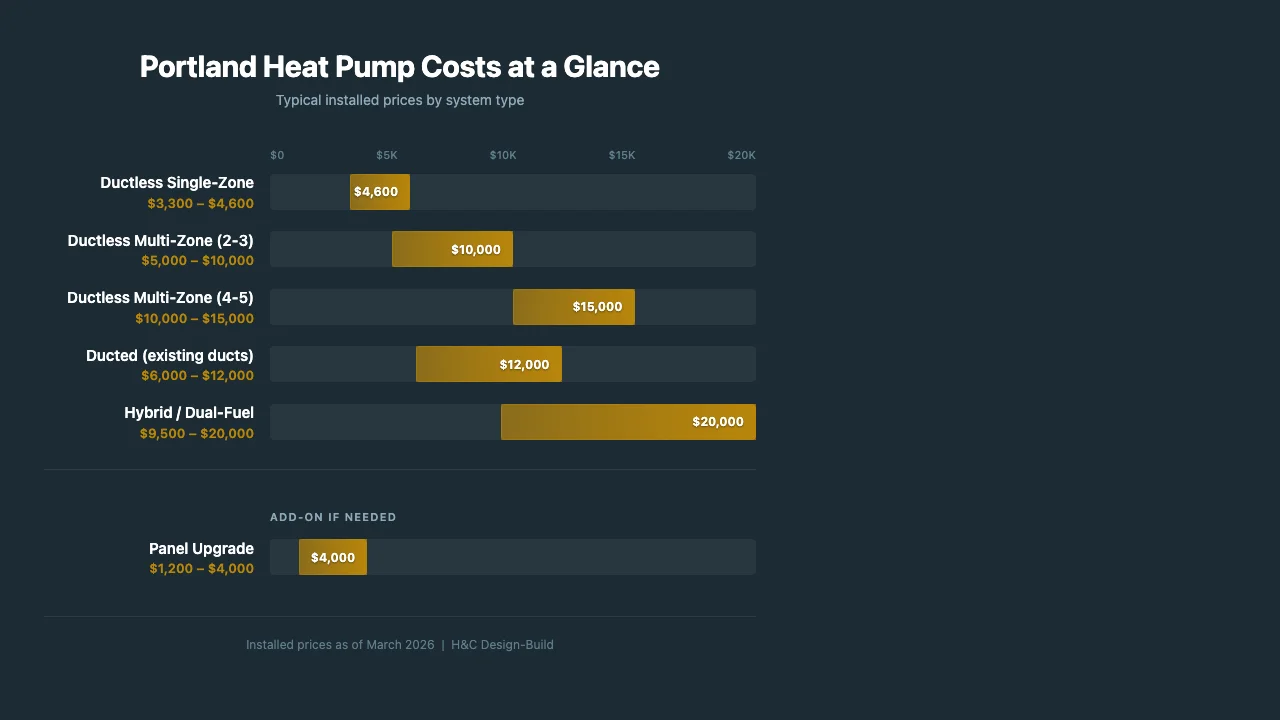
These ranges come from our recent Portland-area bids and published installer data. Installed prices include equipment, labor, permits, and basic electrical work:
| System Type | Typical Cost (Installed) |
|---|---|
| Ductless single-zone | $3,300 to $4,600 |
| Ductless multi-zone (2-3 heads) | $5,000 to $10,000 |
| Ductless multi-zone (4-5 heads) | $10,000 to $15,000 |
| Ducted (existing ductwork) | $6,000 to $12,000 |
| Hybrid / dual-fuel | $9,500 to $20,000 |
| Electrical panel upgrade (if needed) | $1,200 to $4,000 |
Prices vary based on home size, system capacity, installation complexity, and brand. In our experience, Portland pricing tracks close to national averages.
Why Portland's Climate Makes This Work
Heat pump efficiency depends on outdoor temperature. Portland's climate is close to perfect for them.
Portland sits in Climate Zone 4C (opens in new tab) (Marine). Average winter lows stay in the 35 to 40 degree range. At those temperatures, a modern heat pump operates at a coefficient of performance (COP) of 3.0 to 4.0. That means for every unit of electricity consumed, the system delivers 3 to 4 units of heat. Compare that to electric baseboard heat at a COP of 1.0 or a gas furnace at roughly 0.95.
Even during Portland's coldest nights (mid-20s a few times per winter), cold-climate models from Mitsubishi, Daikin, and others maintain full heating capacity down to 5 degrees. Portland never gets close to that.
The 2025 Biennial Oregon Heat Pump Report (opens in new tab) found 31 to 47 percent energy savings from heat pumps alone. Combined with insulation, savings reached 41 to 52 percent. In our projects, homeowners switching from gas furnaces typically save $300 to $800 per year in operating costs. Switching from electric baseboard saves more.
Stacking Rebates
Multiple incentive programs overlap in Portland. Used correctly, they can cut your out-of-pocket cost by 40 to 70 percent.
Active now:
- Energy Trust of Oregon (opens in new tab): $800 to $3,000 depending on system type, income level, and whether you're replacing electric resistance heat. Portland General Electric customers (opens in new tab) may also qualify for a promotional Daikin air handler with qualifying ducted systems or 50 percent off qualifying ductless outdoor units through participating contractors. Check current amounts on Energy Trust's site because incentive levels change periodically.
- Oregon HP3 (opens in new tab): Up to $2,000 per residence. Funded by an EPA Climate Pollution Reduction Grant. As of March 2026, owner-occupied residential funding is fully reserved. Check the HP3 page for waitlist status and other open categories.
Launching 2026:
- HOMES: Performance-based rebates up to $10,000, requiring at least 20 percent energy savings from the retrofit. Expected spring 2026 for single-family homes.
- HEAR: Up to $8,000 for a heat pump for households at or below 150 percent of Area Median Income. Expected fall 2026.
Our HOMES and HEAR application guide walks through eligibility, income thresholds, stacking rules, and common mistakes.
No longer available: The federal 25C tax credit (up to $2,000 for heat pumps) expired December 31, 2025. No replacement federal credit exists for 2026. Oregon's state and utility programs still make the economics work.
What a Realistic Incentive Stack Looks Like
For a Portland homeowner below 80 percent Area Median Income (AMI) installing a ducted heat pump:
| Program | Potential Rebate |
|---|---|
| HEAR (when launched) | Up to $8,000 |
| Energy Trust | Up to $2,000 |
| HP3 (if available) | Up to $2,000 |
| Total potential | Up to $12,000 |
On a $10,000 ducted installation, that could cover the entire cost. Even households above 150 percent AMI can stack Energy Trust plus HP3 for $2,800 to $5,000 in incentives.
What You're Replacing Matters
Your current heating system determines installation complexity and cost.
Forced Air (Gas or Electric Furnace)
Easiest swap. Existing ductwork stays. The heat pump replaces or supplements the existing system.
Baseboard Electric Heat
No ductwork exists. Ductless mini-splits are the go-to solution. Plan for one head per major living area. A three-zone system typically covers a 1,500 to 2,000 square foot Portland home.
Radiant Floor or Hydronic
More complex. The heat pump can sometimes integrate with the hydronic system using a buffer tank, but this is specialized work. Ductless supplemental units often make more sense. Get quotes for both approaches.
Wall Heaters or Space Heaters
These homes benefit most from heat pumps but also need the most planning. Electrical capacity is often limited. Budget for a panel upgrade.
When You'll Need a Panel Upgrade
Not every installation needs one. Here's the checklist:
- 200-amp panel with available breaker space: You're probably fine. A ducted heat pump typically needs a 30 to 60 amp breaker.
- 100-amp panel: You likely need an upgrade, especially if you're also running an electric range, dryer, or EV charger.
- Fuse box: Upgrade required. Insurance companies increasingly require modern breaker panels regardless of the heat pump.
A 200-amp panel upgrade in Portland runs $1,200 to $4,000 installed, including a separate electrical permit (~$225 with state surcharge). If you're planning other electrical work during a whole-home remodel, bundling the panel upgrade saves on permit fees and electrician mobilization.
Permits and Placement
Portland requires a mechanical permit (opens in new tab) for heat pump installation (~$86 including state surcharge). If the work includes new wiring or a panel upgrade, you'll also need an electrical permit.
Your contractor should pull permits as part of the installation. If they suggest skipping permits, find a different contractor.
Outdoor Unit Placement
Portland zoning code (Section 33.110.245.F) (opens in new tab) limits where you can place the outdoor compressor:
- Not in the front setback
- Allowed in side or rear setbacks
- Maximum 5 feet high if within a setback
- Must be screened from neighbors with walls, fences, or vegetation
Noise is worth considering. Modern inverter-driven units run at 40 to 50 decibels, about as loud as a refrigerator. Older fixed-speed units are noticeably louder.
Oregon's 2026 Heat Pump Requirement for New Homes
Oregon adopted the 2026 Residential Specialty Code on February 18, 2026, effective October 1. New homes with split-system air conditioning must now use a heat pump instead of a conventional AC-plus-furnace setup. Gas backup heating is still allowed.
This mandate applies to new construction only. Replacing equipment in an existing home does not require a heat pump. But the economics make it the smarter choice regardless. Why install a system that only cools when you can install one that heats and cools for roughly the same upfront cost?
Pair It With Envelope Work
A heat pump sized for a leaky house is an oversized heat pump for an insulated house. If you're also planning window replacement or insulation upgrades, do the envelope work first. Then size the heat pump to the improved home. You'll need a smaller, less expensive system, and it'll run more efficiently.
During a remodel where you're already opening walls, adding insulation and right-sizing the heat pump is the most cost-effective sequence.
How to Pay for It
Between rebates and financing options, the out-of-pocket cost is often lower than homeowners expect.
- Apply for rebates first, then finance the remaining balance.
- Some Energy Trust Trade Allies offer in-house financing.
- Credit union HELOCs work well for larger electrification projects that combine a heat pump with insulation, windows, or panel upgrades.
Why Heat Pumps Are Portland's Best HVAC Investment
Portland's mild climate and stacked incentive programs make heat pumps one of the highest-ROI upgrades you can do. The Cost vs. Value Report (opens in new tab) has ranked HVAC electrification as high as 104.8 percent return in the Portland market.
Planning a heat pump installation as part of a larger remodel? Reach out to discuss scope, timing, and how to sequence your mechanical upgrades with the rest of the project.
Frequently Asked Questions
How much does a heat pump cost to install in Portland?
Ductless single-zone systems run $3,300 to $4,600. Ducted systems with existing ductwork cost $6,000 to $12,000. Multi-zone ductless runs $5,000 to $15,000 depending on zone count.
What rebates are available for heat pumps in Portland?
Energy Trust of Oregon offers $800 to $3,000 depending on system type and income. Oregon HP3 adds up to $2,000. When HEAR launches, income-qualified households can get up to $8,000. These programs stack.
Do I need a permit to install a heat pump in Portland?
Yes. You need a mechanical permit (about $86) and usually an electrical permit, especially if the installation involves a panel upgrade or new wiring.
Is a heat pump efficient enough for Portland winters?
Portland is one of the best climates in the country for heat pumps. Average winter lows of 35 to 40 degrees keep heat pumps operating at a COP of 3.0 to 4.0, meaning 300 to 400 percent efficiency.
Do I need to upgrade my electrical panel for a heat pump?
Not always. Homes with 200-amp panels and available capacity usually don't need one. With a 100-amp panel or multiple new electric loads, plan on an upgrade. Budget $1,200 to $4,000.
