
You're planning a remodel and asking the question every homeowner asks first: is this worth it?
Portland home remodel ROI depends on what you do, how far you take it, and whether you're remodeling for yourself or for the next buyer. Some projects return more than you spend. Others barely recover half. The difference comes down to scope, not ambition.
Here's what the 2025 data shows for Portland, which projects pay off, and where homeowners lose money.
The Projects That Pay for Themselves
The 2025 Cost vs. Value Report (opens in new tab) tracks 28 project types across 119 metro markets. Portland sits in the Pacific region, which ranks highest nationally for remodeling ROI.
Three categories dominate the top of the list: exterior replacements, entry points, and minor kitchen work.
| Project | National Cost | National ROI |
|---|---|---|
| Garage door replacement | $4,672 | 268% |
| Steel entry door | $2,435 | 216% |
| Manufactured stone veneer | $11,702 | 208% |
| Fiber-cement siding | $21,485 | 114% |
| Minor kitchen remodel | $28,458 | 113% |
| Vinyl siding replacement | $17,950 | 97% |
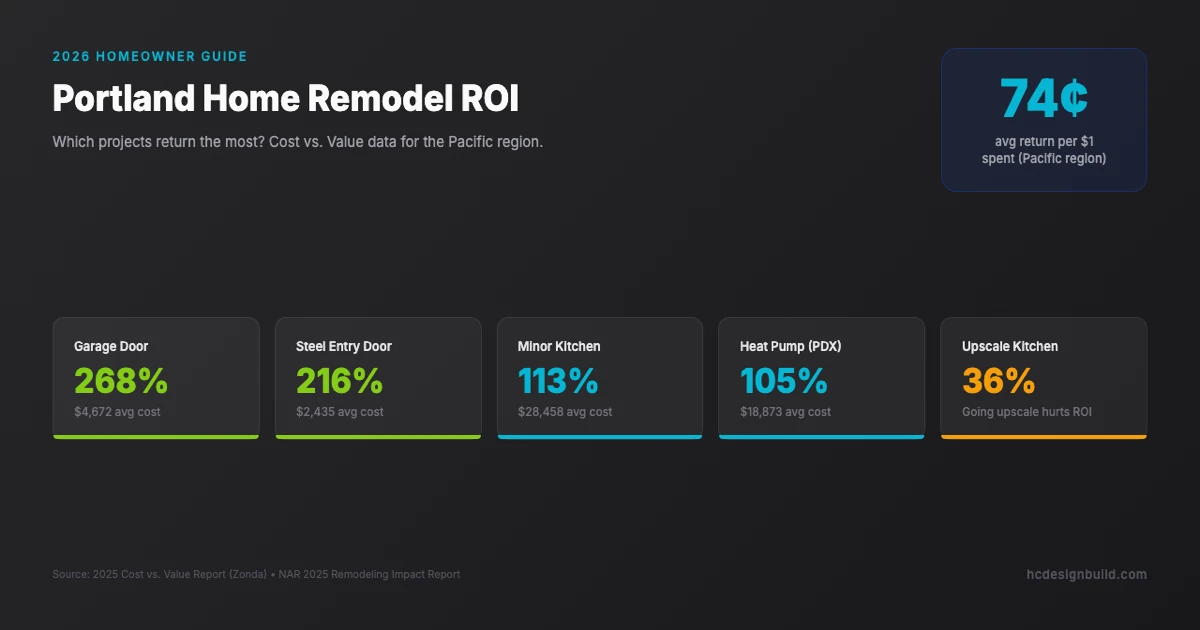
Lower-cost exterior projects with high curb appeal recover the most. Real estate agents weigh first impressions heavily when pricing homes, and these projects deliver exactly that.
The minor kitchen remodel is the only interior project in the top five. That's not a coincidence. It keeps the existing layout and updates finishes: new cabinet fronts, countertops, appliances, and hardware. No structural work, no permit delays, no surprises behind the walls.
Portland Outperforms the National Average
Pacific region numbers beat national averages across nearly every project type. Manufactured stone veneer returns 232% in the Pacific region versus 208% nationally. Vinyl siding hits 100%. Solar panels return 41% regionally versus 30% nationally.
Portland-specific data from the report's city-level breakdown confirms the trend:
| Project | Portland Cost | Portland ROI |
|---|---|---|
| HVAC electrification | $18,873 | 105% |
| Vinyl siding | $18,228 | 98% |
| Garage door replacement | $4,756 | 97% |
| Minor kitchen remodel | $28,057 | 79% |
| Midrange bath remodel | $27,024 | 63% |
HVAC electrification (heat pump conversion) topped the list. It's the only project in Portland that exceeded 100% cost recovery. Portland buyers pay a premium for energy-efficient homes. A Nature Energy study (opens in new tab) analyzing over 400,000 sales found heat pumps add 4.3-7.1% to home sale prices, with markets like Portland toward the higher end of that range.
We've installed heat pumps on Portland projects where the homeowner's main goal was comfort, not resale. The ROI data is a bonus. When your heating bill drops $500 a year and the system also cools the house in August, the investment makes sense regardless of what the Cost vs. Value report says.
Energy Upgrades: Where Rebates Change the Math
Energy projects have a unique advantage in Portland. State and utility rebates reduce your upfront cost, which pushes effective ROI higher than what the Cost vs. Value numbers show.
Oregon's HEAR program launches spring 2026 with rebates up to $8,000 for heat pumps and $4,000 for electrical panel upgrades (opens in new tab). These stack with Energy Trust of Oregon incentives (opens in new tab) (up to $1,000 for ducted heat pumps). A qualifying household could see $9,000 or more in combined rebates on a $12,000 heat pump installation.
One important change for 2026: the federal 25C Energy Efficient Home Improvement Credit expired December 31, 2025 (opens in new tab). The $2,000 heat pump tax credit is no longer available. HEAR and Energy Trust incentives are now the primary programs.
Portland's mandatory Home Energy Score (opens in new tab) makes efficiency visible at listing time. Every home sold in Portland gets a score from 1 to 10. Higher scores correlate with faster sales and higher prices. If your home scores a 3 and comparable listings score 7, buyers notice.
Beyond resale, heat pumps save $300-$800 per year in operating costs compared to gas furnaces in Portland's climate. Over a decade, that adds up to roughly $7,100 in savings versus a furnace-plus-AC system when maintenance and operating costs are included.
The Joy Score Gap: What Makes You Happy vs. What Sells
The 2025 NAR Remodeling Impact Report (opens in new tab) tracks something the Cost vs. Value numbers miss: how happy the project makes you.
NAR's "Joy Score" rates homeowner satisfaction on a 1-10 scale. The top scorers:
- Primary bedroom suite addition: 10
- Kitchen upgrade: 10
- New roofing: 10
- Hardwood floor refinishing: 10
- Closet renovation: 10
Now compare joy to cost recovery:
| Project | Joy Score | Cost Recovery |
|---|---|---|
| Steel front door | 9.5 | 100% |
| Closet renovation | 10 | 83% |
| Vinyl windows | 9.6 | 74% |
| Bathroom renovation | 9.8 | 50% |
| Kitchen upgrade | 10 | varies by scope |
Satisfaction and resale return don't track together. A primary suite addition scores 10 for joy but recovers roughly 32% at resale.
Just know what you're buying. If you're staying in the home for 10 years, a decade of living in a space you love has value that percentages don't capture. If you're selling in two years, spend your money where the return shows up in the listing price.
What Doesn't Add Value
Some projects recover pennies on the dollar, and a few make your home harder to sell.
Going upscale tanks your ROI. A midrange bathroom remodel recovers about 63% in Portland. An upscale version of the same project recovers 42%. An upscale kitchen remodel nationally returns just 36%. The pattern holds across every project type: the fancier you go, the less you recover.
Over-improving for your neighborhood. Appraisers use the principle of regression: a high-value home gets pulled down by lower-value neighbors. A $500,000 renovation in a $350,000 neighborhood won't appraise at $500,000. The neighborhood creates a ceiling. A common industry guideline: keep remodeling costs under 30% of your home's current value, and don't price yourself more than 10-15% above the highest comparable sale on your block.
Removing Portland character. This one is specific to our market. Portland's older homes, especially Craftsman bungalows, carry value in their original details. Built-in bookcases, original millwork, divided-light windows. Buyers seek these features. Tearing them out removes the thing buyers came to see.
We've seen this play out in reverse. On a whole-home renovation in Southwest Portland, keeping the home's character while updating systems, finishes, and the kitchen added substantial value.
Pools in Portland. Industry estimates from Redfin and the National Association of Realtors put pool cost recovery at roughly 15-25% of installation cost. Portland's limited swimming season makes that number worse. Unless you're building for personal use with eyes wide open, pools are a losing investment here.
Reducing bedroom count. Converting a bedroom to a permanent home office drops your bedroom count on the listing. In a family-driven market, that hurts. If you need office space, keep it reversible.
Portland Market Context: What Buyers Want in 2026
Portland's market is shifting toward balance. Median home values sit around $520,000 (opens in new tab) as of early 2026, with inventory near three months' supply. Move-in-ready homes still sell. Homes needing work sit longer.
What Portland buyers prioritize right now:
Energy efficiency leads. Portland requires Home Energy Scores at listing. Buyers compare scores. Homes with documented efficiency improvements sell up to 10% faster (opens in new tab). Heat pump installations, insulation upgrades, and high-performance windows all contribute to the score.
Outdoor living space. Portland's indoor-outdoor lifestyle means covered patios, outdoor kitchens, and usable deck spaces carry premiums of $15,000-$30,000 on recent sales (opens in new tab).
ADU income potential. Accessory dwelling units in Portland rent for $1,500-$2,500 per month (opens in new tab). The Cost vs. Value Report shows ADUs returning only 41% in pure resale terms, but that ignores the rental income. A studio ADU built for around $95,000 generating $1,500 per month pays for itself in roughly five years.
How to Think About ROI
ROI depends on your timeline.
Selling within two years: Spend on high-return projects. Garage door, entry door, siding, minor kitchen updates. These are the projects real estate agents recommend before listing because they show well and recover cost.
Staying five-plus years: Invest in what improves your life. A kitchen you love cooking in, a bathroom that feels like yours, an addition that solves a space problem. You'll get partial cost recovery when you sell, but the daily satisfaction over five to ten years is the real return.
Always worth doing: Deferred maintenance. A failing roof, deteriorating siding, or outdated electrical aren't optional upgrades. They're protection for the value you already have. Skipping them doesn't save money. It lets your home lose value quietly.
Portland homeowners who match their project scope to their timeline get the best outcomes. Upscale spending on a home you're listing next year rarely pays off. And skipping a project you'd enjoy for a decade because the spreadsheet said 42%? That's letting the numbers make a lifestyle decision.
If you're weighing which projects make sense for your home and timeline, reach out for a conversation. We'll help you figure out what makes sense and what it'll cost.
Frequently Asked Questions
What is the average remodeling ROI in Portland?
Portland falls in the Pacific region, which leads the country in remodeling ROI according to the 2025 Cost vs. Value Report. The Pacific region averages roughly 74 cents back per dollar invested across all project types. Exterior projects like garage doors and siding pull that average up. Interior projects, especially upscale finishes, pull it down.
Does a kitchen remodel add value in Portland?
It depends entirely on scope. A minor kitchen remodel (new cabinet fronts, countertops, appliances, no layout changes) returns 113% nationally. A full upscale kitchen remodel returns about 36%. The lesson is clear. Cosmetic upgrades in the existing footprint recover more than gut renovations with custom finishes and layout changes.
Do energy-efficient upgrades increase home value in Portland?
Portland buyers pay a measurable premium for energy efficiency. A Nature Energy study of 400,000-plus home sales found heat pumps add 4.3-7.1% to sale price. Portland also requires a Home Energy Score (1-10) on every listing, which makes efficiency visible to buyers. Homes with higher scores sell faster. With HEAR rebates launching in spring 2026 covering up to $8,000 for heat pumps, the out-of-pocket cost drops significantly.
Should I remodel for resale value or for myself?
If you're selling within two years, focus on high-ROI projects (garage door, entry door, siding, minor kitchen). If you're staying five-plus years, invest in what improves your daily life. A primary suite addition scores a perfect 10 for homeowner satisfaction despite 32% resale ROI. Living in a home you love for a decade has value the numbers don't capture.
What remodeling projects should I avoid for ROI?
Pools in the Pacific Northwest are a losing investment. Upscale kitchen and bathroom remodels consistently return under 50%. Converting a bedroom to a permanent home office reduces bedroom count, which hurts resale. And stripping original Craftsman details (built-ins, millwork, divided-light windows) from Portland's older homes actively reduces buyer appeal.
