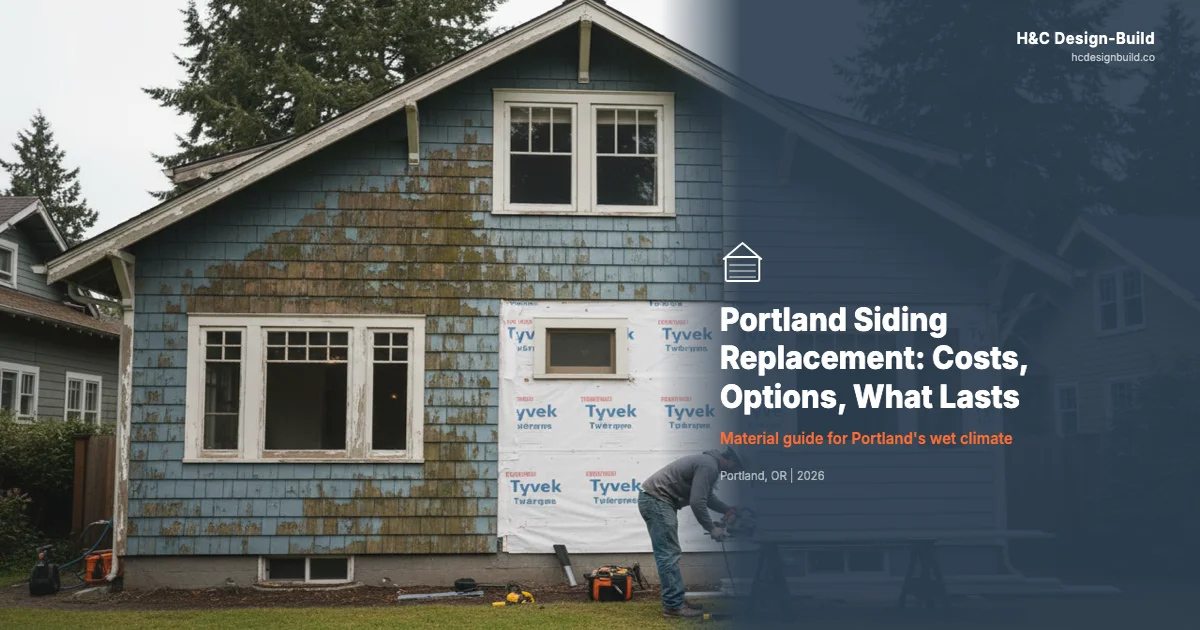
We pulled the cedar siding off a 1952 Cape Cod in Laurelhurst last spring. The owner thought the north side needed a few board replacements. Once we opened the wall, we found rot through the sheathing (plywood layer under the siding) in three bays. Water had wicked behind failed caulk joints for years. What started as a patch turned into a full re-side with new sheathing, a rain screen gap (an air space that lets moisture drain and dry), and rigid foam insulation.
Portland siding replacement cost depends on material choice, wall condition underneath, and whether you add insulation while the walls are open. Here's what each material costs, how it handles our rain, and when replacement makes more sense than patching.
What siding replacement costs in Portland
For a typical Portland home with 1,500 to 2,000 square feet of siding area, here's what full replacement runs in 2025-2026:
| Material | Cost per Sq Ft (Installed) | Typical Whole-House Range | | ------------------------------ | -------------------------- | ------------------------- | | Vinyl | $7 to $10 | $10,500 to $20,000 | | Fiber cement (James Hardie) | $10 to $16 | $15,000 to $32,000 | | LP SmartSide (engineered wood) | $8 to $14 | $12,000 to $28,000 | | Cedar | $12 to $20 | $18,000 to $40,000 | | Metal (steel or aluminum) | $9 to $15 | $13,500 to $30,000 |
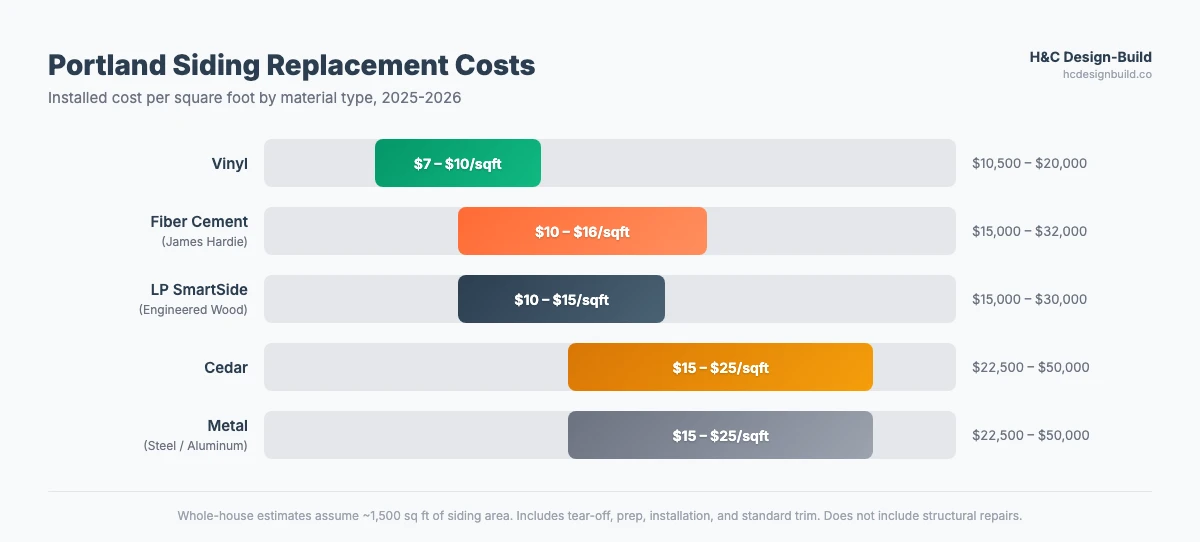
These ranges cover tear-off, prep, installation, and standard trim. They don't include structural repairs to sheathing or framing behind the siding. If your old siding has been hiding water damage, budget an extra $2,000 to $8,000 for sheathing and framing work depending on how far the rot spread.
In our experience, two-story homes, dormers, bay windows, and complex rooflines add 15 to 25 percent to any of these numbers. More cuts, more scaffolding, more flashing details around each penetration.
What drives the price higher
A few factors push costs beyond the per-square-foot material price:
Removing old siding runs $1,000 to $3,000 for tear-off and disposal. Portland homes often have new siding nailed over old layers (we've found three layers on some Sellwood houses), which means double or triple the removal work and disposal fees.
New siding almost always means new trim and flashing around windows, doors, and corners. Fiber cement and cedar trim cost more than vinyl J-channel, but they last longer and look right on older Portland homes.
Tariff impacts are real too. Imported fasteners, flashing materials, and some hardware have seen price increases from 2025-2026 tariffs. Domestic manufacturers like James Hardie and LP are less affected directly, but we've seen prices climb on most materials over the past year.
What holds up in Portland rain
Portland averages about 36 inches of rain per year according to NOAA 1991-2020 climate normals for Portland (opens in new tab), with most of it falling between October and May. North-facing walls take the worst of it because they get less sunlight and dry slower. Moss colonizes them first. Here's how each material handles our climate.
Fiber cement (James Hardie)
Fiber cement is the most common re-siding choice in Portland. It won't rot, warp, or attract insects. It handles moisture without swelling or cupping.
James Hardie's HardiePlank (opens in new tab) carries a 30-year non-prorated substrate warranty and a 15-year warranty on their ColorPlus factory finish. In practice, expect to repaint every 10 to 15 years at $3,000 to $5,000 for a typical home. That's the main maintenance expense.
The trade-offs: fiber cement is heavy (about 2.5 pounds per square foot), so installation takes longer. It's also brittle before it's mounted and cracks if it hits the ground during handling. You need a crew that knows how to work with it.
Cedar
Cedar looks right on Portland's Craftsman bungalows and has natural resistance to fungi and insects. If your home is in a historic district or you're matching original siding profiles, cedar may be the only material that gets the look right.
The trade-off is maintenance. Cedar needs power washing every year and re-staining or repainting every 3 to 5 years at $2,500 to $4,000 per cycle. Skip a cycle in Portland's climate and you'll see cupping, splitting, and moss taking root within a season. Plan on 20 to 40 years of service life if you keep up with it. Walk away from maintenance and you'll get 15.
LP SmartSide (engineered wood)
Engineered wood strand panels treated with LP's SmartGuard process (opens in new tab) to resist moisture, termites, and fungal decay. Per LP's published warranty, it carries a 50-year prorated warranty: 100 percent coverage for the first 5 years, then declining coverage after that.
LP SmartSide is lighter than fiber cement and easier to cut on site, which trims installation time and labor cost. Our crews move through an LP install about 20 percent faster than fiber cement on the same house. It can be painted any color. Repainting schedule runs every 10 to 15 years, similar to fiber cement.
The catch: that prorated warranty means declining coverage over decades, unlike James Hardie's non-prorated 30-year warranty. And while the SmartGuard treatment handles moisture well, it's still wood-based. Bad flashing details or standing water at the base of a wall will still cause problems over time.
Vinyl
The cheapest option and the lowest maintenance. Vinyl doesn't rot, doesn't need painting, and sheds rain without absorbing it. Modern vinyl is more durable than the thin panels from the 1990s.
But vinyl can't be repainted. Color bakes in during manufacturing, and darker shades fade noticeably after 7 to 10 years of Portland's sun-and-rain cycles. It also looks generic. Vinyl on a Craftsman bungalow or a mid-century ranch will look out of place next to the wood and fiber cement on neighboring houses.
Skip stucco
Stucco doesn't work in Portland. Water soaks into it, freeze-thaw cycles crack it, and poor drainage behind stucco leads to hidden rot. We tore stucco off a Multnomah Village ranch two years ago and found the sheathing had rotted through in eight places. It's not built for a climate with 9 months of wet weather. If your roof needs work too, bundling both projects cuts scaffolding and mobilization costs. See our roofing replacement cost guide for material and pricing details.
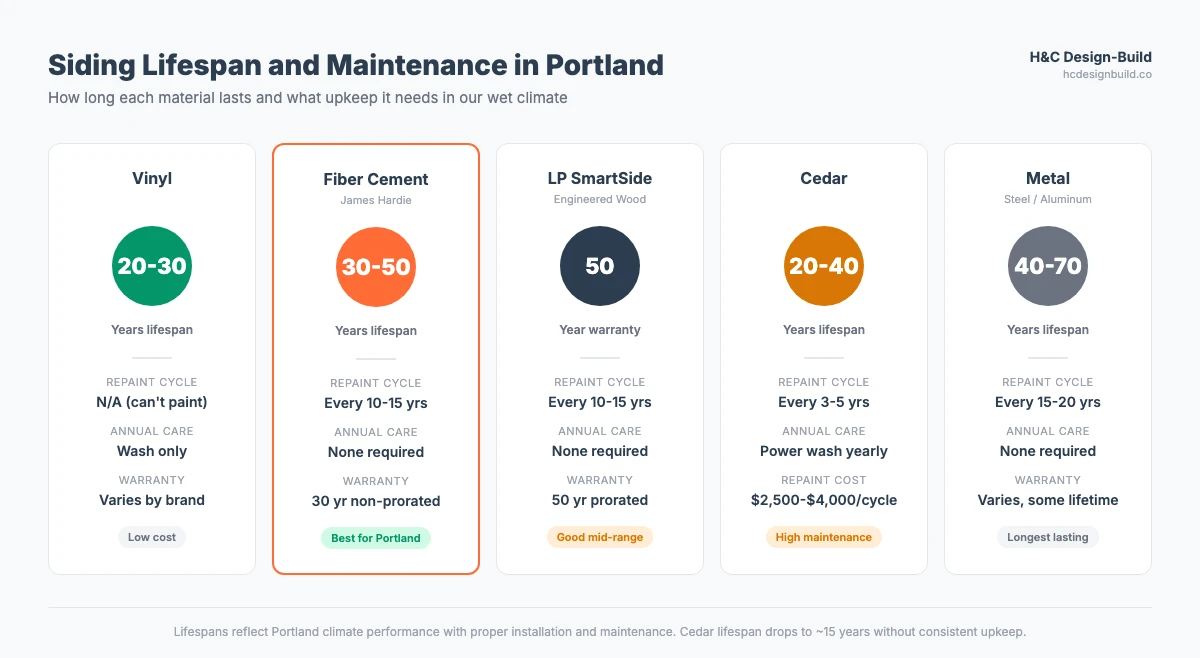
| Material | Lifespan | Maintenance cycle | Best for | | ------------ | ---------------- | --------------------------------------- | ---------------------------------- | | Vinyl | 20 to 30 years | None (no repainting) | Budget-focused, low maintenance | | Fiber cement | 30 to 50 years | Repaint every 10 to 15 years | Most Portland homes | | LP SmartSide | 50-year warranty | Repaint every 10 to 15 years | Lighter installs, mid-range budget | | Cedar | 20 to 40 years | Wash yearly, restain every 3 to 5 years | Historic character matching | | Metal | 40 to 70 years | Minimal | Maximum longevity |
Adding insulation while the walls are open
Re-siding is the cheapest time to improve your wall insulation. Once the old siding is off and the sheathing is exposed, adding rigid foam board takes minimal extra labor compared to doing it as a standalone project.
Adding 1 to 2 inches of rigid foam under new siding costs $3,000 to $6,000 for a typical home. That layer adds R-4 to R-10 of continuous insulation across the entire wall surface (depending on foam type), reducing thermal bridging (opens in new tab) (heat loss through the wood studs). On older Portland homes with little existing wall insulation, we've seen heating bills drop 10 to 20 percent after a re-side with exterior foam.
Energy Trust of Oregon offers $2.25 per square foot (opens in new tab) for wall insulation upgrades that bring walls to R-11 or higher. This incentive currently applies to duplexes, triplexes, and fourplexes only. Single-family homes are not eligible. Check your property type at energytrust.org before budgeting for it. On a qualifying home with 1,500 square feet of wall area, that's up to $3,375 back. You can stack this with Oregon HOMES rebates when they launch for even larger total savings.
Most older Portland homes have little or no wall insulation. If you're already paying to strip the siding, the incremental cost to insulate is a fraction of what it would cost as a separate project later.
Lead paint and permit rules
Permit and lead paint requirements change. Verify current rules with Portland BDS (503-823-7300) and Oregon CCB before starting work.
Pre-1978 homes and lead paint
If your home was built before 1978, any siding work that disturbs more than 20 square feet of painted surface triggers the EPA's Renovation, Repair, and Painting (RRP) rule (opens in new tab). You'll need an RRP-certified contractor. In Oregon, the Construction Contractors Board manages RRP licensing for all contractors doing this work.
RRP compliance adds $500 to $1,500 to the project for lead testing, containment, and proper cleanup. Don't skip it. Fines for non-compliance are steep, and lead dust is a real health risk for anyone living in the home during the work.
More than half of Portland's housing stock was built before 1978. If your home is in that group, lead paint should be part of your planning from the start. Many pre-1940 Portland homes also have foundation problems worth checking.
Permits
Standard siding replacement in Portland does not require a building permit (opens in new tab) as long as the siding is not required to be fire-resistive. Most residential re-siding falls under this exemption. Your work still needs to meet building and zoning codes, but you won't need to pull a permit or schedule inspections.
If your siding project triggers other work (sheathing repair, window replacement, electrical relocation), those items may need their own permits. Window replacements follow separate rules depending on whether you're changing the rough opening size.
When to replace vs. patch
Not every failing section means a full re-side. Here's a rough guide:
- Patch if damage is limited to a few boards or one wall section and the replacement material still matches what's on the house.
- Replace one or two walls if damage concentrates on the north or west side (Portland's weather-facing sides) and the remaining walls are sound.
- Full re-side if damage appears on three or more walls, the siding has passed its expected life, or you want to change materials entirely.
Patching cedar onto a wall that's 25 years old creates a color mismatch you'll never stain out evenly. Patching vinyl is easier because panels lock together, but you need the exact same profile from the same manufacturer. Old vinyl profiles get discontinued, so check availability before committing to a patch approach.
Picking the right material
- Fiber cement fits most Portland homes. It handles our rain and holds paint for 10 to 15 years between recoats with no other annual maintenance.
- Cedar makes sense when matching historic character is the priority and you're committed to the upkeep schedule.
- LP SmartSide sits in the middle: lighter and sometimes cheaper than fiber cement with solid moisture protection, though the prorated warranty is worth understanding before you sign.
Whatever material you choose, the condition of what's behind your current siding matters more than most homeowners expect. A solid re-side starts with sound sheathing and proper flashing.
If you're weighing a siding project and want to know what your walls look like underneath, contact us for an assessment.