
Your parents need a place to live. Or your adult kids moved back and aren't leaving soon. Maybe both. Portland's housing costs make a multigenerational home remodel a financial decision as much as a family one.
The numbers back this up. Pew Research (2021) (opens in new tab) reports 59.7 million Americans live in multigenerational homes, 18% of the population. The National Association of Realtors (opens in new tab) found 17% of all homes purchased in 2024 were multigenerational, an all-time high, with cost savings as the top reason at 36%.
In Portland, median home prices sit around $500,000 while median homeowner income is $126,117 (opens in new tab) according to the Portland Housing Bureau. Combining households makes financial sense. The question is how to make it work inside the house.
Four Ways to Create Multigenerational Space
Multigenerational remodels usually follow one of four paths. The right one depends on your lot, your home's layout, and your budget.
| Path | Typical Cost | Permit Complexity | Best For |
|---|---|---|---|
| Internal reconfiguration | $30K–$80K | Low (no ADU trigger) | Homes with unused space |
| Basement conversion | $75K–$150K | Medium (egress, code compliance) | Older Portland homes with basements |
| Home addition | $250K–$500K+ | High (setbacks, engineering, possible ADU) | Lots with room to expand |
| Garage conversion | $90K–$150K | Medium (ADU if kitchen added) | Detached garages with good bones |
Internal Reconfiguration
The lowest-cost option. You're working within the existing footprint: splitting a large room, adding a bathroom, converting a den into a bedroom suite.
We did this on a Northwest Portland renovation where the homeowner had unused open space on the lower level. We framed a proper utility room and a 5th bedroom where there was just empty square footage. No foundation work, no addition, no ADU permit.
Internal reconfigurations in Portland typically run $30,000 to $80,000 depending on whether you're adding plumbing and how much structural work the split requires.
Basement Conversion
Portland's older homes often have basements with enough ceiling height to convert. Portland's BCG 96-12 (opens in new tab) allows existing basements at 6 feet 8 inches, lower than the 7-foot new-construction standard.
On a Northeast Portland project, we converted an unfinished basement into a master suite with an office. That meant excavating for two egress windows with poured concrete wells, rerouting drainage to protect the foundation, and running new electrical throughout. The egress windows are non-negotiable: Oregon Residential Specialty Code (R310.2) requires a minimum 5.0 square feet of net clear opening for below-grade bedrooms, with window wells at least 9 square feet.
On a North Portland project, we legalized a non-permitted basement by cutting egress windows for bedrooms and running the full permitting and inspection process. Basement legalization is common in Portland's older housing stock. If previous owners finished the basement without permits, the city requires you to bring it up to code before it counts as habitable space.
Basement conversions with a kitchenette and bathroom run $75,000 to $150,000 in Portland, or roughly $125 to $200 per square foot. The cost range reflects whether you need foundation waterproofing, structural reinforcement, or significant plumbing and electrical work. For the full basement finishing process and costs, see our basement finishing guide.
Home Addition
When the existing footprint can't accommodate another household, you build out. A 500-square-foot multigenerational wing in Portland starts around $250,000 and can reach $500,000 or more depending on complexity, finishes, and site conditions.
Portland home additions require a building permit, structural engineering, and often trigger setback and height reviews. If the addition creates a self-contained dwelling unit (kitchen, bathroom, sleeping area, separate entrance), it's classified as an ADU under Title 33, Chapter 33.205 (opens in new tab). That adds zoning requirements but also qualifies you for Portland's ADU incentives.
For full cost and permit details, see our Portland home addition cost guide.
Garage Conversion
Detached garages convert well to multigenerational suites because they already have a foundation, walls, and roof. Portland garage conversions run $90,000 to $150,000 ($150 to $250 per square foot).
The scope typically includes insulation, electrical, plumbing for a bathroom, HVAC, flooring, and interior finishes. If you add a kitchen, the space becomes an ADU. Our garage ADU conversion guide covers the full permit process and cost breakdown.
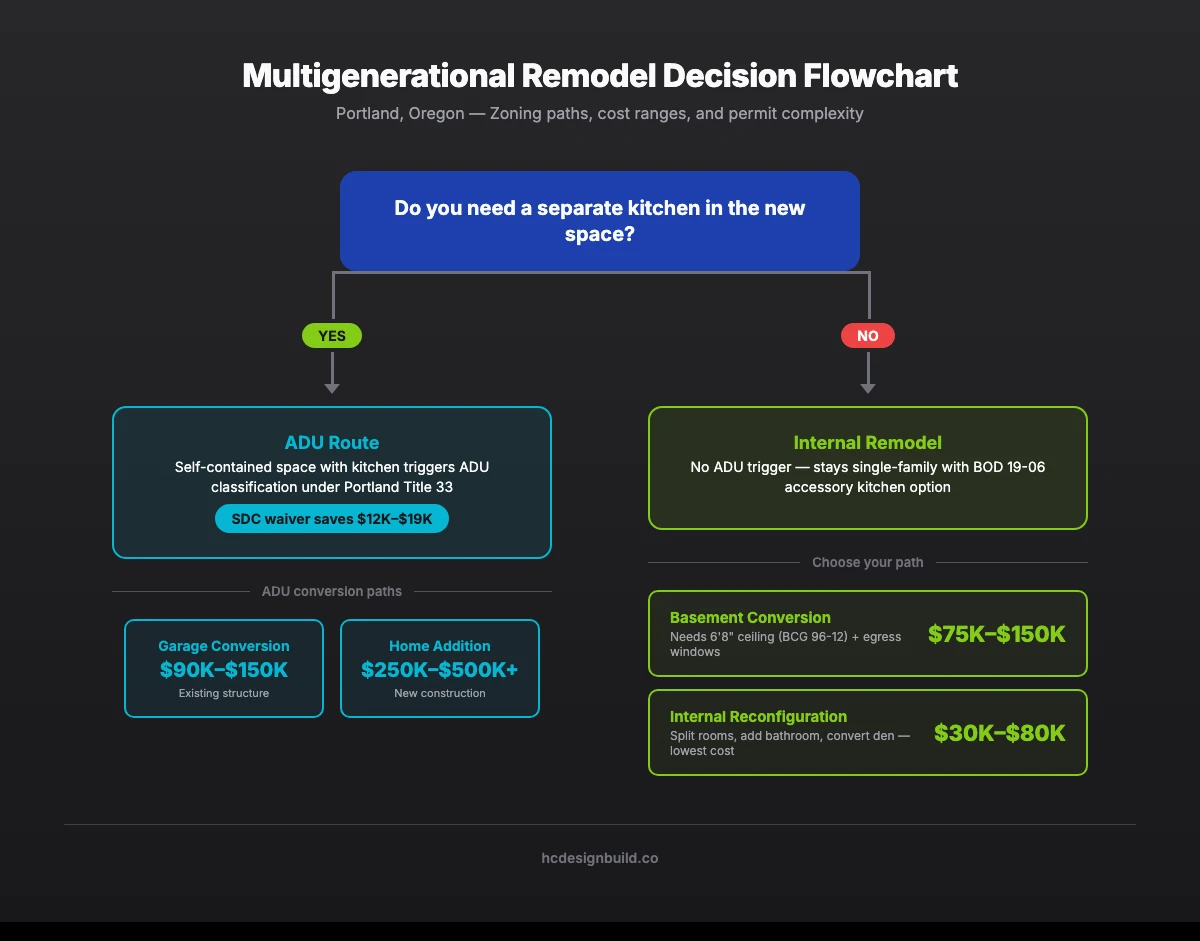
The Zoning Question: ADU or Not?
Portland draws a clear line between a remodeled single-family home and an ADU, and that line determines your permit path, costs, and what you can build.
Portland's Title 33 zoning code (opens in new tab) defines an ADU as a secondary dwelling unit with independent living facilities for sleeping, cooking, and sanitation. The trigger is a self-contained space with all three behind a closeable door.
BOD 19-06 (opens in new tab) gives you a middle path. You can add a second "accessory kitchen" without ADU classification if:
- The kitchen area isn't separated from the rest of the home by walls or a closeable door
- You record an Additional Accessory Kitchen Covenant with Multnomah County
- The kitchen meets all electrical, plumbing, and mechanical code requirements
A wet bar or sink alone doesn't trigger anything (opens in new tab). Portland changed that policy in September 2023. Only permanent cooking facilities (oven, range, permanently installed microwave) create a dwelling unit.
If you do go the ADU route, Portland's incentives help:
- System Development Charge (SDC) waiver (opens in new tab) saves $12,000 to $19,000 if you commit to no short-term rentals for 10 years
- Up to two ADUs per single-family lot (opens in new tab)
- No minimum off-street parking required
- Basement ADUs can reach up to 1,000 square feet
- Standard ADU cap: 800 square feet or 75% of primary home area, whichever is smaller
- Oregon HB 2138 (opens in new tab) retroactively voids HOA covenants restricting ADUs starting 2027
Privacy and Independence: What to Plan
Multigenerational living works when both households feel independent. Design decisions made during planning determine whether that happens.
Separate HVAC Zones
Temperature preferences vary by generation. A single-zone ductless mini-split runs $2,500 to $5,000 installed. A two-zone system covers both areas for $5,000 to $8,000. Each household controls their own thermostat.
Soundproofing Between Units
Standard residential construction provides an STC (Sound Transmission Class) rating of 30 to 45 between rooms. That's not enough when two households share a structure. Target STC 55 to 60 for genuine acoustic privacy. Costs run $1,000 to $4,000 per room depending on the approach: adding insulation between joists, resilient channel on walls, or double drywall layers.
Separate Entrances
Portland doesn't restrict adding exterior doors to a single-family home. But remember the ADU trigger: a separate entrance combined with cooking, sleeping, and sanitation in a self-contained space creates a dwelling unit. If you want a separate entrance without ADU classification, keep the interior layout open to the main home.
Universal Design
If the conversion is for aging parents, build accessibility in now. It costs almost nothing during construction and is expensive to retrofit later. Key specs: 36-inch doorways (ADA minimum is 32), grab bar blocking in all wet areas, at least one zero-step entry, and comfort-height toilets. For a full breakdown, see our aging in place remodel guide.
Who's Buying Multigenerational Homes
Gen X homeowners in the sandwich generation are the primary buyers. NAR data (opens in new tab) shows they account for 21% of multigenerational home purchases, up from 12% a decade ago. Cost savings is the top reason at 36%, more than double the 15% from 2015.
We see this in our consultations. Most multigenerational projects start with a parent's health change or an adult child's rent increase. The family runs the numbers and realizes a remodel costs less than a second mortgage or years of rent.
Portland's affordability gap reinforces this. The Portland Housing Bureau (opens in new tab) reports median renter income at $58,946 against average rents that keep climbing. For many families, combining households is just math.
Financing a Multigenerational Remodel
These are common options, not financial advice. Rates and terms change — talk to a lender about your situation.
HELOC (Home Equity Line of Credit)
Current rates run 6.5% to 8.25%. Fastest to set up and most flexible: draw what you need when you need it. Works best for homeowners with significant equity. See our remodel financing guide for a full comparison.
FHA 203(k)
Allows you to roll renovation costs into your mortgage. Standard 203(k) covers structural changes and room additions, so in-law suites qualify. Minimum 3.5% down with a 580+ credit score. Requires a licensed contractor and owner occupancy.
Fannie Mae HomeStyle
Similar to 203(k) but with higher loan limits ($832,750 standard, $1,249,125 in high-cost areas). As of October 2025, Fannie Mae's Selling Guide allows projected ADU rental income toward mortgage qualification. If your multigenerational conversion qualifies as an ADU, that rental income potential helps you qualify for the loan.
Start With the Zoning Conversation
Before you draw floor plans or price materials, answer one question: ADU or internal remodel? That decision shapes your permit path, your budget, and what you're allowed to build.
Portland's Bureau of Development Services (opens in new tab) offers free 15-minute phone consultations at 503-823-7300. Use them. Describe your project and ask whether it triggers ADU classification.
If you're planning a multigenerational remodel in Portland, reach out to our team. We'll walk your home, assess what's possible within your zoning, and give you honest numbers for your specific situation.
Frequently Asked Questions
Can I add a second kitchen without triggering ADU classification in Portland?
Yes. Portland's BOD 19-06 allows an accessory kitchen if the space isn't separated by a closeable door and you record a covenant with Multnomah County. A kitchenette in an open-plan area stays single-family.
How much does a multigenerational remodel cost in Portland?
It depends on the path. Internal reconfiguration runs $30,000 to $80,000. Basement conversions with a kitchenette and bathroom cost $75,000 to $150,000 in Portland. Additions start around $250,000. Garage conversions fall between $90,000 and $150,000.
Does Portland offer any incentives for multigenerational conversions?
Not directly, but ADU incentives apply if your project qualifies. Portland's SDC waiver saves $12,000 to $19,000 if you commit to no short-term rentals for 10 years. Oregon's HB 2138 also voids HOA restrictions on ADUs and middle housing starting 2027.
What is the minimum ceiling height for a Portland basement bedroom?
Portland's BCG 96-12 allows 6 feet 8 inches for existing basement conversions, lower than the 7-foot standard for new construction. Soffits within 2 feet of a wall can drop to 6 feet. Stair headroom minimum is 6 feet 2 inches.
Do I need a separate entrance for a multigenerational suite?
Portland doesn't restrict adding entrances to single-family homes. But a separate entrance combined with cooking facilities, a bathroom, and a sleeping area in a self-contained space triggers ADU classification. Plan the entrance and the interior layout together.
