
You're planning a basement remodel and radon isn't on the checklist yet. It should be. Portland radon mitigation is straightforward when you catch it during construction, but expensive and disruptive as a retrofit.
Radon is the second leading cause of lung cancer in the United States and the leading cause among non-smokers. The EPA estimates 21,000 lung cancer deaths per year (opens in new tab) from radon exposure. Portland sits in an EPA Zone 2 moderate-risk area, and parts of Northeast Portland test consistently higher than the rest of the city.
This guide covers testing, mitigation systems, and costs. It is not a substitute for professional health or environmental safety advice. Consult a certified radon professional for your specific situation.
Why Portland Has a Radon Problem
Radon is a radioactive gas. It forms when uranium in soil and rock decays, then seeps through foundation cracks, slab joints, sump pits, and gaps around pipes. You can't see or smell it.
Portland's radon comes from geology. The Missoula Floods deposited uranium-bearing rock and sediment across the Willamette Valley roughly 15,000 years ago. That material has been decaying into radium ever since, and the radon it produces works up through Portland's soil and into homes.
The Oregon Health Authority's radon risk map (opens in new tab) breaks Portland down by zip code. Eleven Portland zip codes fall in the elevated-risk category. Another eighteen are moderate risk. Northeast Portland shows the highest concentrations in the city.
Neighboring Clackamas County is EPA Zone 1, the highest risk classification. If your project is in Oregon City, Lake Oswego, West Linn, or Happy Valley, radon testing before any below-grade work is essential.
The catch: radon varies house to house. Two homes on the same block can test at very different levels. Zone classifications indicate probability, not certainty. The only way to know your level is to test.
When to Test During a Remodel
Test before any project that involves below-grade space or changes how air moves through your home.
Test before these projects:
- Basement finishing or conversion: You're about to put living space where radon concentrations are highest. Test first, mitigate before closing walls.
- Foundation repair or waterproofing: Crack repairs, drain tile work, and sump modifications all change how soil gas moves under the slab.
- Crawlspace encapsulation: Sealing a crawlspace changes pressure dynamics. A sealed crawlspace without radon venting can concentrate the gas.
- Attic conversions and additions: Adding living space changes the building's stack effect, which can pull more soil gas upward through the foundation.
- Whole-home remodels: If you're opening walls and replacing systems, adding a radon pipe during rough-in costs almost nothing compared to doing it after drywall is up.
On basement projects in North Portland, we've found that homeowners who test before demo have more options. If levels come back high, the mitigation pipe routes through walls that are already open. After drywall, you're cutting holes and patching.
How to Test
Two practical options for remodel planning:
DIY short-term test ($10 to $20): Buy a charcoal canister kit from a hardware store or order one online. Place it in the lowest livable level with doors and windows closed for 2 to 4 days. Mail it to the lab. Results come back in about a week. The Oregon Health Authority offers free test kits (opens in new tab) to residents in qualifying zip codes.
Professional continuous monitor test ($145 to $225): A certified technician places an electronic monitor for 48 hours. No lab wait. Results are immediate and tamper-evident, which matters for real estate transactions. In Portland, expect to pay $145 to $225 depending on the provider.
For remodel planning, a DIY kit is fine. You need to know whether levels are elevated, not a lab-certified report. If the result comes back at or above 4 pCi/L, hire a certified professional for confirmation testing and mitigation design.
What the Numbers Mean
The EPA action level is 4 pCi/L (opens in new tab). At or above that, mitigate. The EPA also recommends considering mitigation between 2 and 4 pCi/L. The World Health Organization sets a lower action level at 2.7 pCi/L.
For context: the national average indoor radon level is 1.3 pCi/L. Portland's average predicted level is 2 to 4 pCi/L across most of the city, with some neighborhoods testing higher.
The health risk compounds with smoking. At 4 pCi/L, a never-smoker has a 7 in 1,000 lifetime lung cancer risk from radon. For current or former smokers, that jumps to 62 in 1,000. Radon and tobacco smoke together create 10 to 20 times the risk (opens in new tab) of either alone.
Mitigation Systems and What They Cost
Most Portland homes use one of two systems.
Sub-Slab Depressurization (Homes with Concrete Slabs)
This is the standard. A PVC pipe runs through the slab into the gravel layer below. An inline fan creates negative pressure under the slab, pulling radon up through the pipe and venting it above the roofline. The pipe exits through the roof or runs up the exterior wall.
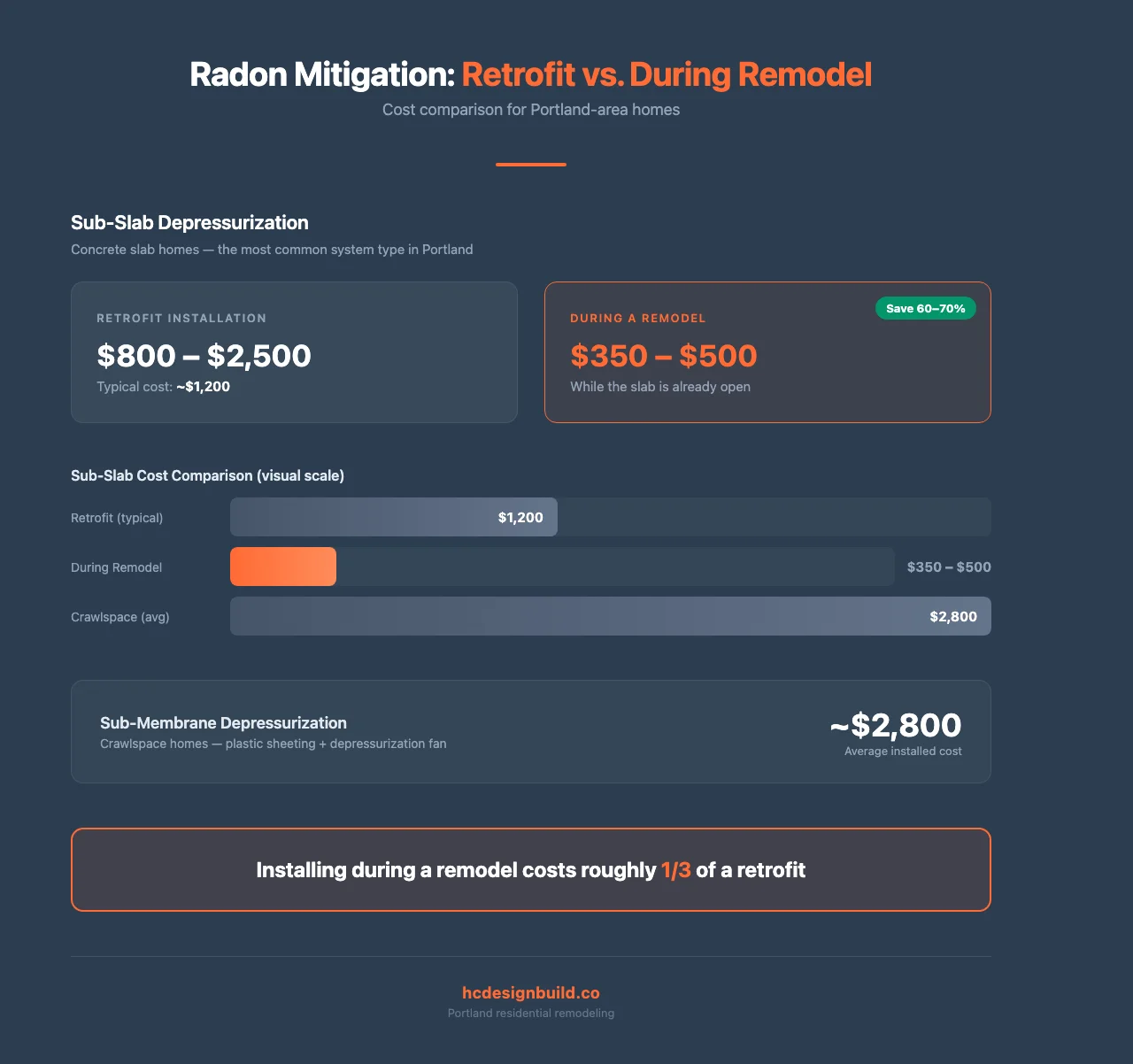
Retrofit cost: $800 to $2,500 installed. In our Portland projects, most installations land around $1,200.
During a remodel: $350 to $500. The slab is already accessible. The pipe routes through open wall cavities. No patching, no rerouting around finished spaces.
That's the math that matters. A system that costs $1,200 as a retrofit costs a third of that when the walls are open.
Sub-Membrane Depressurization (Homes with Crawlspaces)
Portland has a lot of crawlspace foundations, especially in pre-1940 homes. A heavy plastic membrane covers the dirt floor, sealed at edges and seams. A vent pipe and fan pull radon from under the membrane.
Cost: Around $2,800 on average in Portland, higher than slab systems because of the membrane installation labor.
What the System Looks Like
A PVC pipe (3 or 4 inch) runs from the foundation up to above the roofline. On exterior installations, the pipe runs along the side of the house and can be painted to match. Interior installations route through closets, utility rooms, or the garage up through the attic.
The fan sits in the attic or on the exterior pipe. It runs continuously, draws about as much power as a light bulb, and produces a low hum. A U-tube manometer (a small gauge on the pipe) confirms the system is working.
Oregon Code and New Construction
Homes built after April 2013 in Multnomah County already have passive radon-resistant construction per Oregon statute ORS 455.365 (opens in new tab). This applies to seven Oregon counties including Multnomah, Clackamas, and Washington.
The requirement includes a gravel layer under the slab and provisions for a vent pipe. These passive systems rely on natural air pressure. If post-construction testing shows levels above 4 pCi/L, adding a fan converts it to an active system for a few hundred dollars.
Older homes have nothing. No gravel layer, no pipe provisions, no vapor barrier designed for radon. If your home was built before 2013, assume it has no radon protection.
Oregon does not require radon testing or mitigation in existing homes. Sellers must disclose prior test results in the property disclosure, but there's no mandate to test in the first place.
Finding a Certified Professional
Oregon has no state radon licensing requirement. Look for NRPP (National Radon Proficiency Program) (opens in new tab) certification. NRPP is accredited by ANSI and recognized by the EPA.
The Oregon Health Authority maintains lists (opens in new tab) of certified radon measurement and mitigation companies operating in the Portland area. Start there.
Ask any mitigation contractor for their NRPP or NRSB certification number. A certified mitigator has completed a minimum 20-hour training course, passed a national exam, and maintains continuing education. If they can't produce a certification number, find someone who can.
Plan Ahead
Radon mitigation is one of the few upgrades that costs less and works better when you time it right. Test before you start. If levels are elevated, build the system into the renovation plan. The pipe goes in during rough-in, the fan goes in after you confirm post-construction levels, and you never have to cut into finished walls.
If you're planning a basement project or foundation work in Portland, reach out to H&C Design-Build for a project assessment. We'll help you plan for radon along with everything else.
Frequently Asked Questions
How much does radon mitigation cost in Portland?
Active sub-slab depressurization systems run $800 to $2,500 installed in Portland. Crawlspace sub-membrane systems average around $2,800. During a remodel, radon-resistant features can be added for $350 to $500 because the slab is already open.
Does Oregon require radon testing before selling a home?
Oregon does not require radon testing before sale. Sellers must disclose any prior radon testing or mitigation in the property disclosure statement under ORS 105.462-490. Buyers should test independently regardless of what the seller discloses.
How long does a radon test take?
Short-term charcoal canister tests run 2 to 4 days and cost $10 to $20 for a DIY kit. Professional continuous monitor tests take 48 hours and cost $145 to $225 in Portland. Long-term alpha track detectors (90-plus days) give the most accurate annual average.
What radon level is dangerous in a home?
The EPA action level is 4 pCi/L. Above that, mitigate. Between 2 and 4 pCi/L, the EPA recommends considering mitigation. The WHO sets a lower threshold at 2.7 pCi/L. Risk increases above 4 pCi/L, especially for smokers.
Do new Portland homes have radon protection?
Since April 2013, new residential construction in Multnomah County must include radon-resistant features under ORS 455.365. This means a gravel layer under the slab and provisions for a vent pipe. If testing shows elevated levels, a fan converts it to an active system.
