
We replaced a roof on a 1948 ranch in Sellwood last fall. The owner called about a leak in the dining room ceiling. When we got up top, the 25-year-old architectural shingles were curled, split, and covered in moss. Half the drip edge (the metal flashing that directs water into the gutter) had lifted off the fascia (the trim board along the roof edge). Three sheets of plywood underneath were soft enough to push a finger through. That's Portland.
Portland roofing replacement cost depends on material choice, roof complexity, and what the crew finds once old shingles come off. Here's what current pricing looks like, what holds up in our climate, and when replacement makes more sense than another round of patches.
What Roof Replacement Costs in Portland
For a typical Portland home with 1,500 to 2,000 square feet of roof area, here's what a full replacement runs in 2025-2026:
| Material | Cost per Sq Ft (Installed) | Typical Project Range |
|---|---|---|
| 3-Tab Asphalt | $6.50 to $9.50 | $10,000 to $19,000 |
| Architectural Asphalt | $9.50 to $14 | $14,000 to $28,000 |
| Standing Seam Metal | $12 to $18 | $18,000 to $36,000 |
| Tile or Slate | $18 to $30 | $27,000 to $60,000 |
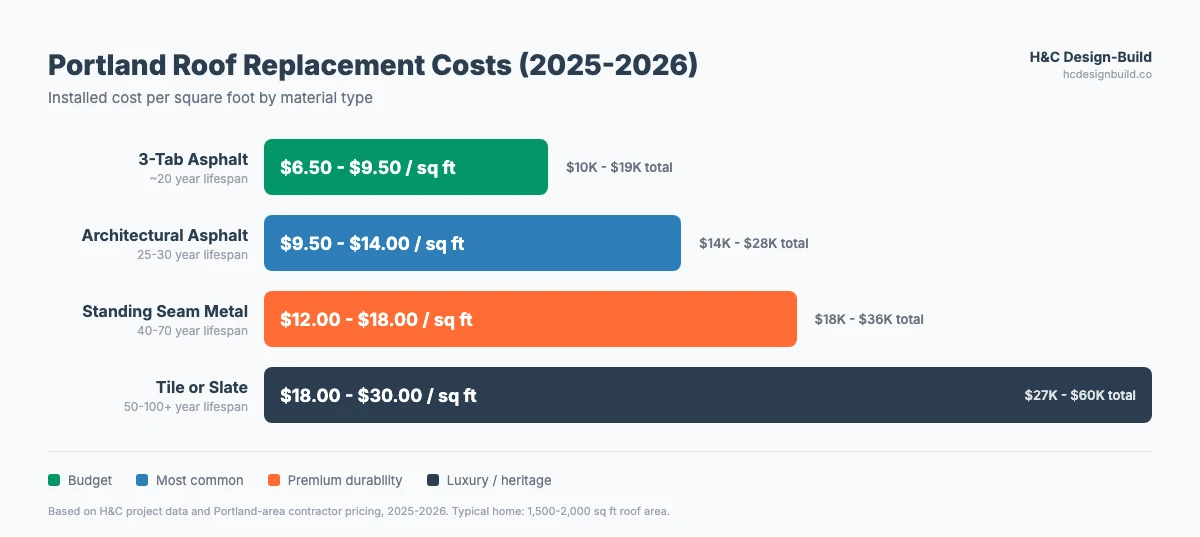
Ranges based on H&C project data and Portland-area contractor pricing, 2025-2026.
Based on our Portland-area project data, labor runs 40 to 60 percent of the total on most roofing jobs. The rest covers materials, tear-off, dump fees, and underlayment. Most residential replacements take 2 to 4 days depending on size and weather.
What Pushes the Price Higher
A few factors drive costs above those base ranges:
Roof pitch. Anything over 6/12 pitch (6 inches of rise per 12 inches of run) requires extra safety equipment and slows crews down. A steep gable on a two-story Portland foursquare can add 20 to 30 percent compared to a low-slope ranch.
Multiple layers. Portland homes from the 1960s and 1970s often have two or three layers of shingles stacked up. Oregon Residential Specialty Code (opens in new tab) allows a maximum of two layers. If yours already has two, everything gets stripped to the deck before new material goes on. Tear-off adds $1,000 to $3,000 depending on roof area and layer count.
Deck condition. Once old shingles come off, soft or rotted sheathing needs replacing. Budget $50 to $100 per sheet of plywood for re-decking. In our experience, about a third of Portland tear-offs reveal at least a few sheets of rotten deck board.
Access and complexity. Tight lots, mature trees, and steep driveways common in West Hills and Northwest Portland add to material delivery and crane costs. Dormers, valleys, skylights, and chimney flashings all add labor time and flashing detail work.
Tariff impacts. Based on our project pricing, roofing materials climbed 6 to 10 percent through 2025. Tariffs on imported building materials have pushed costs up on fasteners, flashing, and some specialty products.
Roofing Materials for Portland's Climate
Portland averages about 36 inches of rain per year according to NOAA climate normals (opens in new tab), with most falling between October and May. Moss grows on every north-facing surface. Summer UV follows months of wet-dry cycles. Your roofing material needs to handle all of it.
Architectural Asphalt Shingles
The standard choice for Portland homes and the most common choice we see on Portland reroofs. Architectural shingles (also called dimensional or laminate) are thicker than basic 3-tab shingles and carry better wind and impact ratings. They also last significantly longer.
Most manufacturers rate architectural shingles for 25 to 30 years, a range consistent with ARMA industry guidance (opens in new tab). In Portland's climate, moss buildup and poor attic ventilation can trim that to 20 years if maintenance falls behind.
Most manufacturers (CertainTeed, GAF, Owens Corning) offer algae-resistant shingles with copper granules that slow moss and algae growth. Worth the small upcharge in our climate. Impact-rated (Class 4) shingles add $1 to $2 per square foot, and some Oregon insurers offer premium discounts for impact-resistant roofs. Check with your provider.
Standing Seam Metal
Metal lasts 40 to 70 years and handles Portland rain better than any other residential roofing option. Rain sheds instantly and moss can't attach to the smooth panels. You won't see the curling and cracking that wet-dry cycles cause on asphalt.
The trade-off is cost. At $12 to $18 per square foot installed, a metal roof runs nearly double what architectural shingles cost. It also needs experienced installers. A poorly fastened standing seam system will oil-can (buckle and wave visibly), and that's hard to fix after the fact.
Corrugated metal panels cost less at $8 to $12 per square foot, but the exposed-fastener design means regular screw tightening as panels expand and contract with temperature. Most homeowners prefer the cleaner look and longer maintenance intervals of standing seam.
Flat and Low-Slope Options
Portland has plenty of flat-roof and low-slope homes, especially mid-century ranches, modern builds, and covered porch roofs. Standard shingles can't handle water pooling, so these roofs need membrane systems.
TPO (thermoplastic polyolefin) runs $8 to $14 per square foot installed. Modified bitumen (torch-down or peel-and-stick) runs $6 to $10 per square foot. Both last 15 to 25 years with proper drainage and regular inspection. TPO costs more upfront but uses heat-welded seams that hold up better against ponding. Modified bitumen is cheaper to install and easier to patch.
The biggest failure point on flat roofs in Portland is ponding. Standing water breaks down any membrane over time. Make sure your contractor checks and corrects slope before laying new material.
When to Replace vs. Repair
Replace when the roof is past its expected life, leaks are showing up in multiple spots, or shingles are visibly failing across the surface. Not every leak means a full tear-off though. Here's how to decide:
- Repair if damage is limited to a few shingles from a branch or wind event and the rest of the roof is under 15 years old with no widespread problems.
- Plan ahead if your roof is 15 to 20 years old with isolated leaks. Fix what's leaking now, but start budgeting for replacement.
- Replace if the roof is past 20 years (3-tab) or 25 years (architectural). Also replace when leaks appear in multiple areas. In our experience, once more than 30 percent of shingles show curling, cracking, or granule loss, patching stops being cost-effective.
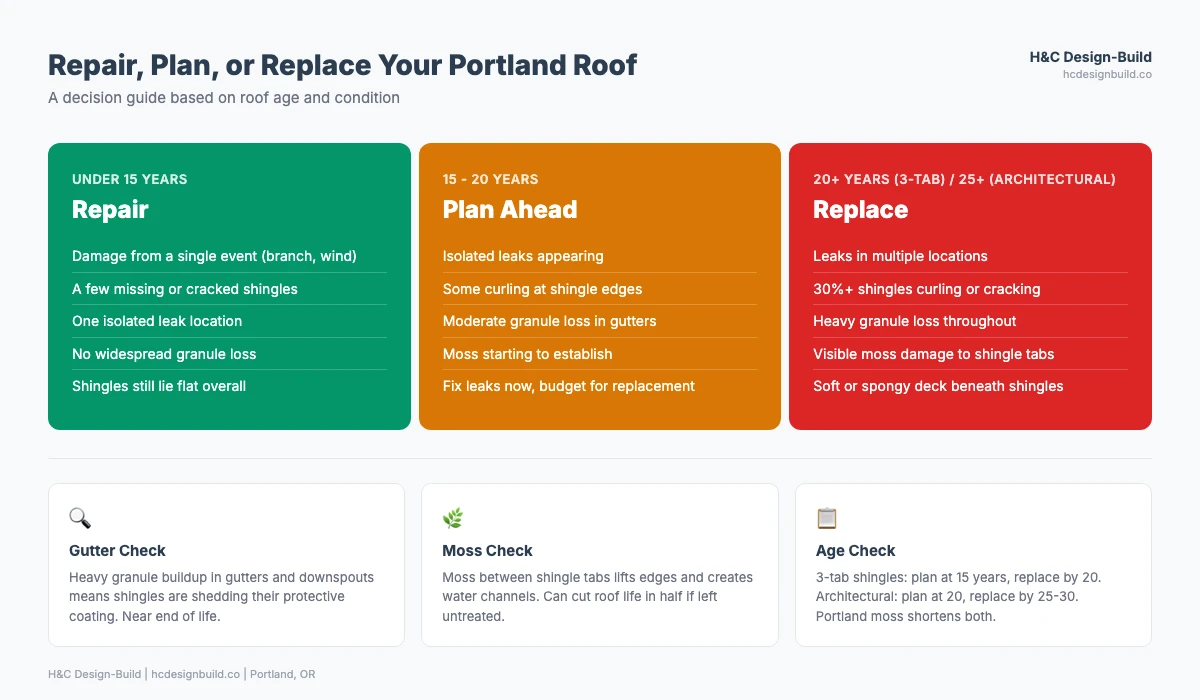
One easy check: look in your gutters. Asphalt shingles shed granules as they age. Heavy granule buildup in gutters and downspouts means the shingles are near end of life, even if they look passable from the ground.
Moss, Rain, and Roof Life
Moss is Portland's most persistent roof problem. It grows between shingle tabs, lifts the edges, and creates channels for water to wick underneath the shingle surface. Left unchecked, moss can cut a roof's useful life in half.
Prevention schedule based on sun exposure:
- Roofs with good sun and airflow: treat every 2 to 3 years
- Steep or complex rooflines: every 1 to 2 years
- North-facing or heavily shaded sections: annually
Zinc or copper strips installed at the ridge line provide long-term suppression. Rain washes trace metals down the roof surface and inhibits moss growth below the strip. Chemical treatments (zinc sulfate or potassium-based soap) work faster but need reapplication.
Never pressure wash an asphalt shingle roof. High-pressure water strips the protective granule coating and speeds up the exact wear you're trying to prevent. Soft brushing followed by chemical treatment is the right approach.
Trimming overhanging branches to let sunlight and air reach the roof surface is the single most effective long-term prevention move. It costs nothing and makes every other treatment work better.
Permits and Code Requirements
Reroofing with similar-weight materials does not require a building permit in Portland, per Portland Permitting and Development (opens in new tab). You can also replace some or all roof sheathing without triggering a permit.
Exceptions that do require a permit:
- Homes in designated wildfire hazard zones
- Townhouses (attached dwellings)
- Solar roof panels or building-integrated photovoltaic systems
If you're switching from lightweight shingles to a heavier material like tile or slate, the structure may need reinforcement to carry the added load. That triggers a structural review and its own permit.
Wildfire Zone Rules
Properties within locally designated wildfire hazard zones fall under Oregon Residential Specialty Code Section R327 (opens in new tab). Required roofing provisions under current Oregon code:
- Minimum Class B fire-rated roof assembly required
- No wood shingles or shakes allowed
- Spaces between roof covering and decking must be fire-blocked
- Gutters and downspouts must be noncombustible
- All roof ventilation openings covered with noncombustible mesh
Most Portland properties fall outside wildfire zones, but some eastern and southwestern edges of the city are designated. Check your property through Portland Maps before assuming you're exempt. For a full rundown on 2026 Oregon code changes affecting Portland homes, see our code update guide.
Smart Upgrades During a Reroof
A roof replacement gives you access to the attic and deck from above, which makes several upgrades cheaper to bundle in.
Insulation and Ventilation
If your attic insulation is thin or compressed, a reroof is the cheapest time to bring it up to current energy code (opens in new tab) (R-38 or higher). Energy Trust of Oregon (opens in new tab) has incentives for qualifying insulation upgrades on eligible property types. The incremental cost is lower when crews already have the roof open.
Proper attic ventilation also extends shingle life by keeping the deck dry and reducing summer heat buildup. Continuous ridge vents paired with soffit intakes (the ventilation slots under the eave overhang) are the most effective setup. Adding ridge ventilation during a reroof runs $300 to $800, a fraction of what it costs to retrofit later. On the Sellwood ranch we opened with, we added ridge vents and R-38 batts while the deck was exposed. The homeowner's heating bill dropped noticeably that first winter.
Gutters, Flashing, and Exterior Coordination
Old gutters and worn flashing around chimneys, valleys, and skylights cause a large share of the leaks we see on Portland homes. Replacing them during a reroof adds modest cost and prevents most of the flashing-related leaks we see come back on older homes.
If your siding also needs replacing or your windows are due for an upgrade, bundling the projects cuts scaffolding costs and ensures all flashing details tie together properly. One crew handling the whole exterior is more efficient than three separate contractors working in different seasons.
Picking the Right Material
For most Portland homes, architectural asphalt shingles are the right call. They handle our climate well, last 25 to 30 years with proper care, and cost less than half what metal or tile runs.
Metal makes sense if you plan to stay long-term and want a 40-plus-year roof with minimal ongoing maintenance. The upfront premium is real, but you'll likely never reroof that house again.
Whatever material you choose, installation quality and deck condition matter more than the brand name on the shingle wrapper. When you're getting bids, ask each contractor how they handle deck rot discovered during tear-off. The answer tells you a lot about how the rest of the job will go.
If your roof is past 20 years or you've had more than one leak repaired, reach out to our team for an assessment before the next rainy season.
Frequently Asked Questions
How much does a roof replacement cost in Portland?
A typical Portland roof replacement runs $10,000 to $28,000 depending on material. Standard asphalt shingles cost $6.50 to $9.50 per square foot installed. Architectural shingles run $9.50 to $14 per square foot.
What is the best roofing material for Portland rain?
Architectural asphalt shingles are the most common and cost-effective choice. They last 25 to 30 years in Portland's climate with proper maintenance. Metal roofing lasts 40 to 70 years and handles rain better, but costs nearly twice as much.
Do I need a permit to reroof my Portland home?
Most reroofing does not require a Portland building permit if you use similar-weight materials. Permits are required for homes in designated wildfire zones, townhouses, and solar roof panel installations.
How long does an asphalt shingle roof last in Portland?
Standard 3-tab shingles last about 20 years. Architectural shingles last 25 to 30 years. Moss, poor ventilation, and deferred maintenance can shorten those numbers by 5 to 10 years in Portland's wet climate.
When should I replace my roof instead of repairing it?
Replace when your roof is past 20 years for 3-tab or 25 years for architectural shingles, when leaks appear in multiple locations, or when more than 30 percent of shingles show curling, cracking, or granule loss.
