
We pulled the ceiling drywall in a North Portland craftsman last year to scope an attic conversion. The ridge sat 9 feet above the attic floor joists. Plenty of headroom. But the 2x6 ceiling joists were sized to hold drywall, not furniture and people. The beam in the basement was already near its limit. That's the story with most Portland attic conversions: the space is there, but the structure needs work to use it.
Portland's older homes have attics worth converting. If your lot is tight on setbacks and FAR, going up beats building out. Here's what it costs and what Portland requires.
What Portland Attic Conversions Cost
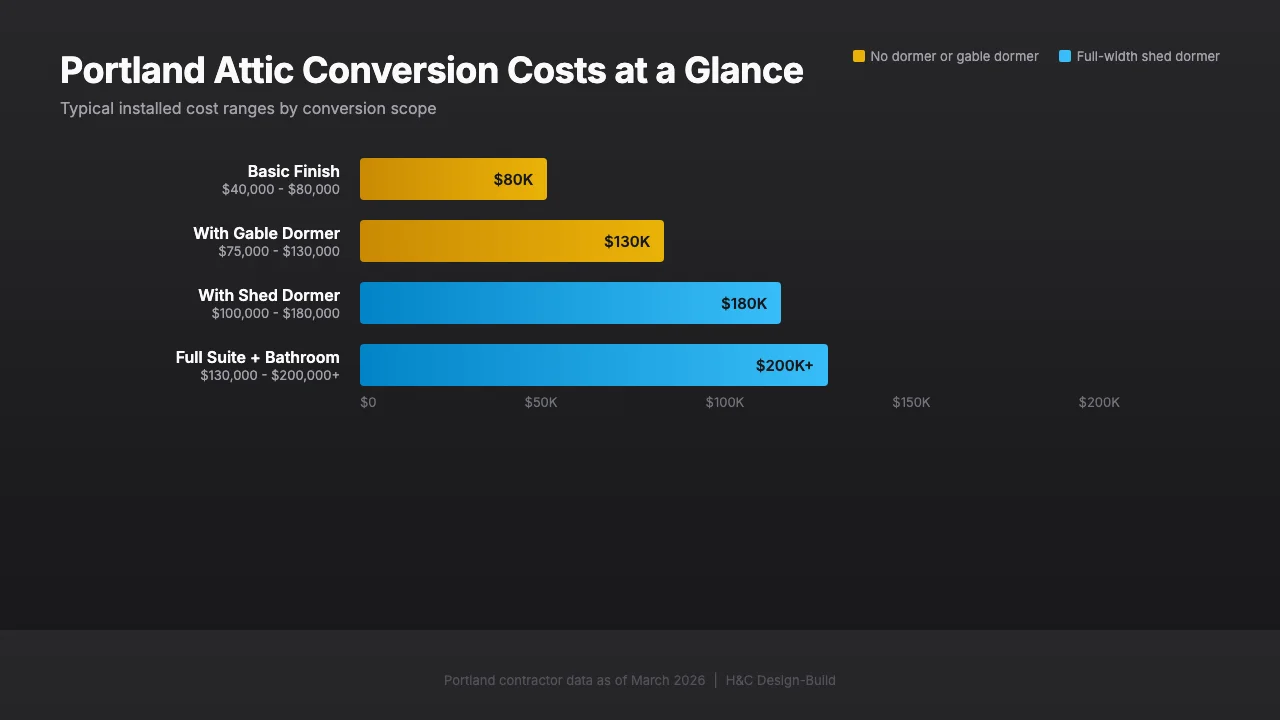
A basic attic conversion in Portland runs $40,000 to $80,000. Add a dormer and it jumps to $75,000 to $180,000. Add a bathroom on top of the dormer and you're looking at $100,000 to $200,000 or more.
| Conversion Scope | Portland Cost Range |
|---|---|
| Basic finish (no dormer, no bath) | $40,000 to $80,000 |
| With gable dormer | $75,000 to $130,000 |
| With full-width shed dormer | $100,000 to $180,000 |
| Full suite (shed dormer + bathroom) | $130,000 to $200,000+ |
In our bids, Portland runs 15 to 20 percent above national averages on remodeling costs. Older homes cost more because of structural upgrades, hazardous material abatement, and the permit complexity of converting space in a house built before modern codes existed.
Where the Money Goes
The structural work and dormer framing eat the biggest share. Here's a component breakdown based on our bids and published Portland contractor data from Amplified Renovations (opens in new tab):
| Component | Cost Range |
|---|---|
| Structural engineering | $400 to $3,000 |
| Floor joist reinforcement | $1,000 to $10,000 |
| Dormer framing and exterior | $20,000 to $85,000 |
| Insulation (roof assembly) | $3,000 to $8,000 |
| Drywall and paint | $3,000 to $7,000 |
| Electrical (arc-fault circuits, lighting) | $2,000 to $5,000 |
| HVAC (ductless mini-split) | $2,000 to $6,000 |
| Egress window | $2,500 to $7,000 |
| Staircase (new or modified) | $1,000 to $5,000 |
| Plumbing (if adding bathroom) | $5,000 to $15,000 |
| Permits (Portland total) | $3,000 to $8,000 |
Bathrooms drive the cost up fast. Running drain lines through the attic floor means routing around joists without cutting them beyond code limits (holes must be centered in the joist, within the middle third of the span, no larger than one-third of the joist depth). Toilets need a 3-inch drain tied into the existing waste stack. If the stack is on the wrong side of the house, that's a lot of pipe and labor.
What You Recoup at Resale
The Pacific region (Oregon, Washington, Hawaii) sees roughly 89% cost recovery on midrange attic bedroom remodels per JLC's 2025 Cost vs. Value report (opens in new tab), well above the 73% national average from the same report. That makes attic conversions one of the better-returning projects in Portland, behind only minor kitchen remodels.
Which Portland Homes Work Best
Not every attic is worth converting. Roof pitch determines how much usable space you start with.
Craftsman bungalows (1905 to 1930) are the strongest candidates. Gable roofs at 6:12 to 8:12 pitch concentrate headroom along a central ridge. Most were built as 1.5-story homes with the upper floor designed for living space. The "Airplane Bungalow" variant common in Laurelhurst has wide dormers already built in. Find them throughout Irvington, Ladd's Addition, Sellwood, and Sunnyside. Our craftsman bungalow remodel guide covers the full scope of working on these homes.
Tudor Revivals (1920s onward) have the steepest pitches in Portland, often 12:12 or steeper. That gives you more attic volume than any other Portland home style. The catch: irregular rooflines and multiple gables produce odd-shaped spaces. Concentrated in Peacock Lane, Eastmoreland, and Irvington.
Dutch Colonials are built for this. The gambrel roof was built to maximize upper-floor space. The nearly vertical lower slope gives you full-height walls where other roof styles would force you into kneewalls. Less common in Portland but found in Laurelhurst and the Northwest District.
American Foursquares (1900 to 1930) are the hardest to convert. The hip roof slopes in on all four sides, limiting headroom to a small area at the center. A 4:12 hip on a 30-foot-wide house might yield only 300 to 400 square feet of usable space. Converting a Foursquare attic almost always requires dormers on multiple sides.
Truss-framed roofs (post-1960s) are generally not convertible. The web members obstruct usable space, and the bottom chords are not designed for floor loads.
Portland's Code Requirements
Portland is friendlier to attic conversions than most cities. Building Code Guide 96-12 (opens in new tab) sets alternative standards for existing homes that are more forgiving than base building code.
Ceiling Height
Portland allows 6 feet 8 inches minimum ceiling height for attic conversions in existing homes (base code requires 7 feet for new construction). At least 50% of the required 70-square-foot minimum room area must meet that height. Space below 5 feet doesn't count toward the minimum.
For bathrooms under sloped ceilings, 75% of the floor area can be below the 6'8" mark. That's generous enough to fit a bathroom under most roof slopes.
Stairs
This is where Portland's alternative standards save a lot of attic conversions. Standard code requires 36-inch-wide stairs with 6'8" headroom, 10-inch treads, and 7¾-inch risers. Portland's BCG 96-12 allows:
| Element | Portland Standard | Base Code |
|---|---|---|
| Width | 30 inches | 36 inches |
| Headroom | 6 feet 2 inches | 6 feet 8 inches |
| Tread depth | 9 inches | 10 inches |
| Riser height | 9 inches max | 7¾ inches max |
| Landing | 30 x 30 inches | 36 x 36 inches |
Those 6 inches of width and 6 inches of headroom make the difference between a viable stairway and one that can't physically fit in the existing floor plan. On the North Portland craftsman, Portland's reduced stair standards are what made the project work. The existing stair opening couldn't accommodate a 36-inch-wide code stairway without stealing space from the bedroom below. Pull-down ladders do not qualify as access for habitable space.
Egress
Every sleeping room needs an emergency escape window per Oregon Residential Specialty Code R310: 5.7 square feet of clear opening, at least 24 inches tall and 20 inches wide, sill no more than 44 inches above the floor. Operable from inside without tools. In an attic with sloped ceilings, placement matters. You need a section of wall tall enough for the window and a clear landing area in front of it. We've had projects where the only viable egress location was inside the dormer itself, which is fine as long as the window meets the size requirements.
Structural
Portland BDS requires structural calculations demonstrating a continuous load path from the attic to the foundation (opens in new tab). They specifically warn that "it's common for the beam in the basement to become overstressed in an attic conversion." That's exactly what we found on the North Portland project. The basement beam was carrying the original roof load fine, but adding 30 psf of live load to the attic floor (up from 10 psf for a non-habitable ceiling) pushed it past capacity.
Typical fixes: sister the joists (bolt a new 2x8 or 2x10 alongside each existing joist), add a mid-span support beam (halves the effective span, roughly quadruples load capacity), or in some cases replace the floor framing entirely. If the conversion involves removing or modifying load-bearing walls to open up the space, the structural scope grows. The structural engineer determines the approach. Budget $400 to $3,000 for the assessment alone.
Dormers: Types, Costs, and Rules
If your attic doesn't have enough headroom on its own, a dormer gets you there. The type you choose affects cost, space gained, and how it looks from the street.
Shed dormers give you the most space per dollar. A single sloped roof extends horizontally from the main roof, creating a rectangular room with nearly full headroom wall-to-wall. A full-width shed dormer in Portland runs $45,000 to $85,000 for the exterior structure, plus $18,000 to $40,000 for interior finishing. The structural trade-off: removing rafters on one side of a gable roof breaks the triangle that keeps the walls from spreading. The dormer framing has to replace that structural function.
Gable dormers are the traditional choice. A triangular roof projects perpendicular to the main roof. Less interior space than a shed dormer of the same width, but a better aesthetic match for Craftsman and Colonial homes. Portland cost: $28,000 to $55,000 for a medium-sized (8 to 14 foot) gable dormer.
Hip dormers suit Craftsman and Foursquare styles. Three-sloped roof, slightly less space than a gable dormer. Similar cost to gable dormers.
Portland Dormer Zoning Rules
Dormers are excluded from Portland's height calculations when all three conditions are met:
- Roof pitch is at least 3:12 and no part extends above the main ridgeline
- Dormer walls are set back at least 12 inches from the exterior wall below
- Dormer width is no more than 75% of the roof width it projects from
Fail any one of those and the dormer counts in the height calculation (opens in new tab). Most residential zones cap at 30 feet.
Historic Districts
If your home is in a city-designated historic district (opens in new tab) (Irvington, Ladd's Addition, Alphabet, King's Hill, and others), dormer additions trigger Historic Resource Review. Most residential dormers affecting less than 150 square feet of roof area qualify for Type I review: staff-level decision, no public hearing.
The criteria follow the Secretary of the Interior's Standards: the dormer must be compatible with the building's massing, scale, and architectural features. Portland doesn't have fixed proportional ratios (no "dormer must be less than X% of roof width"), but reviewers expect dormers that respect the original roof form.
Homes in conservation districts (Eliot, Kenton, Mississippi, Piedmont, Russell, Woodlawn) can use the Community Design Standards (opens in new tab) as a faster alternative to subjective design review.
National Register districts (Eastmoreland, Laurelhurst, Peacock Lane) that are not city-designated do not require city historic review for dormers.
Permits and Timeline
Portland requires a building permit (opens in new tab) for any attic conversion. You'll also need electrical, mechanical, and plumbing permits depending on scope. These can be bundled into a residential combination permit.
Most dormer additions require structural plans drawn by an Oregon-licensed architect or engineer. Portland's "Lateral Bracing Requirements for Minor Additions and Dormers" document offers reduced structural requirements for smaller dormers.
If your dormer adds more than 500 square feet and expands the building envelope, it triggers MRAA requirements (opens in new tab): a mandatory 35-day neighbor notification before the permit can be issued.
Fees (as of July 2025)
Building permit fees are valuation-based (opens in new tab). For a $100,000 attic conversion, expect roughly $1,000 for the building permit, plus the 12% Oregon state surcharge, plus trade permits ($60 to $686 each for plumbing, electrical, and mechanical), plus plan review at $217 per hour. Total permit costs typically run $3,000 to $8,000.
Projects over $100,000 also incur Portland's 1% Construction Excise Tax and 0.12% Metro Excise Tax.
Timeline
Standard plan review runs 8 to 12 weeks. Portland's Field Issuance Remodel (FIR) program (opens in new tab) offers an expedited alternative where an assigned inspector handles plan review and can issue permits on-site, sometimes within days. Attic conversions are eligible. The inspector handles all inspections from start to finish. It's billed hourly with a one-hour minimum per site visit.
Construction runs 3 to 5 weeks for a basic conversion, 10 to 16 weeks with a dormer and bathroom.
Hazards in Portland Older Home Attics
Portland's pre-1940 housing stock (26.7% of all homes per U.S. Census data (opens in new tab)) comes with predictable hazards. Test before you demo.
Knob-and-tube wiring shows up in most pre-1930s attics. It can't handle modern electrical loads and is a fire risk if it contacts insulation. Oregon conditionally allows insulation around K&T if a licensed electrician certifies it's in good condition, but full rewiring is the safer path for a conversion. Many insurers refuse to cover homes with active K&T.
Vermiculite insulation is the lightweight, flaky grey stuff poured between joists. Over 70% of US vermiculite came from a Libby, Montana mine (opens in new tab) contaminated with asbestos. Don't disturb it. Professional abatement is required before any work begins. The ZAI Trust (opens in new tab) offers up to $4,125 toward removal and replacement.
Balloon framing in pre-1920s homes creates open wall cavities running from the basement to the attic. Fire can travel the full height of the house in minutes. Portland inspectors routinely require fire-blocking during attic conversions in balloon-framed homes. Our pre-1940 foundation guide covers more of what you'll find in these older structures.
Lead paint is present in virtually every pre-1970 Portland home. EPA RRP Rule (opens in new tab) compliance is required for any renovation that disturbs painted surfaces.
Insulation: Getting the Roof Assembly Right
When your attic becomes living space, insulation moves from the attic floor to the roof plane. Portland sits in Climate Zone 4C, which requires a minimum R-30 for roof/vaulted ceiling assemblies under the 2023 Oregon Residential Specialty Code (opens in new tab).
The best approach depends on your roof geometry:
Vented assemblies (batts between rafters with a ventilation channel above) work on simple gable and shed roofs. They fail on roofs with hips, valleys, or dormers because the ventilation path gets blocked. If you're adding a dormer, you probably can't use a vented assembly.
Flash-and-batt (1 to 3 inches of closed-cell spray foam against the sheathing, remainder filled with mineral wool batts) works on any roof shape. For Climate Zone 4C, the spray foam layer needs at least R-10. No interior vapor barrier. This is the go-to approach for most Portland attic conversions with dormers.
Full spray foam (closed-cell only) at R-6.5 per inch is effective but expensive and has a high environmental footprint. We use it where rafter depth is too shallow for flash-and-batt.
Portland's BCG 96-12 allows a minimum R-15 in existing 2x4 rafter spaces, but that's the floor, not the target. R-30 is where comfort and energy performance actually meet.
HVAC: Keeping It Comfortable
Attics have the widest temperature swings in any house. Insulation quality matters more here than anywhere else.
A ductless mini-split is what we put in most attic conversions. One system handles heating and cooling, needs only a 3-inch wall penetration for refrigerant lines, and skips the cost of extending ductwork. Single-zone units run $2,000 to $6,000 installed. Floor-mounted models work well where sloped ceilings limit wall-mount height.
Extending existing ductwork is possible if the system has spare capacity, but existing furnaces are sized for the original conditioned area. Adding an attic usually means the system is undersized. Return air is easy to forget: the attic needs both supply and return.
Why Attic Beats Addition in Portland
Portland's inner neighborhoods have typical 50-by-100-foot lots zoned R5. After applying setbacks (10-foot front, 5-foot sides, 5-foot rear), the buildable area shrinks fast. Most older homes already fill that envelope. Side additions on 50-foot lots are often physically impossible with the 5-foot setback. Rear additions eat into the only yard space you have.
Attic conversions work within the existing footprint. No lot coverage increase, no setback issues, no new foundation. The main constraint is the 30-foot height limit, which most 1.5- and 2-story homes sit well under. A basement finishing project is the other way to add space without expanding the footprint, though moisture management is a bigger factor below grade. For ground-level options, see our home addition cost guide.
If you're weighing an attic conversion, reach out. We'll walk the space and tell you what's feasible.
This guide is for informational purposes only and does not constitute financial, legal, or professional advice. Consult a licensed professional for guidance specific to your situation.
Frequently Asked Questions
Can I convert my Portland attic without adding a dormer?
It depends on your roof pitch. Craftsman bungalows with 7:12 or steeper pitches often have enough ridge height to meet Portland's 6 foot 8 inch ceiling minimum without a dormer. Foursquares with hip roofs almost always need dormers because the roof slopes in on all four sides. Measure your ridge height above the attic floor joists. If you have 8 feet or more at the peak, a dormer-free conversion is usually possible.
Does an attic conversion count toward Portland's floor area ratio?
Yes. Any attic space with 6 foot 8 inch or more of headroom counts toward FAR. On a typical 5,000 square foot R5 lot with a 0.5 FAR cap, your total above-grade floor area maxes out at 2,500 square feet. Check your existing FAR before designing the conversion.
How long does an attic conversion take in Portland?
A basic conversion without a dormer takes 2 to 4 months including permitting. A full conversion with a dormer and bathroom runs 4 to 7 months. Portland's plan review alone takes 8 to 12 weeks, though the Field Issuance Remodel program can cut that to days for qualifying projects.
Do I need a structural engineer for an attic conversion?
Almost always. Portland BDS requires calculations showing a continuous load path from the attic to the foundation. Most older homes have ceiling joists sized for 10 psf, but habitable space requires 30 psf. An engineer determines whether sistering joists, adding a support beam, or upgrading the ridge to a structural beam is needed. Budget $400 to $3,000 for the assessment.
What hazards should I check for before starting an attic conversion?
In Portland homes built before 1950, check for knob-and-tube wiring (fire risk if it contacts insulation), vermiculite insulation (70 percent of US vermiculite was contaminated with asbestos from the Libby, Montana mine), balloon framing (open stud bays from basement to attic create a fire chimney), and lead paint on all surfaces. Professional testing before demolition is not optional.
