You're planning a kitchen remodel, pricing a heat pump, or looking at electric vehicle (EV) chargers, and your electrician just told you the panel needs to go first. That's how most Portland homeowners find out their electrical service is 40 years behind their plans. Here's what a panel upgrade actually costs, what the permit process looks like, and how to tell if yours is overdue.
Why Portland Homes Need Panel Upgrades
About 45 percent of Portland's housing stock (opens in new tab) dates to the 1950s or earlier. Many of these homes still run on 60-amp or 100-amp service with the original panel. That was fine when a house had a gas furnace, a few light fixtures, and a radio. It's not fine when you want a heat pump, an induction range, an EV charger, and a bathroom remodel running on the same service.
The most common triggers we see:
- Heat pumps. A ducted heat pump needs a 240V dedicated circuit. If you're switching from gas, your panel may not have room for it.
- Kitchen remodels. Modern kitchens need five or six dedicated circuits: range, dishwasher, disposal, refrigerator, microwave, and sometimes an induction cooktop at 40 to 50 amps.
- EV chargers. A Level 2 charger pulls 30 to 50 amps. On a 100-amp panel, that's a third of your total capacity.
- Home additions and ADUs (accessory dwelling units). New square footage means new circuits. An addition that pushes past your panel's capacity requires a service upgrade before anything else.
- Insurance requirements. Some carriers refuse to insure homes with certain panel brands or fuse boxes. More on that below.
If you're planning any of these projects, check your panel first. Discovering you need an upgrade mid-remodel adds cost and delays.
Portland Electrical Panel Upgrade Costs
Costs vary based on amperage, panel location, and whether rewiring is involved. These are typical Portland contractor estimates as of early 2026:
| Upgrade | Cost Range | | -------------------------------------- | ------------------ | | 100-amp panel replacement (same size) | $1,000 to $1,800 | | 100-amp to 200-amp upgrade | $1,800 to $4,500 | | 200-amp panel replacement | $1,600 to $4,000 | | 200-amp to 400-amp upgrade | $8,000 to $12,000 | | Sub-panel installation (60 to 100 amp) | $500 to $1,500 | | Panel relocation | Add $800 to $3,000 |
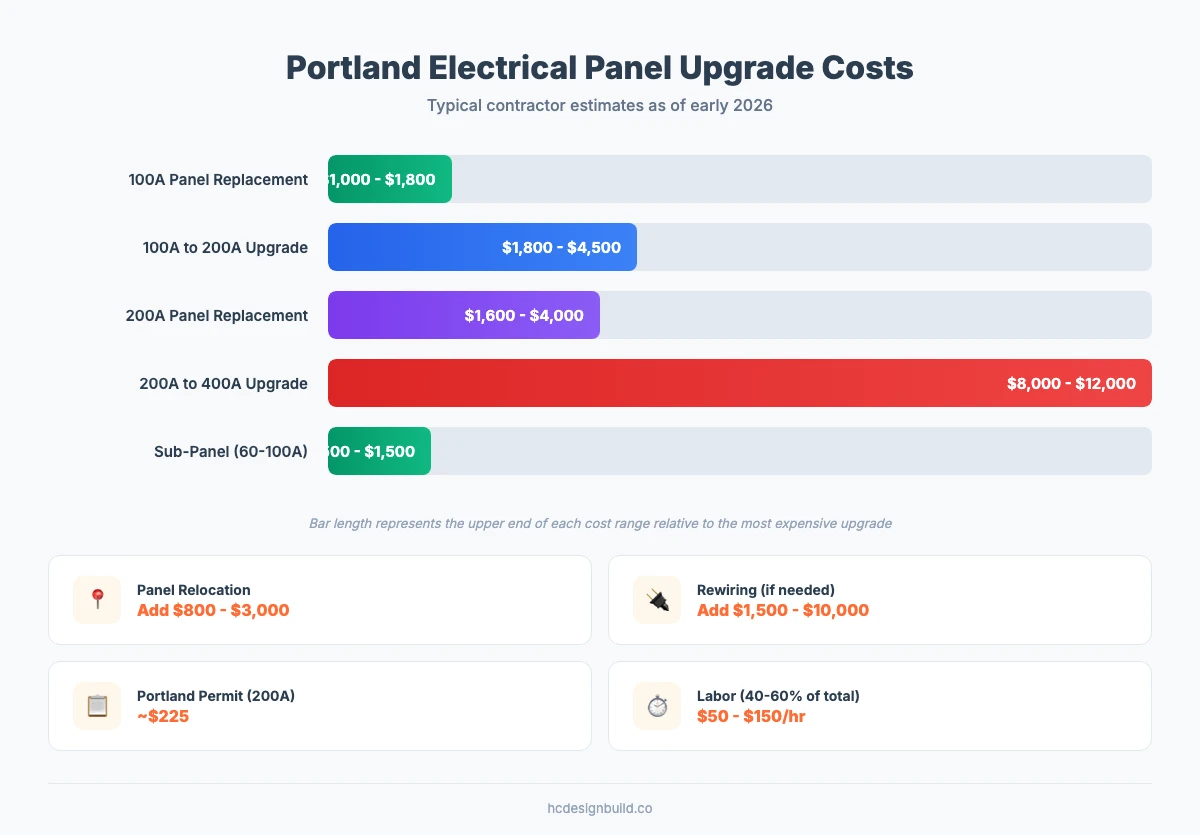
The 100-to-200-amp upgrade is the standard job. For a straightforward swap where the panel stays in the same location, expect $2,500 to $3,500 in Portland. When the meter base needs replacing, the mast needs raising, or the panel moves to a new wall, costs climb toward the upper range.
Labor runs 40 to 60 percent of total cost. Portland electricians typically charge $50 to $150 per hour depending on the firm and scope, based on local contractor surveys. A clean panel swap takes four to eight hours. Add wiring work and you're looking at one to three days.
What Pushes Costs Higher
- Panel relocation. Moving a panel from one wall to another or from a bedroom closet (no longer code-compliant for new work) to a garage adds $800 to $3,000 in labor and materials.
- Mast and meter base. Older homes sometimes need the entire service entrance replaced, not just the panel. Portland General Electric (PGE) requires coordination for the disconnect and reconnect.
- Rewiring. If your home has knob-and-tube or aluminum wiring, an electrician may recommend partial or full rewiring. That's $1,500 to $10,000 on top of the panel, depending on how much of the house is involved.
- AFCI breakers. Current code requires arc-fault circuit interrupter breakers on most branch circuits. At $50 to $100 each, these add up fast on a panel with 20 or more circuits.
Dangerous Panel Brands in Portland
Portland's older housing stock means certain problem panels show up on almost every block. If you open your panel and see one of these names, replacement isn't optional. It's a safety issue.
Federal Pacific Electric (FPE) Stab-Lok
The most common dangerous panel in Portland. FPE manufactured these from the 1950s through the 1980s, and they're everywhere in the city's mid-century homes. Independent testing by electrical engineer Jesse Aronstein shows Stab-Lok breakers fail to trip 25 to 65 percent of the time (opens in new tab). The Consumer Product Safety Commission (CPSC) investigated in the early 1980s and found the breakers failed safety tests, but never issued a formal recall.
Look for "Federal Pacific Electric" or "FPE" on the panel door. The breakers have a distinctive narrow profile.
Zinsco / GTE Sylvania
Especially common in the western U.S. Manufactured from the 1950s through the 1970s. The aluminum bus bars corrode and lose conductivity over time. Breakers can melt to the bus bar and refuse to trip, even when switched to the "off" position. According to field testing reported by home inspection professionals, about 25 percent of Zinsco breakers fail to trip.
You'll recognize them by the colored toggle handles: red, blue, and green.
Pushmatic / Bulldog
These use push-button switches instead of toggle breakers. The internal grease that lubricates the thermal trip mechanism settles and hardens over decades. A Pushmatic breaker can show "off" on the outside while staying energized inside. Replacement parts haven't been manufactured in years.
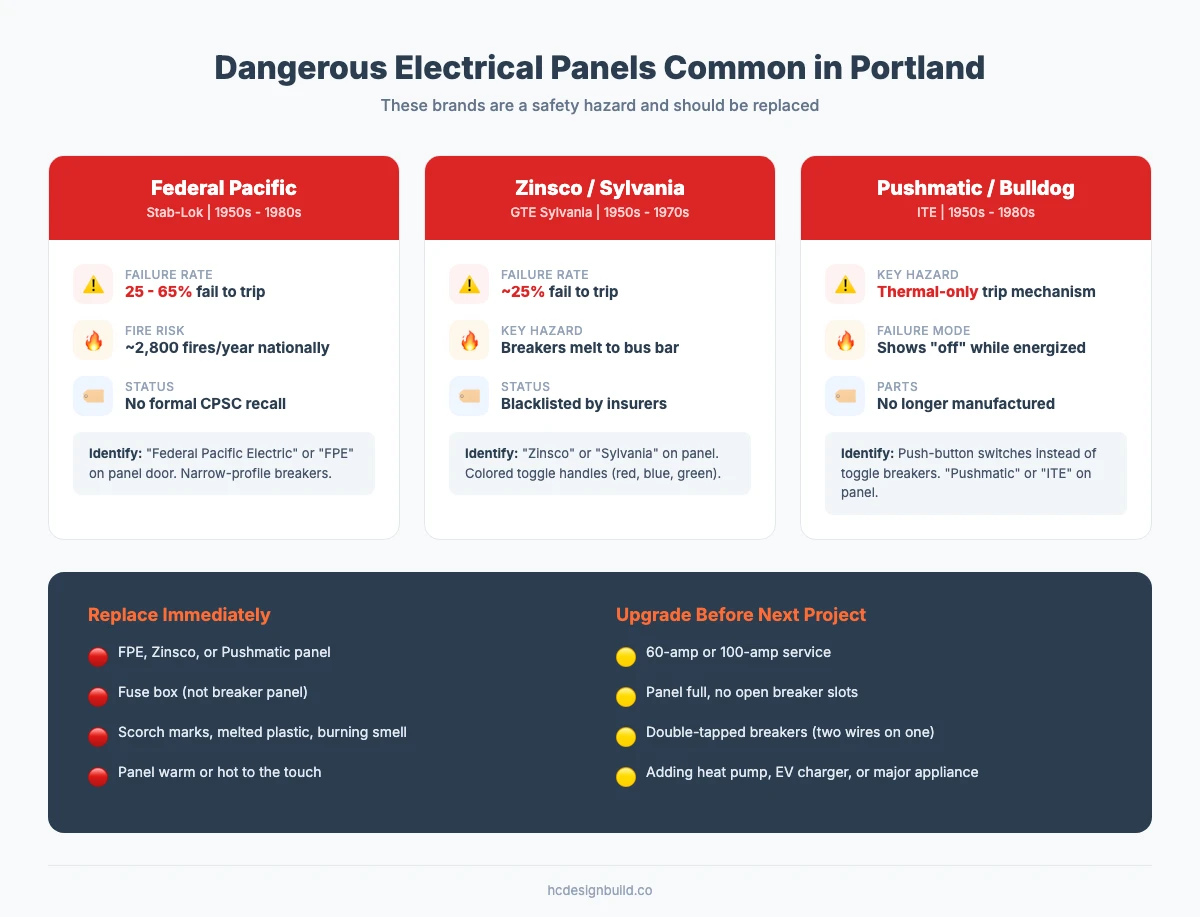
All three brands are blacklisted by many insurance companies. If you have one, budget for replacement regardless of whether a remodel is on the table.
Portland Permit Requirements
Portland requires an electrical permit (opens in new tab) for any panel replacement, service upgrade, or fuse-to-breaker conversion. No exceptions.
Permit Fees (as of July 2025)
| Service Size | Base Fee | With 12% State Surcharge | | --------------- | -------- | ------------------------ | | Up to 200 amps | $201 | $225 | | 201 to 400 amps | $283 | $317 | | Reconnect only | $181 | $203 |
Branch circuits added with the service run $20 each. A reinspection costs $153 (opens in new tab) if the first inspection fails.
The Process
1. Apply for the permit. Online through DevHub is fastest: 24-hour turnaround for most residential electrical permits. You can also apply by email or in person at 1900 SW 4th Ave. 2. Schedule PGE disconnect. The utility has to cut power before the old panel comes out. Your electrician coordinates this directly with PGE. 3. Installation. The electrician mounts the new panel, lands the circuits, connects the service entrance cables. 4. Inspections. Portland requires a service inspection (mast, meter base, panel) and a final inspection. Schedule through DevHub or the automated line at 503-823-7000. 5. PGE reconnect. After the final inspection passes, PGE restores power. Expect a day or two for scheduling.
Total timeline from permit to power-on: two to four weeks for a standard upgrade. Complex jobs with rewiring or service entrance work can run six weeks.
The "Whole House to Code" Question
This is the number one question homeowners ask, and the answer is simpler than most people expect. Oregon's code uses a "touch it, own it" principle: when you alter electrical work, the altered portion must meet current code. A panel upgrade by itself does not trigger a whole-house rewire.
Your existing wiring stays as-is. But if an inspector spots a safety hazard during the panel inspection, like exposed splices, improper grounding, or missing junction box covers, those specific issues need to be corrected. The inspector won't make you run new Romex to every outlet in the house just because you swapped the panel.
Rebates and Tax Credits (2026 Update)
The incentive picture shifted at the end of 2025. Here's where things stand:
Federal 25C tax credit: expired. The 30 percent credit (up to $600) for panel upgrades that enabled electrification expired December 31, 2025, under the One Big Beautiful Bill Act. If your project wrapped in 2025, you can still claim it on your 2025 tax return via IRS Form 5695 (opens in new tab). For 2026 projects, this credit is gone.
PGE Smart Charging rebate: closed. PGE offered up to $1,000 toward panel upgrades (up to $5,000 for income-qualified households) as part of their EV charging program. New enrollments closed July 31, 2025.
Oregon HOMES and HEAR programs: coming. The HOMES program (opens in new tab) launches spring 2026 with performance-based rebates for efficiency upgrades. The HEAR program launches fall 2026 and targets low-to-moderate income households with point-of-sale rebates covering 50 to 100 percent of costs up to $14,000. Panel upgrades done as part of electrification may qualify under HEAR. Both programs are administered by Energy Trust of Oregon and Earth Advantage.
If you're not in a rush, timing a panel upgrade to coincide with HEAR's launch could save thousands. If your panel is a safety concern (FPE, Zinsco, fuse box), don't wait.
Panel Upgrades During a Remodel
The cheapest time to upgrade your panel is when your walls are already open for a remodel. Running new circuits to a kitchen or bathroom is straightforward when the drywall is off. Doing it after the drywall goes back up means cutting holes, fishing wire, and patching, which adds labor.
How panel upgrades fit into larger projects:
- Kitchen remodel. Budget for the panel upgrade in the electrical rough-in phase. Your electrician pulls permits for both the panel and the kitchen circuits together. One permit application, one set of inspections.
- Home addition. The structural and electrical permits usually run in parallel. Size the new panel for the addition's loads plus future capacity.
- Whole-home remodel. This is the ideal time. Everything is open, every circuit gets assessed, and you end up with a modern panel and clean wiring for the next 40 years.
- Heat pump swap. If you're replacing a gas furnace with a heat pump, the electrical contractor can handle the panel upgrade and the heat pump circuit in one visit.
Folding the panel work into a larger project also means one general contractor manages the scheduling. No separate electrician visits, no separate permit timeline, no PGE coordination headaches you have to manage yourself.
How to Tell If Your Panel Needs Upgrading
Open your panel door and check for these:
| Status | Signs | | -------------------------------- | ------------------------------------------------------------------------------------------------------------------------------------------------------------------ | | Replace now | Federal Pacific, Zinsco, or Pushmatic brand. Fuse box instead of breakers. Scorch marks, melted plastic, or burning smell. Panel warm to the touch. | | Upgrade before your next project | 60-amp or 100-amp service. Panel full with no open slots. Double-tapped breakers (two wires on one breaker). Planning a heat pump, EV charger, or major appliance. | | Probably fine for now | 200-amp panel with open slots. No hazardous brand. Panel installed in the last 20 years. No major electrical additions planned. |
An electrician can do a load calculation if you're not sure. They'll add up your existing electrical loads and compare them to your panel's capacity. This takes about an hour and tells you exactly how much headroom you have. If you're planning a remodel, a design-build firm can coordinate this assessment as part of the project planning.
If your panel is part of a bigger project or you want to plan the upgrade alongside a remodel, reach out to us and we'll walk through the scope together.
This guide is for informational purposes. Electrical work requires a licensed electrician. Consult a qualified professional for your specific situation and a tax advisor regarding credits and deductions.