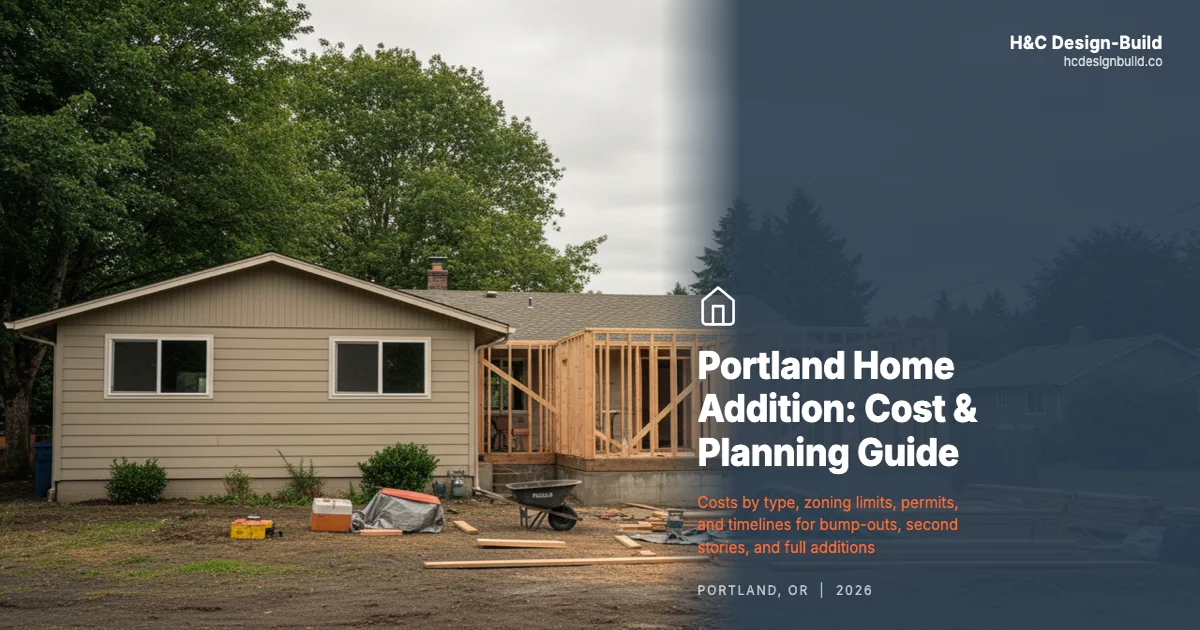
We framed a 400-square-foot primary suite addition on a 1948 ranch in Woodstock last fall. The homeowners had outgrown their two-bedroom layout but loved their neighborhood and their $2,800 property tax bill. Adding on cost less than buying a bigger house and kept them in the neighborhood they'd lived in for 15 years.
If you're weighing a home addition in Portland, here's what it actually costs and what the city requires. Plus how to avoid surprises mid-project.
What a Portland Home Addition Costs
A Portland home addition runs $60,000 to $400,000 depending on what you're building. A simple bump-out that extends one room is a different project than adding a full second story.
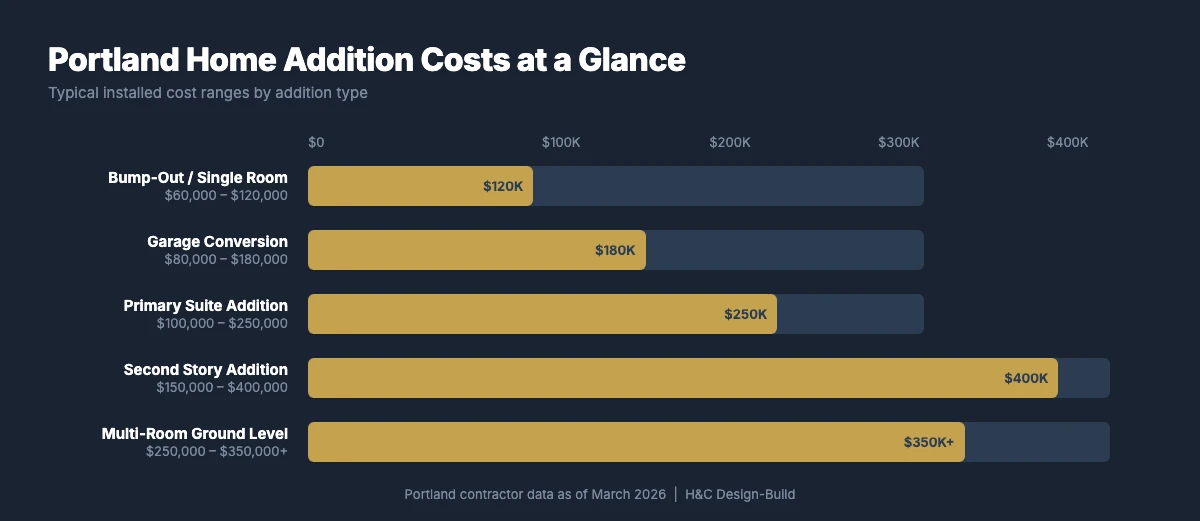
These ranges come from our 2025-2026 Portland-area bids and published contractor data from Amplified Renovations (opens in new tab) and Creekstone Design + Remodel (opens in new tab):
| Addition Type | Typical Cost Range | | --------------------------------- | --------------------- | | Bump-out or single-room addition | $60,000 to $120,000 | | Primary suite addition | $100,000 to $250,000 | | Second story addition | $150,000 to $400,000 | | Multi-room ground-level addition | $250,000 to $350,000+ | | Garage conversion to living space | $80,000 to $180,000 |
Bathrooms and kitchens push per-square-foot costs higher because of plumbing, tile, and fixtures. A bedroom addition with basic finishes costs less per square foot than a primary suite with a tiled shower and heated floors.
What Drives the Price
Foundation type matters most. Slab-on-grade is cheapest. Full basement or pier-and-beam costs more, and second stories may require reinforcing the existing foundation underneath.
Roofline integration is the other big variable. A simple shed roof is straightforward. Getting a new roofline to match the existing one takes custom valley flashing, matched fascia profiles, and more framing hours.
Beyond structure, watch for these cost drivers:
- Extending HVAC, electrical, and plumbing to the new space. If your electrical panel needs an upgrade, budget $1,200 to $4,000 for that separately.
- Builder-grade finishes versus custom tile, cabinetry, and fixtures can double the per-square-foot cost.
- Imported materials like cabinets, fixtures, and certain framing hardware have seen price increases from 2025-2026 tariffs.
Types of Home Additions
Bump-Out Additions
A bump-out extends an existing room by 50 to 200 square feet. Common for expanding a kitchen, adding a breakfast nook, or stretching a bathroom. Foundation and roof work are minimal compared to a full addition. Most bump-outs don't trigger Portland's MRAA requirements because they stay under 500 square feet.
Ground-Level Additions
A new wing attached to the house at grade. This is the most common addition type in Portland's older neighborhoods. You get new foundation, walls, roof, and full integration with the existing structure. We build a lot of primary suites and family rooms this way, and occasionally an in-law suite with a separate entrance. For families combining households, our multigenerational remodel guide covers what triggers ADU classification and how to plan the zoning path.
Second Story Additions
A second story adds weight to everything below it. The existing foundation and walls need to carry the new load. Structural engineering is required to evaluate whether your foundation can handle it. Many Portland homes built before 1960 need foundation reinforcement for a second story. Costs run higher because of that reinforcement work, scaffolding, and the scramble to get the house dried in once the existing roof comes off. If you have an unfinished attic with enough roof pitch, an attic conversion is often a less disruptive way to gain upper-floor space without tearing off the existing roof.
Garage Conversions
Converting an attached garage to living space is often the most affordable way to add square footage. The shell already exists. Our garage ADU conversion guide covers the specifics, but the same approach works for adding a bedroom, office, or family room without creating a separate dwelling unit.
Portland Zoning: What You Can Build
Portland zoning controls additions through setbacks, height limits, and floor area ratio (FAR). Check what your lot allows before you sketch plans.
Setbacks
Setbacks define how close to the property line you can build. These vary by zone:
| Zone | Front | Side | Rear | Max Height | | -------------------- | ----- | ---- | ---- | ---------- | | R7 (7,000 sf lots) | 15 ft | 5 ft | 5 ft | 30 ft | | R5 (5,000 sf lots) | 10 ft | 5 ft | 5 ft | 30 ft | | R2.5 (2,500 sf lots) | 10 ft | 5 ft | 5 ft | 35 ft |
Source: Portland Base Zones, Chapter 33.110 (opens in new tab)
Most of inner Portland is zoned R5 or R2.5. Outer neighborhoods tend to be R7. Look up your zone on Portland Maps (opens in new tab).
We run into setback surprises on about one in four projects. Homeowners measure from the house to the fence and forget the fence isn't on the property line. Get a survey before you commit to a design.
Floor Area Ratio (FAR)
FAR is the ratio of your building's total floor area to your lot area. It's the number that determines how big your house can be. The base FAR applies to most single-family homes. Higher ratios (up to 1.0) are available for duplexes, triplexes, and projects meeting specific Portland zoning criteria per Chapter 33.110 (opens in new tab).
| Zone | Base FAR (single-family) | Example: Max Building on Typical Lot | | ---- | ------------------------ | ------------------------------------ | | R7 | 0.4 | 2,800 sf on a 7,000 sf lot | | R5 | 0.5 | 2,500 sf on a 5,000 sf lot | | R2.5 | 0.7 | 1,750 sf on a 2,500 sf lot |
The 250-square-foot exemption. If your home passed final inspection at least 5 years ago, you get a one-time 250-square-foot exemption from FAR calculations for an addition. We've had projects where that exemption saved the whole design on a tight R5 lot.
What counts toward FAR: All above-grade floor area, garages, and attic space with 6 foot 8 inch or more headroom. What doesn't count: Below-grade basements (less than 50% of wall area above ground), decks, patios, and covered porches.
Historic Districts
If your home is in one of Portland's 18 historic districts (opens in new tab) (Irvington, Ladd's Addition, Alphabet District, and others), additions require Historic Resource Review. The main constraint is visibility: additions go on the rear or side, and materials and window patterns need to match the original house. Plan for extra review time.
Properties in Portland's six conservation districts (Eliot, Kenton, Mississippi, Piedmont, Russell, Woodlawn) can often use Community Design Standards as a faster alternative.
Permits and the MRAA Process
Portland requires a building permit (opens in new tab) for any home addition. Additions over 500 square feet also trigger the MRAA process with a mandatory 35-day neighbor notification period. You'll also need separate trade permits for electrical, mechanical, and plumbing work.
Permit Costs
Building permit fees are based on project valuation. For a $150,000 addition, expect roughly $1,300 to $1,500 for the building permit alone, plus a 12% Oregon state surcharge (opens in new tab) on all permits. Trade permits add more. Total permit costs for a typical addition run $2,000 to $4,000 depending on scope.
Plan review fees apply at $217 per hour per the current fee schedule (opens in new tab) when review exceeds 30 minutes. Most additions require multiple hours of review.
MRAA: The 500-Square-Foot Threshold
Additions over 500 square feet trigger Portland's Major Residential Alteration and Addition (MRAA) (opens in new tab) requirements. MRAA also applies if you remove more than 50% of existing exterior walls.
What MRAA adds to the process:
- 35-day neighbor notification period before the permit can be issued. Your contractor must post door hangers on abutting and across-street properties and email neighborhood associations.
- Notification must include the permit application number, approximate construction start date, and contact information.
- Unlike demolition permits, neighbors cannot extend the 35-day MRAA delay.
If your addition is 499 square feet or less, you skip MRAA entirely. That's one reason bump-outs under 500 square feet are popular.
Energy Code Requirements
Additions of 225 square feet or more of heated space must include at least one Additional Measure energy upgrade per the 2024 Oregon Residential Specialty Code (opens in new tab) (effective October 2026). Small additions (225 to 599 square feet) can choose from either Table N1101.3 or Table N1101.1(2). Additions of 600 square feet or more require a standard Additional Measure from Table N1101.1(2) (opens in new tab). Plans must show insulation R-values and window U-values.
Tree Preservation
Portland's tree preservation code (opens in new tab) applies when construction disturbs root zones of trees 12 inches or larger in diameter. You must preserve at least one-third of nonexempt trees 12 inches or larger on site. Trees 20 inches or larger require preservation or mitigation fees. Trees 36 inches or larger require neighborhood notification and a posted waiting period before removal (check Title 11 (opens in new tab) for current requirements).
Root protection fencing must be installed and inspected before any ground disturbance. If you have a large Douglas fir or Oregon white oak near the addition footprint, factor this into your site plan early.
How Long a Home Addition Takes
Plan for 6 to 12 months from first design meeting to move-in, depending on scope.
Phase Breakdown
| Phase | Duration | Notes | | ----------------------- | -------------- | ---------------------------------------------------------------------------------------------------- | | Design and architecture | 4 to 8 weeks | Schematic design through construction documents. Structural engineering included. | | Permitting | 8 to 16 weeks | Standard review runs 8 to 12 weeks as of early 2026. MRAA adds 35 days. Historic districts add more. | | Construction | 14 to 26 weeks | See breakdown below |
Construction Timeline (Typical Single-Story Addition)
The foundation phase takes about three weeks regardless of addition size. We've timed it on everything from 200-square-foot bump-outs to 600-square-foot wings. Here's the full breakdown for a ground-level addition:
| Sub-Phase | Duration | | ---------------------------------------------- | ------------ | | Foundation: excavation, forms, pour, cure | 3 weeks | | Framing and rough-in: structure, roof, MEP | 5 weeks | | Finish: siding, drywall, trim, flooring, paint | 6 weeks | | Total construction | 14 weeks |
Second story additions take longer. The foundation reinforcement alone can add two to three weeks, and the crew has to get temporary weatherproofing up fast once the old roof comes off. Budget 20 to 26 weeks of construction for a full second story.
Portland-Specific Delays
Rain season (October through April) slows foundation pours and framing. Concrete needs dry days to cure properly, and we've had projects where a week of November rain pushed the foundation phase out by two weeks.
The MRAA 35-day notification is a hard delay you can't accelerate. Historic Resource Review adds 4 to 12 weeks on top of that for properties in historic districts. And tree preservation inspections must pass before any ground disturbance begins.
Addition vs. Remodel vs. Move
Figure this out before you spend money on design. An addition isn't always the right call.
| Option | Best When | Typical Cost | | -------- | -------------------------------------------------------------------------------------------------- | ---------------- | | Addition | You need more square footage, love your neighborhood, and have FAR/setback room | $60K to $400K+ | | Remodel | You have enough space but a bad layout. Reconfiguring the floor plan fixes it | $100 to $250/sf | | Move | Your lot can't accommodate what you need, or the addition cost exceeds the value gap between homes | Market dependent |
An addition makes sense when you like your neighborhood, your property tax basis is favorable (Portland homeowners with long tenure often pay far less than current assessed values), and you have lot coverage and FAR room to build. The layout problem has to be square footage, not floor plan.
Consider a remodel instead if you have enough space but a bad layout. Opening walls or a whole-home remodel at $100 to $250 per square foot costs less than adding on at $200 to $400 per square foot.
Sometimes the right move is literally moving. If your lot can't accommodate the square footage you need because of FAR and setback limits, or if foundation issues make structural additions risky, the addition math won't work.
Hiring a Contractor
Oregon requires contractors to hold an active Construction Contractors Board (CCB) (opens in new tab) license. For additions, look for a Residential General Contractor endorsement, which requires a $25,000 surety bond and $500,000 general liability insurance. Verify those are current before signing anything. Check for complaints on the CCB website.
A design-build firm handles architecture, engineering, and construction under one contract. For additions, this matters because design decisions affect structural requirements, and structural requirements affect cost. Having the architect and builder on the same team catches problems on paper instead of on the jobsite.
Financing a Portland Home Addition
Most of our clients use a HELOC or home equity loan. Cash-out refinances work too, though rates make them less attractive right now. Our financing guide breaks down each option for Portland homeowners.
For larger additions, construction loans let you draw funds in phases as the work progresses. Some lenders offer combined construction-to-permanent loans that convert to a standard mortgage when the project is complete.
How to Start Planning Your Addition
1. Look up your zoning on Portland Maps (opens in new tab). Find your zone (R5, R2.5, R7) and check for overlay zones or historic district designations. 2. Calculate your remaining FAR. Measure your existing house square footage, divide by lot size, and see how much room you have to add. 3. Check your setbacks. Measure from your property lines. That tells you where an addition can physically go. 4. Talk to a contractor or architect before committing to a design. A 30-minute site visit can identify deal-breakers like foundation issues, tree conflicts, or zoning constraints that would change your approach.
If you're thinking about an addition, give us a call. We'll walk your lot and tell you what's buildable.
This guide is for informational purposes only and does not constitute financial, legal, or professional advice. Consult a licensed professional for guidance specific to your situation.