You've looked at your house room by room for years. The kitchen needs work. The bathrooms are dated. The wiring is original, the layout doesn't match how you live, and fixing one room won't solve the bigger problem.
A whole-home remodel is the answer. But whole home remodel cost ranges for Portland run from $40 to $400+ per square foot, which is almost useless without context. That's because the planning drives the price, not the other way around.
This guide covers how whole-home projects are sequenced, what it takes to live through one, and what the numbers look like in Portland for 2026.
What Counts as a Whole-Home Remodel
Not every multi-room project is a whole-home remodel. The term covers three distinct scope tiers, and the cost gap between them is large.
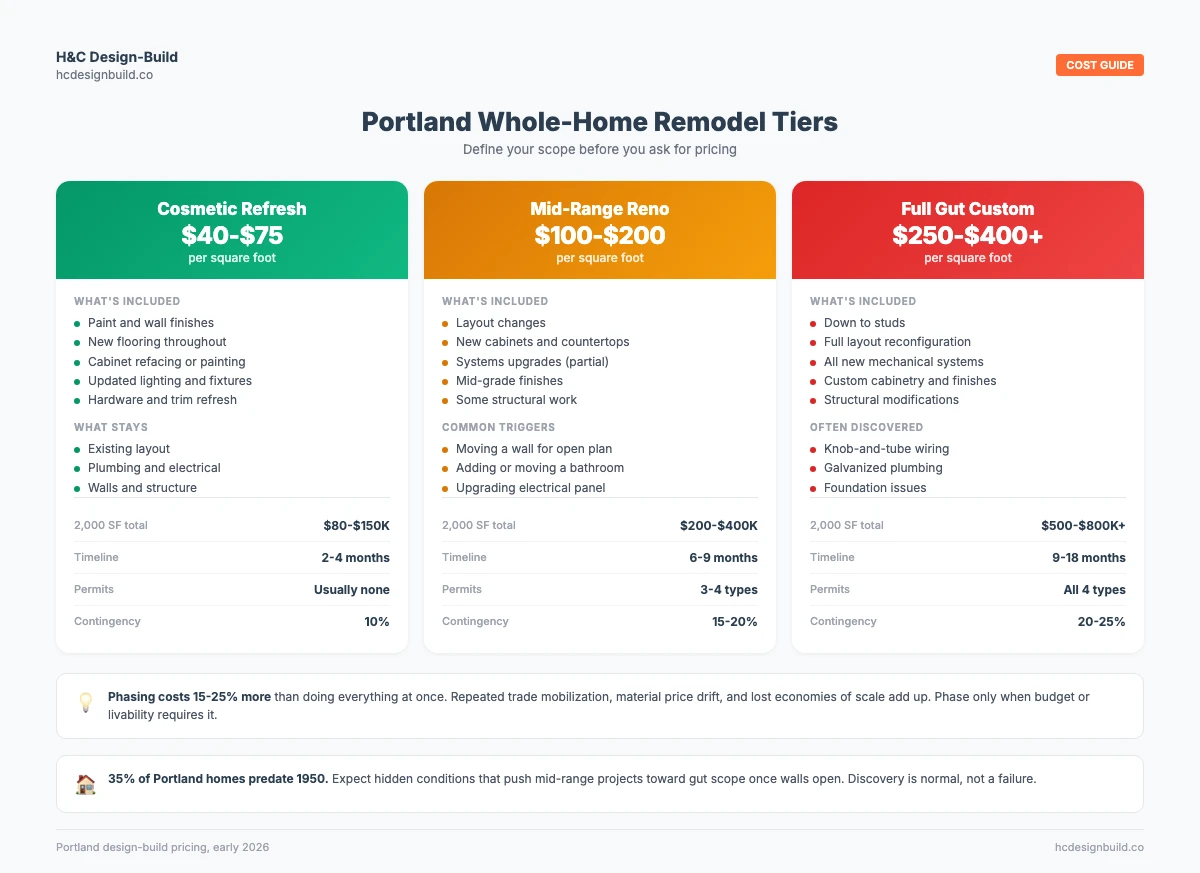
| Scope | What's included | Typical cost per SF | | -------------------- | --------------------------------------------------------------------------- | ------------------- | | Cosmetic refresh | Paint, flooring, fixtures, cabinet refacing, lighting | $40-$75 | | Mid-range renovation | Layout changes, new cabinets, systems upgrades, mid-grade finishes | $100-$200 | | Full gut | Down to studs, structural reconfiguration, custom finishes, all new systems | $250-$400+ |
What pushes a project from one tier to the next is usually scope creep behind the walls. You open up a kitchen for a layout change and find knob-and-tube wiring, galvanized pipes, or undersized framing. A mid-range plan becomes a gut when discovery forces system replacements.
Define your tier before you ask for pricing. The range between a cosmetic refresh and a full gut on the same house can be 3x to 5x.
How Whole-Home Remodels Are Sequenced
This is where most homeowners have the least information and the most anxiety. The sequence matters because getting it wrong means rework, wasted money, and a longer timeline.
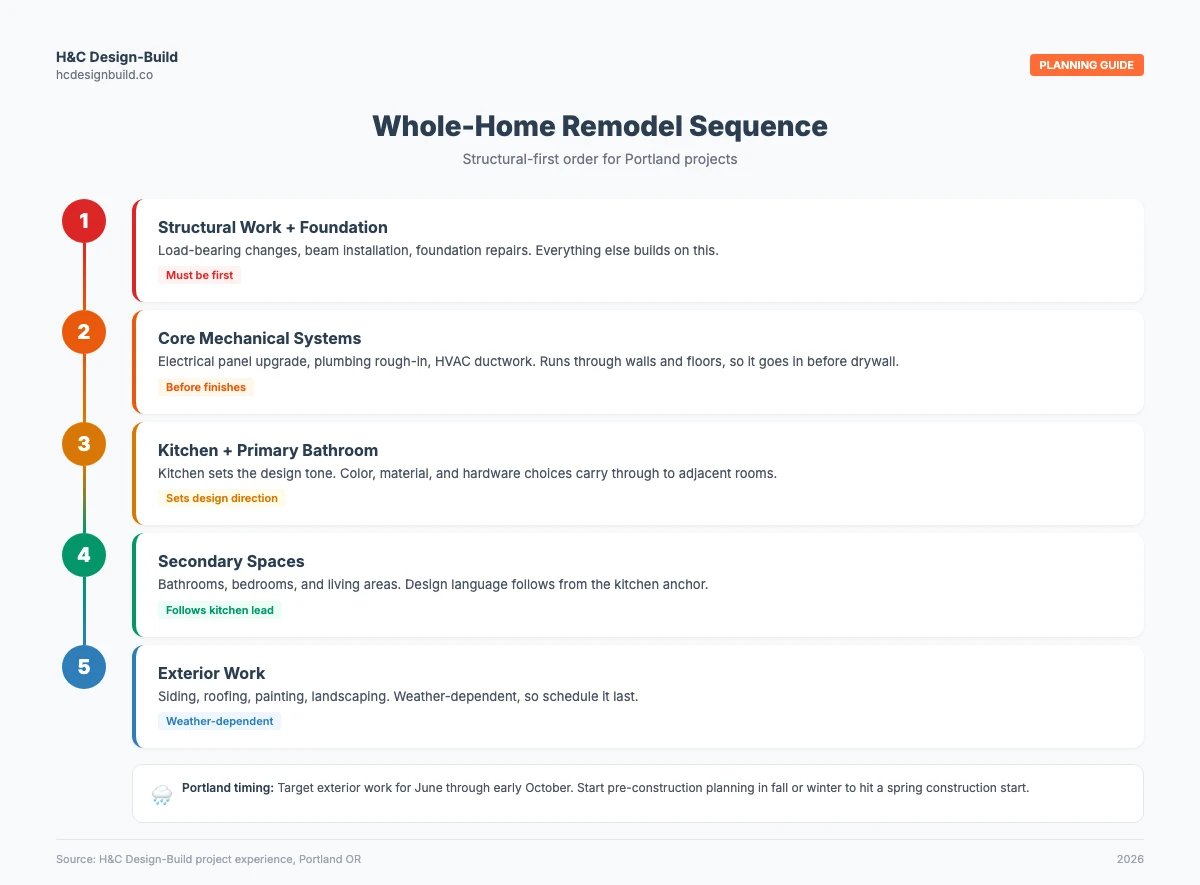
The standard order follows a structural-first approach:
1. Structural work and foundation. Load-bearing changes, beam installation, and any foundation repairs happen before anything else goes in. 2. Core mechanical systems. Electrical panel upgrades, plumbing rough-in, HVAC ductwork. These run through walls and floors, so they precede drywall and finishes. 3. Kitchen and primary bathroom. The kitchen sets the design tone for the rest of the home. Color, material, and hardware choices here carry through to adjacent rooms. 4. Secondary bathrooms, bedrooms, and living spaces. Once the kitchen anchors the design language, secondary spaces follow. 5. Exterior work. Siding, roofing, painting, and landscaping. In Portland, this means targeting the June through early October dry window.
Phasing vs. all at once
Doing everything at once costs less. Trades mobilize once, material prices lock at one point, and the project finishes faster. Phasing the same scope typically adds 15-25% to the total because of repeated setup costs, mobilization fees, and material price drift between phases.
Phasing makes sense when your budget requires it, when you need to stay in the house, or when the scope divides naturally by floor or wing. Otherwise, a single mobilization is more efficient.
Portland seasonal timing
Start pre-construction planning in fall or winter. That gives 4-6 months of design, permitting, and procurement before construction begins in spring. Exterior work gets the full dry season. Interior-only projects can start any time of year, and contractor availability is often better in fall and winter when outdoor demand drops.
Living in Your House During Construction
This is one of the most common questions, and one that most cost guides skip past with a vague "plan ahead."
Living in is feasible when the project preserves at least one functional bathroom and some form of cooking area throughout construction. That requires phasing work zones so basic services stay online. A designated clean room, sealed off from construction dust, gives you a retreat from the chaos.
Dust containment makes or breaks the experience. Plastic sheeting and zippered barriers isolate work zones. Air scrubbers filter construction particulates. HVAC vents in construction areas get sealed to stop dust from circulating through the rest of the house. Without containment, fine drywall and demo dust gets into everything you own.
Move out when the kitchen and all bathrooms go offline simultaneously. Move out if anyone in the household has respiratory conditions, severe allergies, or is pregnant. And move out if the home was built before 1978 and you have young children, because lead paint disturbance during renovation is a real health risk.
The EPA's RRP Rule (opens in new tab) requires a Certified Renovator for any work in pre-1978 homes that disturbs more than 6 square feet of interior painted surface. That's federal law. Ask your contractor for their EPA Lead-Safe certification before signing a contract.
If you stay, a temporary kitchen runs on a microwave, toaster oven, mini fridge, and an induction cooktop. Set it up in a dining room, laundry room, or garage with adequate electrical capacity. It's not glamorous, but it works.
If all bathrooms go offline, a portable toilet runs $75-$200 per week. Extended-stay hotels cost $3,000-$6,000 per month. Short-term rentals run $50-$200 per night depending on location and size. Factor these costs into the project budget before construction starts, not after.
What It Costs in Portland
Here's where the scope tiers translate to real dollars. These ranges reflect Portland design-build pricing as of early 2026.
| Scope | Cost per SF | Typical total for a 2,000 SF home | | -------------------- | ----------- | --------------------------------- | | Cosmetic refresh | $40-$75 | $80,000-$150,000 | | Mid-range renovation | $100-$200 | $200,000-$400,000 | | Full gut custom | $250-$400+ | $500,000-$800,000+ |
The kitchen and bathrooms take the biggest share of any whole-home budget. Our Portland kitchen remodel cost guide and Portland bathroom remodel cost guide break those rooms down by scope tier.
Portland market context
Portland runs 15-20% above the national average for remodeling labor. The Mortenson Construction Cost Index (opens in new tab), which tracks commercial construction, showed Portland costs up 3.9% year over year through Q3 2025 compared to 6.6% nationally. Residential trends tend to track in the same direction. Portland's cost escalation is running at roughly 60% of the national rate.
If your home sits in a historic district, expect 15-25% added cost from extended permitting and specific material requirements.
Tariff exposure also affects specific line items, especially imported appliances, specialty tile, and metal-heavy fixtures. Our tariff impact guide covers which materials carry the most risk and what you can control.
Contingency: plan for discovery
Every whole-home budget needs a contingency line. For newer homes or cosmetic scopes, 10% is reasonable. For homes built before 1960, budget 15-20%. For homes with significant unknowns or deferred maintenance, up to 25%.
Discovery is not a failure. It's the reason experienced contractors insist on contingency before the project starts.
What Drives Cost in Older Portland Homes
About 35% of Portland's housing stock was built before 1950 (opens in new tab). That means a large share of whole-home remodels in this city involve conditions that add scope and cost once walls come open.
Pre-1930s homes often have knob-and-tube wiring with no grounding and crumbling rubber insulation. Many insurance carriers won't cover homes with active knob-and-tube, so full rewiring becomes a requirement, not an upgrade.
Galvanized steel pipes show up in pre-1960s homes. Internal rust buildup causes low water pressure and potential lead leaching at corroded joints. Once you open walls, replacing the whole system is usually more cost-effective than patching.
Asbestos can be present in flooring, insulation, ductwork, and siding in homes built before 1980. Oregon regulations (opens in new tab) require testing before any renovation or demolition. Lead paint in pre-1978 homes triggers federal RRP compliance, which is mandatory and not optional.
Undersized electrical panels are another common find. Original 60-100A panels can't support a modern kitchen, heat pump, and EV charger. Panel upgrades add $2,000-$5,000+. Foundation problems are common in Portland's clay soil, especially in pre-1940 homes with rubble or post-and-pier foundations.
If your home is a Craftsman, Foursquare, or early Portland bungalow, expect at least some of these conditions. Budget accordingly.
Energy upgrades during a whole-home remodel can offset long-term operating costs. Our Portland energy efficiency rebates guide covers available incentives for heat pumps, insulation, and electrification work.
Permits and Timeline
Whole-home remodels in Portland typically need four permit types:
1. Structural/building for layout changes, load-bearing wall removal, and additions 2. Electrical for panel upgrades, new circuits, and wiring 3. Plumbing for fixture relocation, new supply lines, and water heater replacement 4. Mechanical for HVAC installation, ductwork, and gas piping
Our Portland building permits guide covers the full permit process. Portland has also offered a Field Issuance Remodel (FIR) program (opens in new tab) that cuts permit wait times from weeks to days by pairing a certified contractor with a single Senior Building Inspector from planning through final inspection. The FIR program has paused enrollment periodically due to staffing constraints, so check the Portland.gov page for current availability before counting on it.
Permit fees are based on fair market value of the construction, plus a 12% State of Oregon surcharge on all permits and a 1% City of Portland tax on projects valued at $100,000 or more.
Realistic timelines
| Scope | Construction phase | Total including pre-construction | | --------- | ------------------ | -------------------------------- | | Cosmetic | 4-12 weeks | 2-4 months | | Mid-range | 4-6 months | 6-9 months | | Full gut | 6-12 months | 9-18 months |
Pre-construction includes design, permitting, and material ordering. It adds 2-6 months before construction starts. Custom cabinets alone can have lead times of 6-16 weeks. The biggest timeline risk most homeowners can control is decision speed. Hundreds of choices go into a whole-home remodel, and slow decisions compound into schedule slip.
For a broader scope-by-scope schedule, see our Portland remodel timeline guide.
Why Whole-Home Projects Need a Single Point of Contact
When homeowners manage multiple subcontractors directly, they take on full-time project management whether they planned to or not. One late electrician delays the tile installer, who delays the cabinet guy, who delays the plumber coming back for trim-out. Scheduling cascades are the most common source of blown timelines on multi-trade projects.
A design-build approach puts one entity in charge of both design and construction under a single contract. A University of Colorado study of 212 projects (opens in new tab) found that design-build delivery averages 102% faster from start to finish and 3.8% less cost growth than the traditional architect-plus-contractor model.
The practical benefit: one project manager, one phone number, one weekly update. Design and construction phases can overlap, so the team starts building resolved portions while design continues on later phases. Change orders route through a single channel instead of bouncing between an architect and a general contractor.
Our Portland design-build guide explains how this delivery model works in more detail.
Is It Worth the Investment
According to industry estimates from the National Association of Realtors, a whole-home remodel recoups roughly 50% of its cost at resale. Individual projects recover more. Minor kitchen remodels return 96-113% in the Pacific region per the 2025 Cost vs. Value report (opens in new tab). Garage door replacements return nearly double their cost.
But percentage ROI misses the point for most homeowners doing whole-home work. The return is a house that works the way you live, not a house optimized for the next buyer. Our Portland remodel ROI guide breaks down which individual projects recover the most and which ones don't.
Portland's average home value sits around $546,000 according to Zillow's Home Value Index (opens in new tab). A $300,000 mid-range remodel on a home you plan to keep for 5+ years makes financial sense when the alternative is buying new in a market where move-in-ready homes sell fast and competition stays firm.
When renovation costs approach 75% of what new construction would cost for a comparable home, teardown-and-rebuild enters the conversation. For most Portland whole-home remodels, you're well below that threshold.
If you want a scope review and cost range for your specific home, reach out to H&C Design-Build.