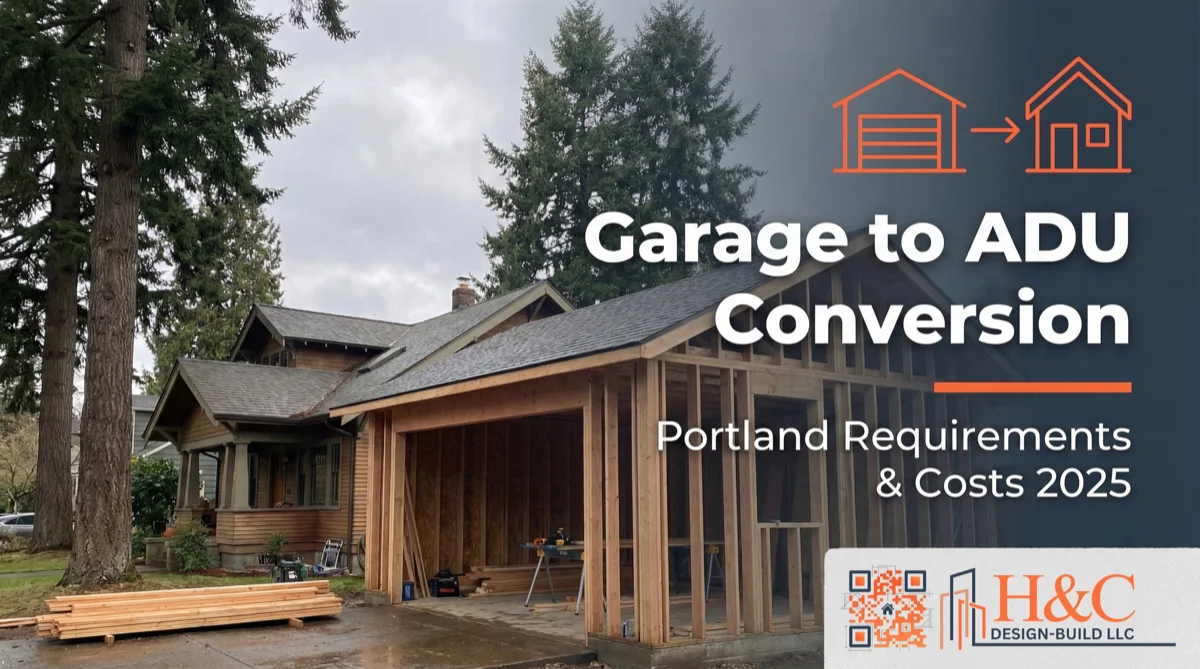
A Portland garage to ADU conversion can look simple from the backyard. You see an old detached garage and picture rental income or space for family. The structure may look like a head start, but conversion scope is usually bigger than homeowners expect.
That's partially true. Portland has ADU-friendly rules: no parking requirement (opens in new tab), no owner-occupancy rule under HB 2001 (opens in new tab), and an SDC waiver option (opens in new tab). But "easy" depends on what you're starting with.
A garage conversion often lands in the six-figure range in Portland. The structure that seemed like a head start often needs foundation work, new framing, complete electrical systems, and upgrades to meet habitable-space codes. We've seen conversions end up close to new-construction budgets.
Here's what you need to know before committing.
Portland Garage to ADU Conversion Rules
Portland permits one or two ADUs on most residential lots, depending on your zoning. Converting an existing garage counts as one of these. The city actively encourages ADU development and has removed many barriers that exist elsewhere.
Size Limits
Portland caps ADUs at 800 square feet or 75% of the primary dwelling's living area, whichever is smaller, per Portland ADU zoning requirements (opens in new tab). Most two-car garages fall between 400 and 600 square feet. This limit rarely causes problems for conversions.
No Owner-Occupancy Requirement
Oregon House Bill 2001 (opens in new tab) eliminated owner-occupancy requirements statewide. You don't need to live in either the main house or the ADU. You can rent both. This makes garage conversions viable as pure investment properties.
No Parking Requirement
Portland doesn't require any parking for ADUs under its ADU zoning rules (opens in new tab). Converting your garage to living space won't trigger a replacement parking mandate. Your tenants figure out street parking like everyone else.
Setback and Placement Rules
Detached ADUs must sit either 40 feet back from your front lot line or behind the rear wall of your main house. This comes from Portland ADU zoning requirements (opens in new tab). Side and rear setbacks start at 5 feet but vary by zone. Most existing garages already meet these requirements.
Height limits are 20 feet outside setbacks and 15 feet within setback areas under Portland ADU zoning requirements (opens in new tab).
For the complete Portland ADU zoning requirements (opens in new tab), check the city's official page.
The Real Costs of Converting a Garage
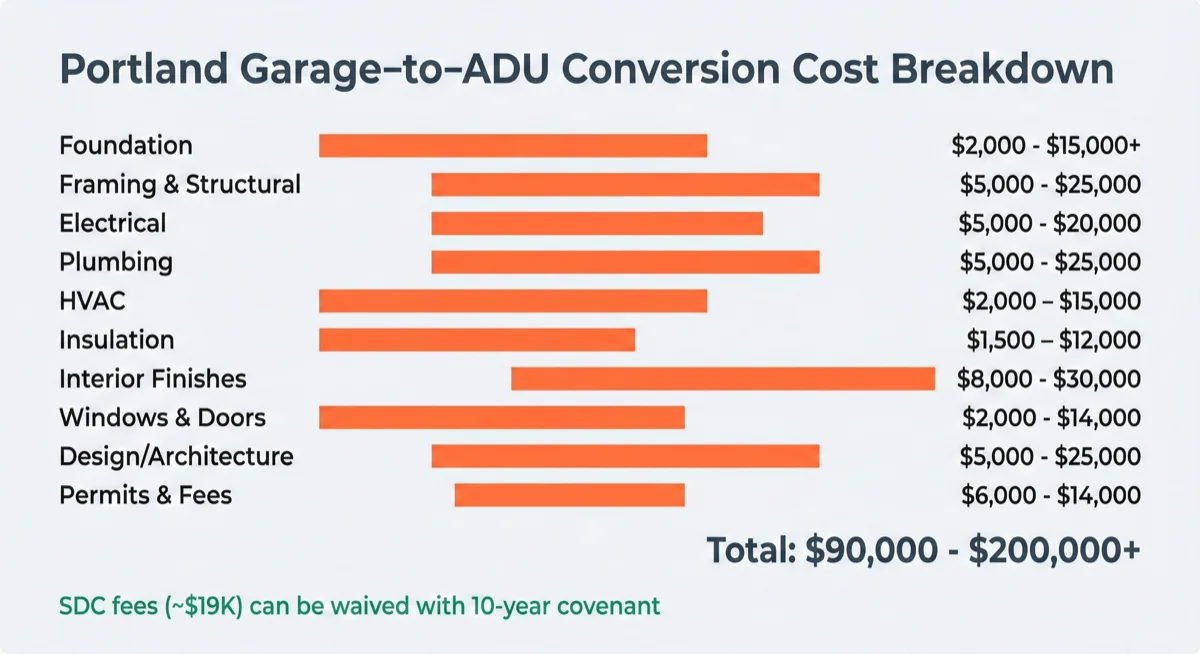
Garage conversions in Portland typically run $120,000 to $200,000 for a 400 to 600 square foot unit. We've seen conversions end up close to new-construction budgets when foundation and structural work stacks up. The range is wide because existing conditions matter.
Cost Drivers
- Existing foundation condition
- Structural reinforcement needs
- New electrical service and panel work
- Plumbing routing to kitchen and bathroom
- HVAC strategy and ductless vs ducted approach
- Insulation and envelope upgrades
- Windows, doors, and egress modifications
- Design, drafting, and engineering scope
Permit and Development Fees
Plan review and permit fees vary by project complexity and current city rates. The larger fee category is usually System Development Charges.
SDCs for ADUs can be a significant five-figure cost. Exact amounts change over time and vary by bureau. Verify current numbers in Portland's fee schedules (opens in new tab) before budgeting.
You can waive these entirely through Portland's ADU SDC Waiver Program (opens in new tab). The catch: you sign a 10-year covenant stating neither the ADU nor your main house will be used as a short-term rental. Violate the covenant and you owe 150% of current SDC fees. For most homeowners planning long-term rentals or family housing, the waiver makes sense.
Why Conversions Sometimes Cost as Much as New Construction
Garages weren't built to be lived in. That creates problems:
Foundation issues: Many older Portland garages have shallow footings or simple slabs that don't meet current code for habitable space. Hand-digging new footings around an existing slab can add substantial cost.
Structural deficiencies: Garage framing is often lighter than residential standards require. Walls may need reinforcement. Roof structures may need upgrading.
No existing utilities: Running new sewer, water, and electrical to a detached structure can be expensive. New construction is often designed with utility routing in mind from day one.
Code compliance layers: Converting means bringing everything up to current code while working around existing constraints. New construction starts fresh.
We tell clients: if your garage needs major foundation work and significant structural upgrades, get a quote for demolition and new construction too. Sometimes the numbers are surprisingly close, and new construction gives you more design flexibility.
Building Code Requirements for Living Space
Converting a garage to habitable space triggers specific code requirements. Portland's Building Code Guide for ADUs (opens in new tab) covers the details, but here are the critical items.
Ceiling Height
Minimum 6 feet 8 inches in habitable rooms for conversions under Portland's ADU code guide (opens in new tab). Portland allows this reduced height for conversion projects. Bathrooms and hallways can go as low as 6 feet 2 inches in some configurations.
Many older garages have 8-foot ceilings, which gives you room for insulation and finished ceiling materials. Garages with lower ceilings may not be viable candidates.
Electrical Requirements
This is where conversions get expensive. Portland requires ADU electrical circuits to be independent from the main dwelling under the ADU code guide (opens in new tab). No shared loads are allowed.
You need either a separate electrical service or a new subpanel. If you use a shared panel, it must be in a common area with direct access from both units.
Homeowners cannot do their own electrical work on ADUs per the ADU code guide (opens in new tab). You must hire a licensed electrical contractor. All new circuits require Arc-Fault Circuit Interrupter (AFCI) protection.
Plumbing Requirements
Water supply systems must be independent under Portland's ADU code guide (opens in new tab), with one exception. A single water line can serve both units with individual fixture shut-offs. You can also use one whole-dwelling shut-off valve accessible from both units.
Every ADU needs a kitchen sink separate from the bathroom lavatory. Water systems must provide hot and cold running water at minimum 15 PSI. Water heating must reach at least 120 degrees per the ADU code guide (opens in new tab).
Egress Windows
Every bedroom needs an emergency escape window. Requirements per Portland's egress standards (opens in new tab):
- Minimum 5.7 square feet clear opening (5 square feet for basement or grade-level rooms)
- At least 24 inches tall
- At least 20 inches wide
- Sill no more than 44 inches above the floor
Most garage windows don't meet these requirements. Budget for new window openings. Our window replacement cost guide covers material options and pricing.
Insulation and Energy Code
Exterior walls need R-15 minimum insulation. Flat ceilings require R-38 under Portland's ADU code guide (opens in new tab). If you're creating vaulted ceilings with existing rafters, you may be able to use R-15 in 2x4 spaces with proper documentation.
You must maintain at least 1 inch of air space between insulation and roof decking for ventilation under the ADU code guide (opens in new tab).
Fire Separation
If your garage sits within 3 feet of a property line, exterior walls facing that line need fire-rated construction under Portland's ADU code guide (opens in new tab). This usually means two layers of 5/8-inch Type X gypsum board with no windows or penetrations in that wall section.
Roofs within 3 feet of property lines need similar treatment underneath the decking per the ADU code guide (opens in new tab).
The Permit Process
Timeline
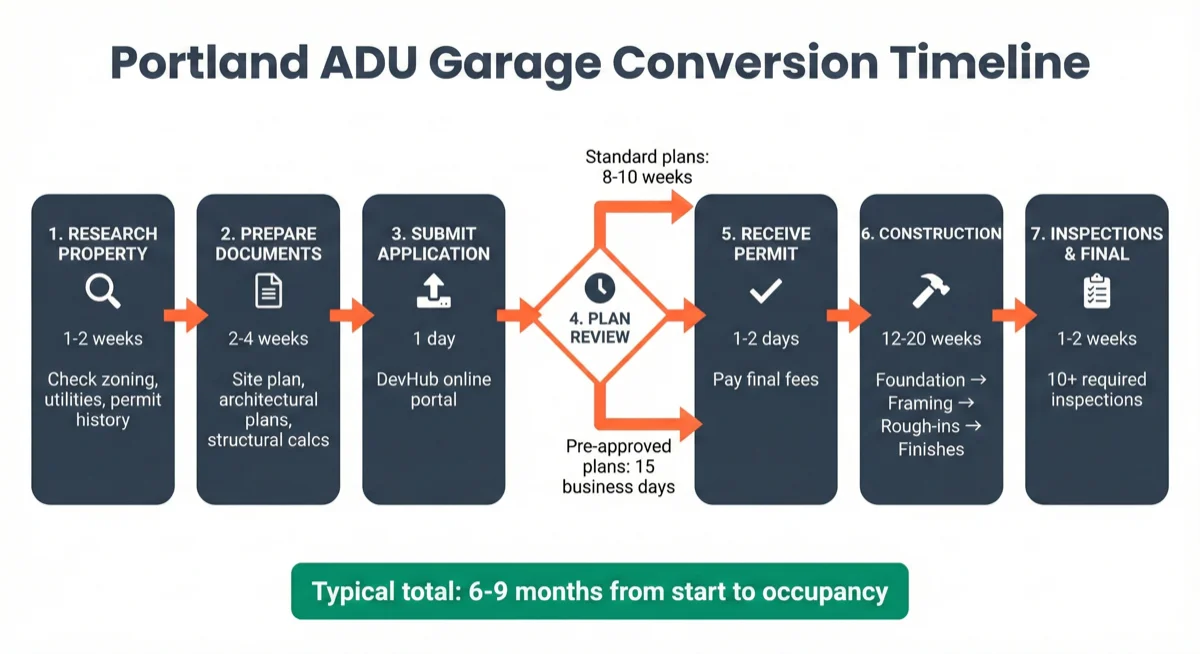
Standard ADU permit review often takes several weeks in Portland, depending on current queues. Check the city's permit timeline dashboard (opens in new tab) before scheduling. If you use one of the city's pre-approved ADU plans (opens in new tab), Portland currently states review can drop to 15 working days.
For garage conversions using custom plans, expect the longer timeline.
Required Documents
- Building permit application
- Site plan drawn to scale
- Architectural plans showing existing and proposed conditions
- Structural plans if you're modifying load-bearing elements
- Trade permit applications for electrical, plumbing, and mechanical
Inspections
Your project will require multiple inspections:
1. Pre-construction erosion control (if disturbing soil) 2. Setbacks and location verification 3. Foundation and footings 4. Plumbing rough-in 5. Electrical rough-in 6. Mechanical rough-in 7. Framing (after all trade rough-ins approved) 8. Insulation 9. Trade finals 10. Final building inspection
Keep approved plans on site for every inspection. Don't cover any work before it's inspected.
For the complete permit process, see our Portland building permits guide.
When Garage Conversions Make Sense
Garage conversions work best when:
The structure is sound. Newer garages with proper footings and decent framing convert most economically. Much older structures often need extensive upgrades.
Ceiling height works. You need enough height to finish at code-compliant clearances. Portland allows 6 feet 8 inches in habitable rooms for conversions under the ADU code guide (opens in new tab).
Utilities are close. If sewer and water lines run near your garage, connection costs stay reasonable. Long utility runs add thousands.
You have no other build options. On constrained lots where new construction isn't possible, conversion may be your only path to an ADU.
You're doing basic finishes. Premium kitchens, custom tile, and high-end fixtures push conversion costs toward new construction pricing without the design flexibility.
When to Consider New Construction Instead
New construction often makes more sense when:
- Foundation work is extensive
- Structural framing needs major reinforcement
- Ceiling height is marginal
- You want more floor area than a typical garage footprint provides
- Design flexibility matters to you
New detached ADUs in Portland typically cost more than simple conversions, but they start fresh with modern code compliance, optimal layouts, and fewer hidden conditions.
Making the Decision
Get a structural assessment before committing to a conversion. An early engineer evaluation can save you from discovering major foundation or framing issues after you've already paid for design work.
Have a contractor walk the garage and give you a realistic range. If the low end of that range approaches new construction costs, seriously consider building new.
Check your lot for other ADU options. Sometimes a different location on your property makes new construction feasible where you assumed conversion was the only choice.
Portland wants you to build ADUs. The regulations support it. The SDC waiver helps finance it. The question is whether your specific garage makes conversion the smartest path or just the most obvious one. For a breakdown of financing options including HELOCs and contractor financing, see our remodel financing guide.
Need help evaluating your garage for ADU conversion? Contact H&C Design-Build for a project assessment. We'll give you honest numbers on whether conversion makes sense for your situation.