
The first hard fall rain in Portland is when small maintenance problems start charging interest.
You find the gutter overflowing at one corner, water splashing back onto the siding, a curb inlet disappearing under wet leaves, and a furnace that kicks on and smells dusty. None of that feels like a remodel problem until it is.
A Portland fall home maintenance checklist should start with water, not cosmetics. Portland's downtown water-year normal is 44.07 inches of precipitation (opens in new tab), and the wet stretch starts loading up right when leaves begin dropping. If water is going to find a weakness, it usually does it between late fall and early spring.
Portland fall home maintenance checklist: start outside
If you only have a Saturday, do the outside work first.
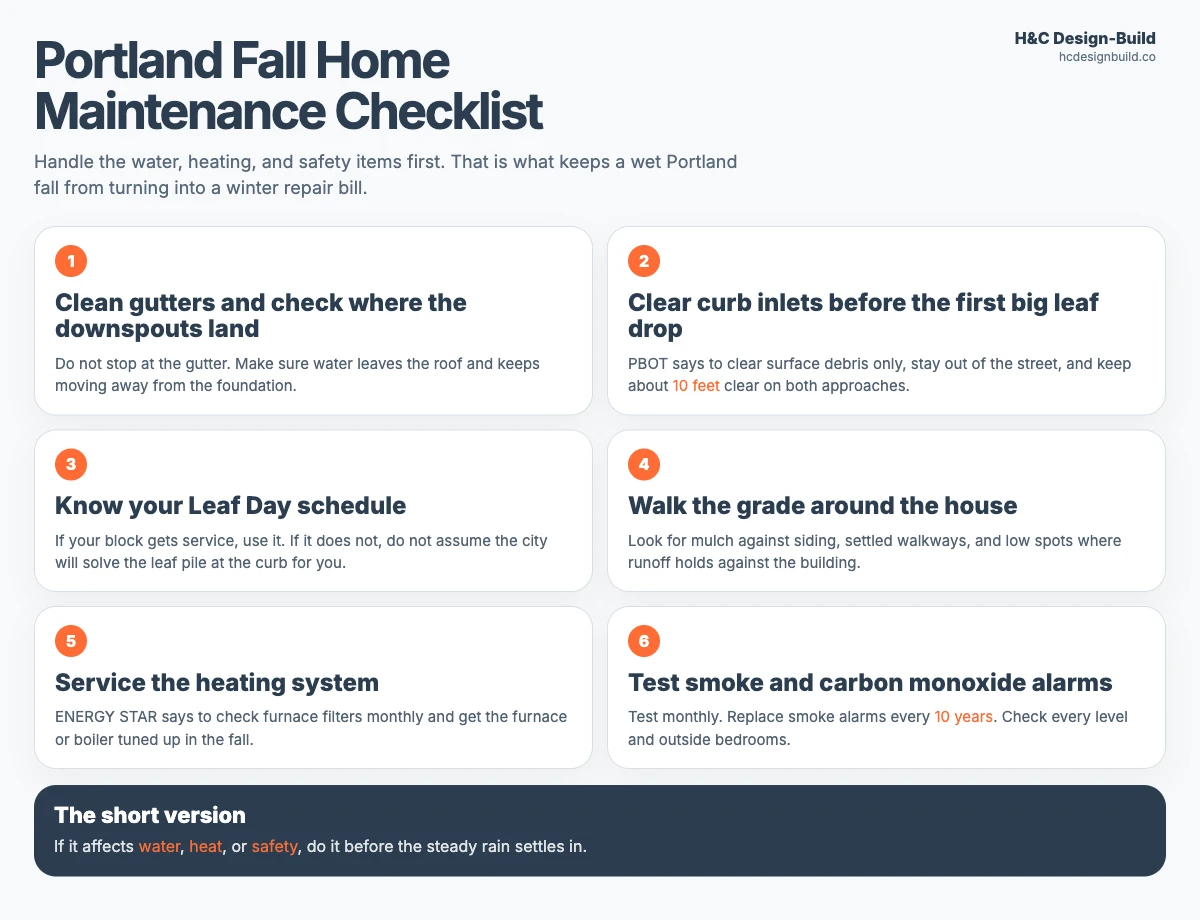
1. Clean gutters and watch where the downspouts actually discharge
Cleaning the gutters is obvious; what homeowners miss is where that water lands after it leaves the gutter.
Portland's downspout disconnect guidance (opens in new tab) tells homeowners to keep removing leaves and debris from gutters, downspouts, and extensions. It also says to make sure water drains safely away from the foundation, which matters more than people think. We have worked on houses where the roof was doing its job, but the buried rain drain or short downspout extension was still pushing water back toward the house.
On one H&C basement project in Northeast Portland, we had to reroute and consolidate a buried gutter rain drain system before new egress windows could go in. Water management problems often show up when you finally open things up.
If the downspout dumps at the base of the wall, fix that before winter.
2. Clear the curb inlet in front of your house
Portland asks residents to help with this for a reason. PBOT says it maintains more than 58,000 storm drains (opens in new tab), which is too many for crews to keep perfectly clear during heavy leaf drop.
Their guidance is straightforward:
- Use a rake, broom, or shovel, not your hands
- Clear only drains you can reach safely from the curb or sidewalk
- Clear surface debris only
- Never lift the grate
- Clear about 10 feet on both approaches to the drain (opens in new tab)
This is one of the cheapest ways to reduce street ponding in front of your house. If the water cannot get into the drain, it will look for the low point instead.
3. Know whether your block gets Leaf Day service
PBOT's posted Leaf Day (opens in new tab) schedule for the 2025-26 season covered 82 zones. It ran from November 1, 2025 through January 17, 2026. The next season may shift, but that window tells you when the city expects heavy leaf load and flooding risk.
If you are in a Leaf Day zone, use the city's schedule. If you are not, do not count on the city to solve the leaf pile at the curb for you.
4. Walk the grade around the house
This five-minute check catches more trouble than people think.
Look for mulch piled against siding, soil sloped toward the foundation, settled walkways, and low spots where runoff sits after a storm. On a North Portland drainage project, we ended up regrading the side yard and correcting flow toward a drywell. The original slope was holding too much water near the house. That kind of correction is much cheaper before you have rot, mold, or crawl-space moisture.
If the grade is wrong, fall is when to catch it.
Before you go inside, check the walls below the roofline.
Gutter overflow usually leaves clues before it becomes an interior problem. Look for soft fascia, open trim joints, peeling paint below a gutter outlet, and siding that stays dark after the rest of the wall dries. Also check hose bibs, dryer vents, exterior outlets, and light fixtures. Those small openings are where wind-driven rain and splashback can get behind the exterior assembly.
The tradeoff is timing. A little caulk over sound, dry trim can be maintenance. Caulk smeared over wet wood, punky fascia, or an active leak just hides the problem until spring. If the wood is soft, the paint is bubbling, or the trim joint keeps opening up, treat it as repair work, not touch-up work.
After a hard rain, check the basement or crawl space too.
You are not doing a full inspection. You are looking for fresh staining, damp soil, musty odor, rust on duct straps, water tracks on the foundation wall, and insulation that has sagged or stayed wet. Those clues tell you whether exterior drainage is becoming an interior moisture problem. If the same corner is damp after every storm, the gutter, grade, downspout, and buried drain all need to be considered together.
Check the systems you are about to rely on all winter
5. Service the heating system and check the filter
ENERGY STAR's Home Check-Up (opens in new tab) says furnace filters should be checked every month and recommends a heating-system tune-up in the fall.
That advice lines up with real-world Portland houses. The first cold snap is a bad time to discover the igniter is failing, the filter is packed, or the system has been short-cycling for weeks.
At minimum:
- check the filter now
- replace it if it is dirty
- schedule service if the system is overdue or showing any odd behavior
If you have not run the heat since spring, do it before the weather turns for real.
Also check the areas the system depends on but homeowners tend to ignore. Keep supply registers open, make sure returns are not blocked by furniture, and look around any outdoor equipment for leaves, dirt, or debris. ENERGY STAR includes those checks in its heating and cooling section because airflow and service access affect how well the system runs.
6. Test smoke alarms and carbon monoxide alarms
The Oregon State Fire Marshal says smoke alarms belong on every level of the home and outside bedrooms (opens in new tab), should be tested monthly, and should be replaced every 10 years or per the manufacturer. The same page says to change alarm batteries at least once a year or when they start chirping.
Fall is the right time to check this because winter means more closed windows, more heating equipment use, and more time indoors.
If your house has fuel-burning equipment, treat carbon monoxide alarms as part of the same seasonal check, not a separate someday task.
What can wait, and what should not
Not every item on a fall maintenance list has the same consequence.
Do these before the rainy season settles in:
1. Gutters and downspouts 2. Curb inlets and leaf buildup 3. Obvious grading problems 4. Furnace filter and heating check 5. Smoke and carbon monoxide alarms
These can wait a bit longer if needed:
- cosmetic paint touch-ups
- non-critical caulking that is still intact
- minor landscape cleanup away from drainage paths
The rule is simple: if it affects water, heat, or safety, move it up the list.
The other rule is harder but just as important: do not confuse a cosmetic patch with maintenance. Paint over a sound surface is maintenance; paint over swollen trim is a delay. A splash block that moves water away from the house is maintenance; a splash block sitting in a settled hole is decoration. Fall is when you decide which one you are looking at.
The problems this checklist actually prevents
This work is not glamorous, but it heads off the expensive stuff.
Water at the foundation turns into crawl-space moisture, basement seepage, paint failure, siding damage, and sometimes mold. If you have already dealt with that once, you know the cleanup bill is a lot bigger than a Saturday with a ladder and a rake. Our Portland mold remediation guide gets into what happens when moisture problems sit too long.
And if your roof or siding is already showing its age, fall is also when you figure out whether you are doing maintenance or buying time. If that line is getting blurry, our Portland roofing replacement guide is the next place to look.
The simple version
Portland fall home maintenance is mostly about controlling water before water starts controlling the job.
Clean the gutters, make sure the downspouts discharge where they should, keep the storm drain clear if you can do it safely, and check the grade, fascia, trim, and penetrations. Service the heat and test the alarms.
That is the list.
If you want a contractor's opinion on whether you are dealing with a basic maintenance issue or the start of a bigger exterior or drainage fix, contact H&C Design-Build. We can help you sort out what needs attention before the rain gets there first.