
If water pours over the gutter edge in Portland, do not stop at the gutter.
Follow the water after it leaves the roof. If it drops at the foundation, backs up in a buried rain drain, or runs across a low side yard toward the house, the problem is bigger than the gutter. That is the kind of pattern that turns into basement seepage, crawl space moisture, paint failure, and siding rot.
Portland gets an average of 37 inches of rain each year (opens in new tab), so small drainage flaws get tested again and again. The weak spots are predictable: gutters full of leaves, downspouts that dump too close to the wall, and yards that hold water when they should be moving it away.
Start with the water path, not the gutter alone
Homeowners usually notice the symptom first:
- water spilling over the front gutter
- a puddle forming at one basement corner
- ponding near the sidewalk after a storm
- moss, peeling paint, or dark staining near the lower wall
What matters is the full path from roof to discharge.
On a Northeast Portland basement conversion, our crew had to reroute and consolidate a buried gutter rain drain system before the new egress windows could go in. On a North Portland landscaping and drainage project, we had to reslope runoff toward the drywell because the yard was holding too much water near the house. Those are normal Portland problems. The gutter may be where you first see trouble, but the real fix usually reaches farther downstream.
Portland gutter and drainage guide: what to check first
If you are trying to protect the foundation, check these in order.
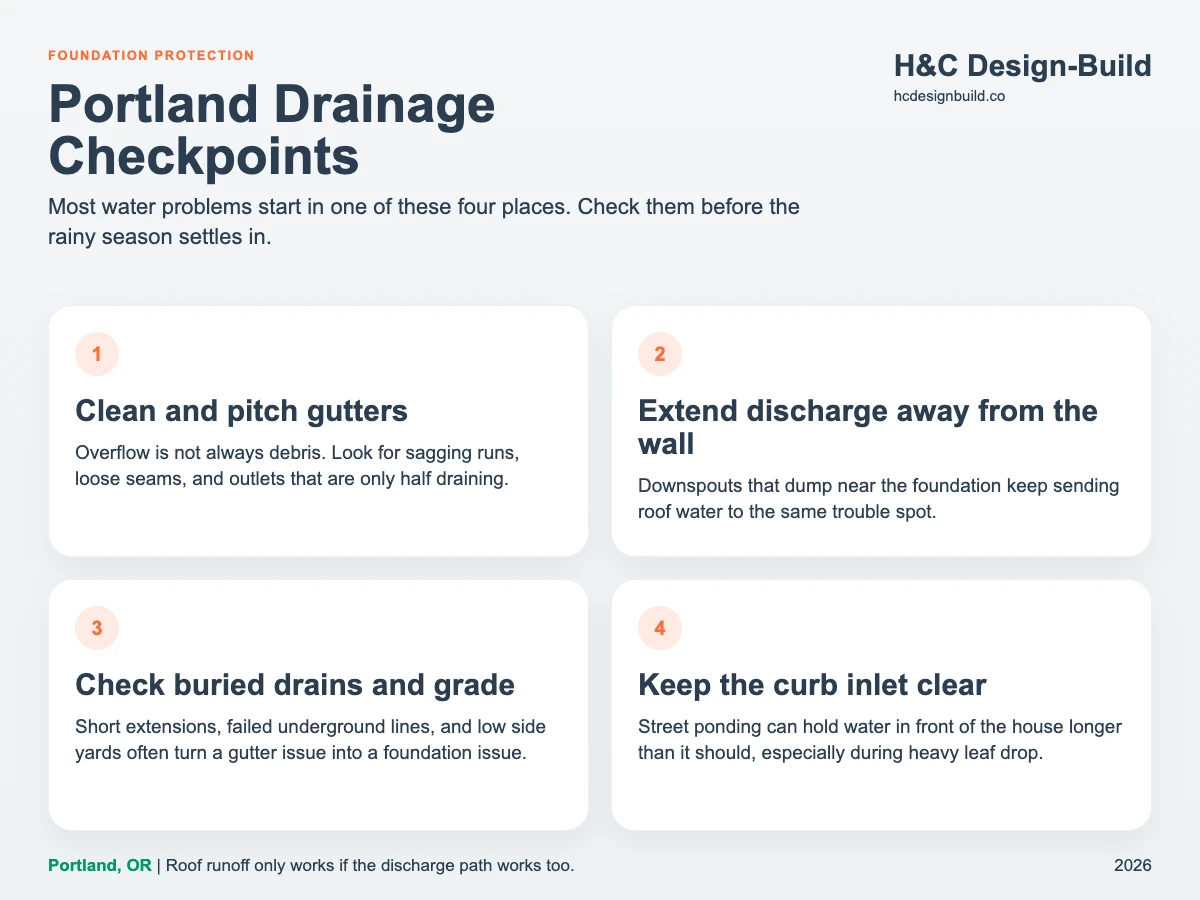
1. Are the gutters actually draining, or just holding debris?
Leaves and roof grit are the obvious failure point, especially once fall starts. If the gutter is packed, water will run over the face instead of toward the outlet.
That part is basic. What homeowners miss is uneven pitch, loose fasteners, separated seams, and sagging runs. A gutter can look mostly clear and still fail during a hard rain if the outlet end has settled or the downspout connection is partially blocked.
If one section overflows and the rest does not, do not assume the whole system needs replacement. Check the outlet, slope, and downspout first.
2. Where does the downspout discharge?
This is the bigger issue in Portland.
Portland BES says a disconnected downspout should discharge:
- at least 6 feet from a basement
- at least 2 feet from a crawl space or slab foundation
- at least 5 feet from a neighbor's property line
- at least 10 feet from buildings on an adjacent property
- at least 3 feet from the public sidewalk
- at least 10 feet from retaining walls
- not on slopes greater than 10 percent
Those distances come straight from the city's Downspout Disconnection guidance (opens in new tab).
If your downspout elbow ends right at the wall, or the splash block has settled and now pitches back toward the house, that is a real drainage defect. It is small until the rainy season exposes it.
3. Is the buried rain drain still working?
Buried rain drains are where a lot of Portland houses get tricky.
The gutter may connect to an underground line that is old, root-intruded, crushed, disconnected, or just overwhelmed. When that happens, the backup usually shows up as water bubbling near the foundation, standing water at the downspout, or overflow during heavy rain even after the debris is cleaned out.
If a house has already had landscape changes, additions, or patched drainage work over the years, do not assume those buried lines still pitch and discharge the way they should.
4. Does the grade move water away from the house?
Gutter drainage and grading work together. If one fails, the other picks up the bill.
Walk the perimeter in the rain if you can do it safely. Look for:
- mulch or soil touching siding
- low spots that hold water near the foundation
- downspout discharge onto compacted ground with nowhere to go
- walkways or patios that now pitch back toward the house
This is one reason our pre-1940 Portland foundation guide keeps coming back to drainage. Foundation repairs are more expensive when the real cause is still sending water to the same spot.
5. Is the street drain in front of the house blocked?
Portland PBOT maintains more than 58,000 storm drains (opens in new tab), but the city also asks residents to help keep nearby inlets clear during leaf season.
PBOT's guidance is simple:
- use a rake, shovel, or broom
- clear only surface debris
- never lift the grate
- clear about 10 feet on both approaches to the drain
- call PBOT if the drain is still clogged after the surface debris is removed
This matters because bad street drainage can keep water ponding against the curb, driveway, or frontage longer than it should. That does not replace a site drainage problem, but it can make one worse.
What Portland allows, and when a simple gutter fix becomes permit work
Not every drainage fix needs a permit.
Portland BES says a permit is not required for a standard downspout disconnection that uses an extension and splash block. That is the basic homeowner-level correction.
The line changes when you start putting drainage underground.
The city's Residential Plumbing Permits page (opens in new tab) says plumbing permits are needed to install outdoor plumbing systems including rain drains or drywells. The city also says on its Drywells page (opens in new tab) that single-family residential drywells do not require a separate city permit. A plumbing permit may still be required when you run pipe underground to connect downspouts.
That is the practical takeaway:
- splash block and extension: basic fix
- underground rain drain, drywell, or soakage trench: check permit requirements first
Portland's Soakage Trench guidance (opens in new tab) also adds site constraints around slopes, infiltration rate, groundwater, setbacks, and proximity to foundations. Once you are in that territory, stop treating it like a weekend gutter project.
When a gutter issue is really a drainage and foundation issue
Homeowners usually wait too long on this line.
Call it more than a gutter problem when you see:
- repeated overflow even after cleaning
- water standing at the base of the downspout
- basement seepage or crawl space moisture after storms
- staining, rot, or peeling paint low on the wall
- erosion channels in the side yard
- pooled water near steps, patios, or foundation corners
- a buried line that seems to surcharge during heavy rain
At that point, you are diagnosing a water path, not a gutter hardware issue.
What homeowners can do themselves
Some work is reasonable DIY maintenance.
Usually safe for a homeowner:
- clean accessible gutters
- flush downspouts
- add or replace a splash block
- extend a downspout to a safe surface discharge point
- clear a nearby storm drain from the curb
- remove leaf buildup before the rainy season
Time to call a pro:
- second-story or hard-to-access gutters
- repeated overflow after cleaning
- suspected buried drain failure
- standing water near the foundation
- grading corrections
- drainage work near retaining walls
- drywell or soakage trench planning
Portland BES also offers technical help for private-property drainage issues (opens in new tab). That is worth knowing if you are trying to figure out whether the problem is site drainage, runoff management, or a public right-of-way issue.
The gutter fix that does not hold up
The most common bad fix is cleaning the gutter and calling it done.
If the water is still discharging too close to the house, backing up underground, or running into a low side yard, you have only cleaned the symptom. You did not correct the water path.
The second bad fix is burying a drain line without checking slope, outlet, or permit requirements. Underground does not mean solved. It just means the failure is harder to see until it surfaces in the wrong place.
A simple Portland checklist before next rain
Before the next hard storm, check these:
1. Clean the gutters and watch for one-sided overflow. 2. Make sure each downspout discharges away from the foundation. 3. Look for standing water at downspout bases. 4. Check the grade around basement and crawl-space walls. 5. Clear the storm drain in front of the house if you can do it safely. 6. Investigate buried rain drains if overflow keeps happening.
If you are already seeing moisture inside, do not wait for another season to confirm it.
Our Portland mold remediation guide explains what happens when wet conditions keep cycling through a crawl space or lower wall assembly. By the time mold or rot is visible, the drainage problem has usually been active for a while.
The short version
In Portland, gutters matter because drainage matters.
The goal is simple: move water off the roof and safely away from the house, into a discharge path that works in real rain, on a site that does not send it back to the foundation.
If you are trying to figure out whether you need basic gutter correction, grading work, or a larger drainage fix, contact H&C Design-Build. We can help you sort out what is maintenance, what is repair, and what is the start of a bigger water-management problem.